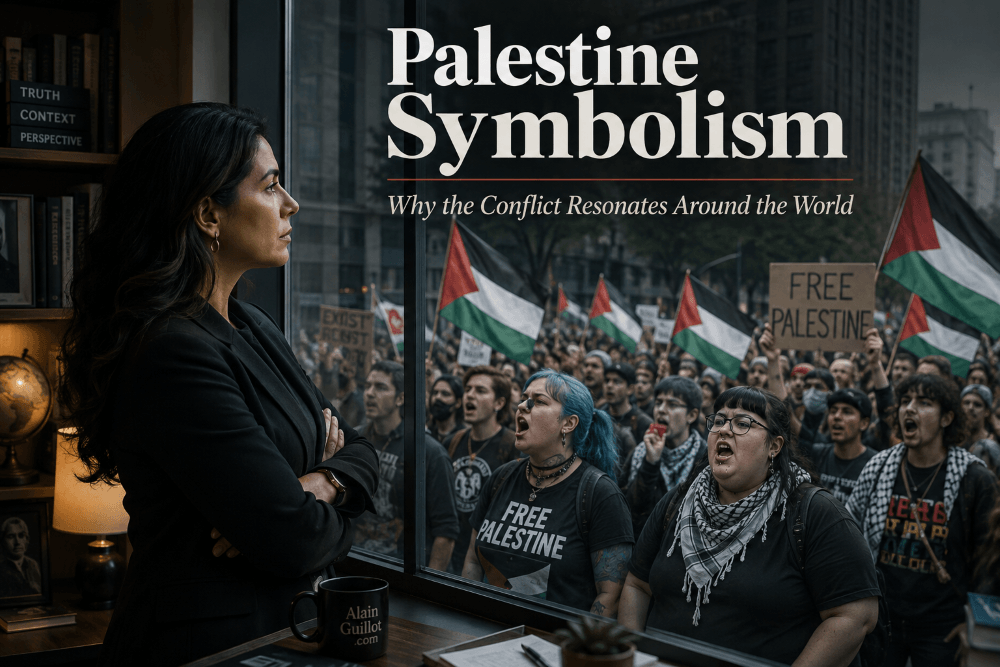
Many conflicts are fought over land, religion, or resources. But some conflicts evolve into something much larger. They become symbols that people around the world use to explain politics, virtual signaling, morality, identity, and history.
The debate surrounding Palestine symbolism is one such example.
Whether you support Israel, support Palestine, or simply wish for peace, it is difficult to deny that the conflict has become far more than a territorial dispute. It has become a symbol onto which millions of people project their own political beliefs and moral convictions.
Maybe the greatest obstacle to peace is not simply disagreements over borders or security, but the enormous symbolic weight the conflict now carries.
Numerous institutions benefit from the ongoing conflict in Palestine. Although many organizations have been established to resolve the issue, these same entities simultaneously profit from the problem remaining unsolved.
Palestine Symbolism Goes Beyond Geography
The Israeli-Palestinian conflict began as a struggle over territory, national identity, and security.
Today, however, the conflict has acquired a much broader meaning.
For many observers, Palestine represents:
- Anti-colonial resistance
- Human rights
- Religious identity
- National sovereignty
- Western imperialism
- Democracy versus authoritarianism
- Civilization itself
Different political movements interpret the same events through entirely different lenses.
A progressive activist in New York, an Islamist in Tehran, a conservative in Texas, and a student in Paris may all talk about Palestine—but they are often talking about entirely different ideas.
The conflict has become a canvas onto which every ideology paints its own worldview.
How Palestine Symbolism Shapes Global Politics
This symbolic power explains why events occurring in a relatively small region generate worldwide demonstrations, diplomatic crises, university protests, and endless online debates.
Few conflicts receive this level of global attention.
That attention creates incentives.
Political leaders gain support by taking strong positions.
Activists build communities around the issue.
Media organizations know the topic attracts readers.
Academics dedicate careers to studying it.
International organizations receive funding tied to humanitarian work.
None of this necessarily implies bad faith.
It simply illustrates a broader reality: once an issue becomes central to institutions, those institutions naturally organize themselves around it.
The same phenomenon can be observed in climate policy, immigration, healthcare, transgender ideology, and many other public debates.
Systems Matter—but People Matter More
Although many organizations benefit from the problem remaining unsolved because it gives them either political power, attention, or feeling moraly supperior, we as every day individuals, we have to take personal responsability.
Simply by refusing to participate in a protest we do not fully understand, or declining to repeat a popular slogan, we are already taking responsibility for our own actions. We are applaying critical thinking.
History is full of examples where courageous leaders changed systems rather than merely adapting to them.
Consider:
- Nelson Mandela choosing reconciliation over revenge.
- Mohandas Gandhi who employed nonviolent resistance to lead the successful campaign for India’s independence from British rule.
- Abraham Lincoln choosing to permanently abolish slavery via the 13th Amendment rather than compromising to end the American Civil War earlier.
- Rosa Parks choosing to keep her seat on a segregated bus, triggering the Montgomery bus boycott and forcing the dismantling of Jim Crow transit laws.
- Martin Luther King Jr. choosing a strategy of radical, disciplined nonviolence to confront institutional racism is the ultimate example of a leader forcing an entire system to change rather than adapting to its rules
These leaders operated within powerful political systems.
Yet they still exercised agency.
Likewise, history also contains examples of leaders who intentionally escalated conflict because doing so served their political interests. The Iranian regime’s creation and financing of the “Axis of Resistance” is a textbook modern example of a government deliberately engineering external conflict through proxies to secure domestic survival and regional political leverage.
Systems create incentives.
Individuals decide whether to follow them.
Ignoring that distinction risks turning political actors into passive participants when, in reality, they remain morally responsible for the decisions they make.
The Incentives That Keep Conflict Alive
Even while recognizing personal responsibility, we should acknowledge that long-running conflicts often create self-reinforcing incentives.
These include:
- Political survival
- Ideological identity
- International funding
- Media attention
- Domestic legitimacy
None of these incentives automatically produce violence.
But together they make compromise more difficult.
Every concession risks alienating someone’s political base.
Every ceasefire creates critics who claim weakness.
Every peace proposal threatens existing power structures.
Understanding these incentives helps explain why peace negotiations repeatedly fail.
Why Ordinary Citizens Should Care
You do not have to live in the Middle East to be influenced by this conflict.
Universities debate it.
Political parties campaign on it.
Religious organizations discuss it.
Social media amplifies it.
Foreign policy is shaped by it.
Understanding the symbolic dimension helps us become more thoughtful consumers of political information.
Instead of immediately asking:
“Which side is completely right?”
We might begin with a different question:
“What incentives are shaping the way each side presents its story?”
That question encourages curiosity instead of outrage.
Why are thousands protesting over Palestine when many might not know the full, complex history? It’s often less about geopolitics and more about the psychology of crowds, social media, and fitting in. People are jumping on the bandwagon due to viral online trends, simplifying a nuanced conflict into a “good vs. evil” story to fit their own worldviews, and using protests as a way to boost their social standing through “virtue signaling.”
Avoiding the Trap of Determinism
One criticism of purely systemic explanations is that they can unintentionally remove human agency.
If every participant is simply responding to incentives, then no one is truly accountable.
I disagree.
Systems influence behavior.
They do not dictate it.
People still possess moral judgment.
Leaders still make decisions.
Citizens still vote. The can decide to protest or not to protest.
Journalists still choose which stories to publish. They can be objective or they can be woke.
Activists still decide whether to promote dialogue or polarization.
Recognizing incentives should deepen our understanding—not excuse harmful choices.
Good political analysis must hold two ideas simultaneously:
- Institutions shape behavior.
- Individuals remain responsible for their actions.
Ignoring either principle produces an incomplete picture.
A Better Way to Think About Peace
Perhaps lasting peace will require more than negotiations over territory.
It may also require reducing the symbolic value that the conflict has accumulated over decades.
That is easier said than done.
But meaningful progress begins by recognizing that peace depends on both institutional reform and personal leadership.
Healthy institutions encourage cooperation.
Courageous individuals choose it.
History suggests we need both.
Final Thoughts
The Israeli-Palestinian conflict is undoubtedly one of the world’s most emotionally charged issues.
Viewing it through the lens of Palestine symbolism offers an interesting perspective on why the conflict resonates so deeply across cultures and political ideologies.
At the same time, we should resist explanations that portray history as something that simply happens to people.
Systems matter.
Culture matters.
Institutions matter.
But ultimately, human beings make decisions.
Some choose war.
Others choose compromise.
Recognizing both structural incentives and individual responsibility provides a richer—and, I believe, more hopeful—framework for understanding one of the world’s most enduring conflicts.
Frequently Asked Questions
What is Palestine symbolism?
Palestine symbolism refers to the idea that the Israeli-Palestinian conflict has become more than a territorial dispute. It serves as a powerful symbol through which different political, religious, and ideological groups interpret broader issues such as colonialism, human rights, nationalism, and international power.
Does recognizing systemic incentives remove personal responsibility?
No. Institutions and incentives can shape behavior, but they do not eliminate individual agency. Political leaders, citizens, activists, and organizations still make choices and remain accountable for those decisions.
Why does the Israeli-Palestinian conflict receive so much global attention?
The conflict combines historical, religious, geopolitical, and humanitarian dimensions. Over time, it has also become a symbolic issue that resonates with diverse audiences around the world, amplifying its influence far beyond the region itself.
Can understanding incentives help promote peace?
It can contribute to a deeper understanding of why conflicts persist. By examining both structural incentives and the choices made by individuals, policymakers and citizens may be better equipped to identify obstacles to peace and opportunities for constructive dialogue.
Previous Politics posts