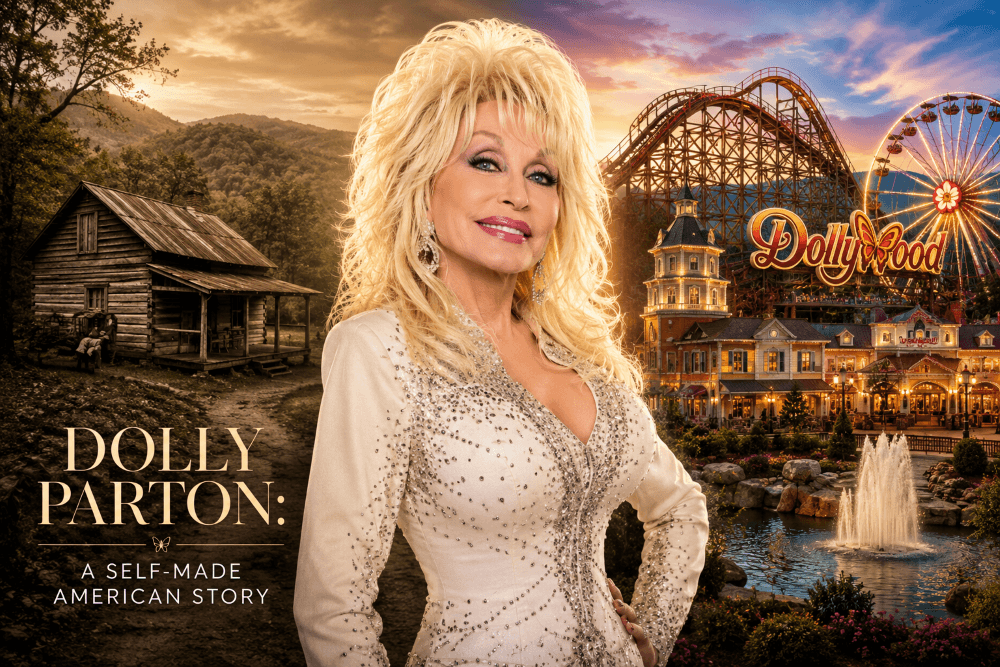
Dolly Parton was a singer, songwriter, actress, philanthropist and cultural icon. But there is another part of her remarkable life that deserves just as much recognition: Dolly Parton was an entrepreneur.
Her story belongs in any discussion about self-made success.
Dolly was born into poverty in rural Tennessee, one of 12 children in a family with very little money. From those humble beginnings, she built a career, a brand and a business empire worth hundreds of millions of dollars.
She didn’t inherit wealth. She created it.
And perhaps most importantly, she never seemed embarrassed about where she came from. She turned her origins into one of her greatest strengths.
From a One-Room Cabin to Nashville
Dolly Rebecca Parton was born on January 19, 1946, in Locust Ridge, Tennessee, in the Great Smoky Mountains.
She was the fourth of 12 children.
The Parton family had little money, but their home was filled with music. Dolly began performing as a child and quickly realized that music could become more than entertainment. It could become her future.
After graduating from high school in 1964, she left for Nashville almost immediately.
There was no large financial safety net waiting for her if she failed.
She had talent, ambition and an extraordinary willingness to work.
Those qualities eventually took her from singing on local radio and television programs to The Porter Wagoner Show, and from there to becoming one of the most recognizable performers in the world.
But talent alone doesn’t explain Dolly Parton’s success.
Behind the rhinestones was a very smart businesswoman.
Dolly Parton Entrepreneur: Own What You Create
One of the greatest lessons from Dolly Parton’s career is surprisingly modern:
Own your intellectual property whenever possible.
Early in her career, Dolly established her own music publishing company and retained ownership of much of the music she wrote.
That decision became enormously valuable.
She wrote thousands of songs during her career, including classics such as Jolene, 9 to 5 and I Will Always Love You.
One of the most famous stories in Dolly’s business career involved Elvis Presley.
Elvis wanted to record I Will Always Love You. For a young songwriter, having Elvis record your song would have been an extraordinary opportunity.
There was just one problem.
Elvis’s manager, Colonel Tom Parker, wanted Dolly to surrender half of the publishing rights.
Dolly refused.
Imagine how difficult that decision must have been.
She was turning down Elvis Presley.
But Dolly understood that the song was an asset. Giving away ownership for short-term fame could cost her far more over the long term.
Years later, Whitney Houston recorded I Will Always Love You, turning it into one of the most successful recordings in music history.
Dolly still owned her publishing rights.
That is entrepreneurship.
Sometimes the most important business decision isn’t saying yes to an opportunity.
It’s knowing when to say no.
She Turned Dolly Parton Into a Brand
Long before people talked about “personal branding” on social media, Dolly Parton understood it instinctively.
The blonde hair.
The bib boobs
The rhinestones.
The exaggerated country glamour.
The Tennessee accent.
The humor.
The self-deprecation.
The authenticity.
None of it was accidental.
Dolly created an image that was instantly recognizable, but unlike many manufactured celebrity brands, hers was connected to her actual personality and background.
She knew exactly who she was.
That consistency became enormously valuable.
Dolly wasn’t simply selling records. She was building something much bigger: trust between herself and her audience.
That trust could eventually extend into movies, television, books, merchandise, tourism, hospitality, beauty products and other businesses.
Dollywood: Bringing the Money Back Home
Perhaps the greatest example of Dolly Parton the entrepreneur was Dollywood.
In 1986, Dolly partnered with the owners of an existing amusement park in Pigeon Forge, Tennessee, and transformed it into Dollywood.
This was much more than a celebrity licensing deal.
Dolly invested in the region where she grew up.
Instead of leaving rural Tennessee behind after becoming successful, she helped turn her fame into an economic engine for the area.
Dollywood grew into a major tourism destination, eventually expanding beyond the original theme park into resorts, a water park and other attractions.
It also became one of Dolly’s most valuable assets.
There is an important entrepreneurial lesson here.
Dolly understood something many entrepreneurs eventually discover:
Your reputation can become capital.
She spent decades earning the affection and trust of millions of people. Dollywood transformed some of that goodwill into a business while simultaneously creating jobs and tourism in her home region.
She didn’t forget where she came from.
She invested in it.
Multiple Sources of Income
Dolly Parton also understood diversification long before “multiple income streams” became a favorite phrase among financial influencers.
Her financial success didn’t depend entirely on selling records.
Over the decades, her income and wealth came from numerous sources:
- Songwriting royalties
- Music publishing rights
- Concerts and performances
- Movies and television
- Dollywood
- Resorts and tourism
- Books
- Licensing
- Merchandise
- Beauty and consumer products
- Partnerships using the Dolly Parton brand
This is another important lesson for entrepreneurs.
Once you create something valuable — a song, business, reputation, audience or brand — look for ways to build additional assets around it.
Dolly didn’t simply earn money.
She built assets that could continue producing money.
She Knew the Difference Between Income and Ownership
This might be the most important financial lesson from Dolly Parton’s life.
A performer can make a lot of money.
An owner can build wealth.
Dolly became both.
She could have simply collected checks for concerts, television appearances and record sales. Instead, she retained publishing rights, invested in businesses and acquired ownership stakes in assets.
That distinction matters.
Income pays you once.
Ownership can pay you for decades.
The Dolly Parton entrepreneur story is therefore not simply a celebrity success story. It is a lesson in turning creative talent into long-term capital.
What was Dolly Parton’s net worth at the time of her death?
According to Forbes, Dolly Parton had an estimated net worth of $450 million in 2026. While that sum is about as larger-than-life as her personality, it’s actually less than the estimates of the fortune she gave away.
Through the years, Parton’s charitable giving was estimated to be as high as $500 million, fulfilling her mantra to “give from the heart.”
I just give from my heart. I never know what I’m going to do or why I’m gonna do it. I just see a need and if I can fill it, then I will.
Regarding her $450 million fortune, Forbes estimates that most of Parton’s wealth stemmed from her 50% ownership stake in the Dollywood Company, which operates the Dollywood theme park and other family attractions in Pigeon Forge, Tennessee.
Parton’s music catalog, which contains more than 3,000 of her songs, is valued at $120 million. She recorded 49 albums over her prolific 60-year career.
Even today, her music attracts 16.2 million monthly Spotify listeners, and her 1973 single “Jolene” has been streamed more than 950 million times.
Success Didn’t Mean Forgetting Poverty
One of the things I admire most about Dolly Parton’s story is that wealth never seemed to make her ashamed of poverty.
She talked openly about growing up poor.
She wrote about it.
She joked about it.
She celebrated the people and culture of the Appalachian community where she was raised.
She understood that being poor was something that happened to her family. It didn’t define what she was capable of becoming.
That distinction matters.
People sometimes imagine successful entrepreneurs as people who begin with money, connections or elite educations.
Dolly Parton’s life reminds us that entrepreneurship can begin with almost nothing.
What matters is creating something other people value.
From Poverty to Giving Away Millions of Books
Dolly’s success also allowed her to become an extraordinary philanthropist.
In 1995, she launched Dolly Parton’s Imagination Library, inspired partly by her father, who had been unable to read and write.
The idea was wonderfully simple.
Send free books to young children.
What began in her home county in Tennessee eventually expanded internationally, distributing hundreds of millions of books to children.
There is something beautiful about that circle.
A girl born into a poor family in the Tennessee mountains becomes wealthy through creativity and entrepreneurship — and then uses part of that wealth to give children opportunities her own family never had.
That is a legacy much bigger than money.
What Entrepreneurs Can Learn From Dolly Parton
Dolly Parton’s life offers several lessons that apply far beyond the entertainment industry.
1. Start with what you have
Dolly didn’t start with money.
She started with a voice, songwriting ability, ambition and a willingness to work.
Entrepreneurs rarely begin with every resource they need. They begin with whatever is available and build from there.
2. Own your work
Her decision to protect her publishing rights may have been one of the most important financial decisions of her career.
Creators should always understand the value of intellectual property.
3. Think long term
Turning down Elvis Presley sounds crazy if you’re thinking about tomorrow.
It looks brilliant when you’re thinking about the next 50 years.
4. Build a recognizable brand
People knew what Dolly represented.
Her brand wasn’t created by a marketing committee. It grew from an exaggerated but authentic version of herself.
5. Turn income into assets
Dolly didn’t simply spend the money she earned from entertainment.
She invested in businesses and intellectual property that produced additional income.
6. Never forget where you came from
Some successful people spend their lives trying to escape their origins.
Dolly turned hers into part of her identity.
Then she invested back into the community that helped create her.
A Self-Made American Success Story
Dolly Parton will always be remembered for the music.
People will continue singing Jolene. They will continue listening to 9 to 5. Future generations will discover I Will Always Love You.
But her business legacy deserves to be remembered too.
She was a songwriter who understood intellectual property.
A celebrity who understood branding.
An entertainer who understood ownership.
An investor who understood the economic power of her reputation.
And a wealthy entrepreneur who understood that money could be used to create opportunities for other people.
Dolly Parton’s life traveled an extraordinary distance — from a poor childhood in the Great Smoky Mountains to becoming one of the world’s most recognizable entertainers and a multimillionaire entrepreneur.
Yet somehow, she never seemed very far from that little girl in Tennessee.
Maybe that was part of her genius.
She didn’t become successful by trying to become somebody else.
She figured out how to turn being Dolly into something the entire world valued.
That may be the greatest entrepreneurial lesson she left us.
Frequently Asked Questions
Was Dolly Parton an entrepreneur?
Yes. In addition to being a singer and songwriter, Dolly Parton was an entrepreneur who owned valuable music publishing rights and invested in businesses including Dollywood, tourism, hospitality, merchandise and consumer products.
How did Dolly Parton become wealthy?
Dolly Parton built wealth through several sources, including songwriting royalties, music publishing, entertainment, business investments and her ownership interest in Dollywood. Her decision to retain ownership of much of her music was particularly important.
Did Dolly Parton grow up poor?
Yes. Dolly Parton was born in rural Tennessee and was one of 12 children. Her family had very little money. She frequently discussed her humble childhood and incorporated those experiences into her music and public identity.
What can entrepreneurs learn from Dolly Parton?
Dolly Parton’s career demonstrates the importance of protecting intellectual property, thinking long term, building an authentic brand, diversifying income, investing in assets and maintaining a strong connection with customers and community.
Other Self Made Posts