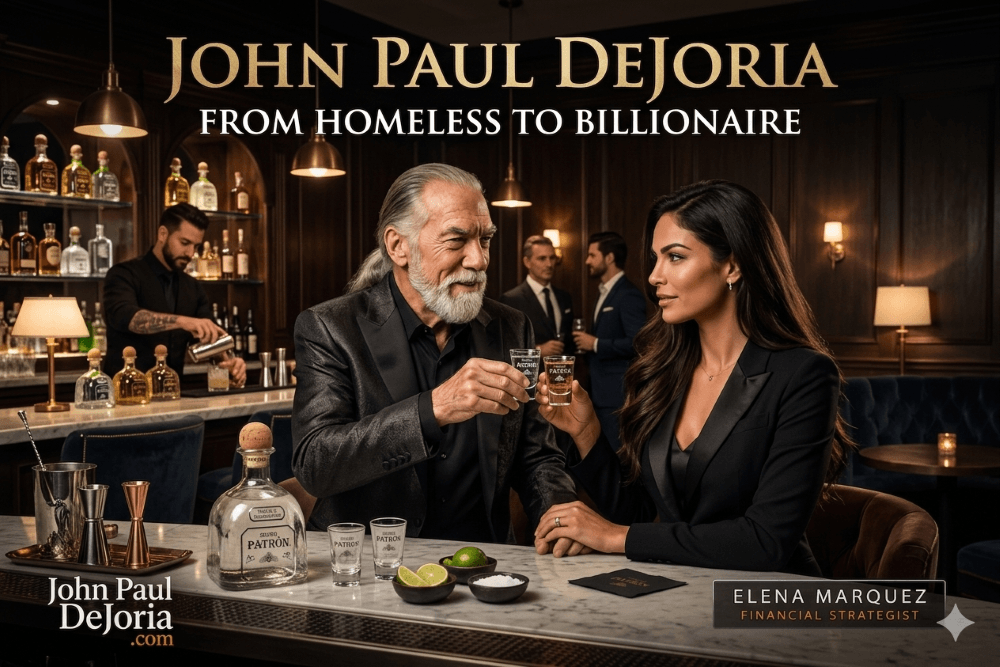
There are entrepreneurs who start with advantages. Then there are entrepreneurs like John Paul DeJoria.
John Paul DeJoria didn’t inherit money. He didn’t come from Silicon Valley privilege. He didn’t have wealthy investors backing him.
At one point, he was homeless. Twice.
Once, he was collecting Coke bottles from trash cans so he could feed his young son. Years later, at age 36, he was sleeping inside a 20-year-old Rolls-Royce while trying to launch a hair care company with only $700.
Most people would have quit.
DeJoria kept going.
That persistence would eventually help him build two billion-dollar empires: John Paul Mitchell Systems and Patrón.
Jhon Paul DeJoria’s Humble beginning
John Paul grew up in poverty. His mother was unable to suport him and at age 2 he was sent to a foster home until age 9. At that age he started selling Christmas cards and newspapers to help out with the house expenses.
After serving two years in the military, he held a series of low paying jobs such as jonitor (Me too, I worked as a janitor), door-to-door encyclopedia salesman, and insurance salesman.
John Paul DeJoria and the Power of Starting Small
The story of John Paul DeJoria is not just about money. It’s about refusing to let circumstances define your future.
In 1980, DeJoria and hairstylist Paul Mitchell wanted to launch a revolutionary hair care company.
They had products ready. They had vision. They even had an investor lined up with half a million dollars.
Then, one month before launch, the investor disappeared.
No explanation. No funding. No safety net.
Most entrepreneurs would have considered the project dead.
DeJoria did the opposite.
He borrowed $350 from his mother. Paul Mitchell matched it with another $350.
That was their starting capital.
$700.
No office. No marketing department. No warehouse. No investors.
Just two men betting on themselves during one of the worst economic periods in modern American history.
Inflation was soaring. Interest rates reached 17%. Starting a business in that environment looked irrational.
But sometimes desperation creates clarity.
Sleeping in a Rolls-Royce While Building an Empire
DeJoria moved into his car while building the company.
Ironically, it was a Rolls-Royce he had purchased years earlier during a brief period of financial success.
He was homeless, but he still drove to meetings looking professional.
That mattered.
Entrepreneurship is often romanticized today. Social media makes startup life look glamorous. John Paul DeJoria’s experience was the opposite.
He knocked on salon doors every single day.
Most rejected him immediately.
Salon owners told him:
- Nobody knew the brand
- The packaging looked cheap
- They already had suppliers
- They didn’t trust a salesman working out of his car
The rejection never stopped.
But DeJoria had learned a critical lesson from selling encyclopedias door-to-door years earlier:
You have to approach door number 100 with the same enthusiasm as door number one.
That mindset changed everything.
The Rise of Paul Mitchell Systems
Eventually, salon owners began trying the products.
And the products worked.
The formulas saved hairstylists time. Clients loved the results. Word spread organically throughout the salon industry.
The business slowly gained traction.
The first two years were brutal. Long hours. Minimal revenue. Every dollar reinvested back into the company.
Then, in year three, something changed.
The company generated $1 million in gross revenue.
That momentum never stopped.
Within a decade, John Paul Mitchell Systems became one of the largest professional hair care brands in the world.
Then tragedy struck.
Paul Mitchell died of cancer in 1989.
Many entrepreneurs would have sold the company or walked away.
DeJoria stayed.
He continued building the business in his friend’s name while creating a unique corporate culture focused on employee loyalty and autonomy.
The result?
Over four decades, employee turnover remained extraordinarily low.
Today, the company generates over $1 billion annually and remains privately held.
John Paul DeJoria Built a Second Billion-Dollar Empire
Most entrepreneurs spend an entire lifetime trying to build one successful company.
John Paul DeJoria decided to build another.
In 1989, while visiting Mexico with entrepreneur Martin Crowley, DeJoria discovered a tequila that tasted dramatically different from the harsh, low-end products dominating the American market.
He saw an opportunity.
At the time, tequila was associated with cheap shots and college parties.
DeJoria believed tequila could become luxury.
That idea became Patrón.
The strategy was simple but revolutionary:
- Premium quality tequila
- Handmade production
- High-end branding
- Luxury pricing
A bottle sold for around $38 when most tequila cost under $15.
Industry experts thought the idea was absurd.
Americans, they argued, would never pay luxury prices for tequila.
They were wrong.
DeJoria focused on elite restaurants, celebrity hotspots, and influential bartenders. Instead of mass marketing, he relied on product quality and word of mouth.
The strategy worked brilliantly.
Patrón became synonymous with luxury tequila.
Celebrities embraced it. Restaurants promoted it. Consumers associated it with status and quality.
By 2018, Bacardi acquired Patrón in a deal valued at approximately $5.1 billion.
Not bad for a man once sleeping in his car.
Lessons Entrepreneurs Can Learn from John Paul DeJoria
The story of John Paul DeJoria contains lessons most business schools never teach.
1. Start Before You Feel Ready
DeJoria lost a half-million-dollar investor and launched anyway.
Most people wait for perfect conditions. Successful entrepreneurs often start with whatever they have available.
2. Rejection Is Part of the Process
Doors slammed in his face constantly.
He kept knocking.
Persistence is frequently more important than talent.
3. Premium Brands Win
Both Paul Mitchell and Patrón succeeded because they positioned themselves as premium products rather than competing on price.
4. Hardship Can Become Fuel
DeJoria’s struggles didn’t destroy his ambition.
They sharpened it.
When you’ve split a 99-cent meal with your child, quitting stops feeling like an option.
Final Thoughts
The story of John Paul DeJoria is not motivational fluff.
It’s a reminder that some of the world’s biggest businesses began under terrible conditions.
No funding.
No stability.
No guarantees.
Just relentless persistence.
Today, entrepreneurs spend endless time worrying about venture capital, valuations, and startup optics.
DeJoria’s story suggests something simpler:
The money doesn’t build the business.
The entrepreneur does.
Frequently Asked Questions
Who is John Paul DeJoria?
John Paul DeJoria is an American entrepreneur best known for co-founding Paul Mitchell hair products and Patrón Tequila.
Was John Paul DeJoria homeless?
Yes. John Paul DeJoria experienced homelessness twice during his life, including while building Paul Mitchell Systems.
How much money did John Paul DeJoria start with?
He and Paul Mitchell started their company with only $700 after their original investor backed out.
Did John Paul DeJoria sell Patrón Tequila?
Yes. Bacardi acquired Patrón Tequila in 2018 in a deal valued at approximately $5.1 billion.
Other Self Made Posts