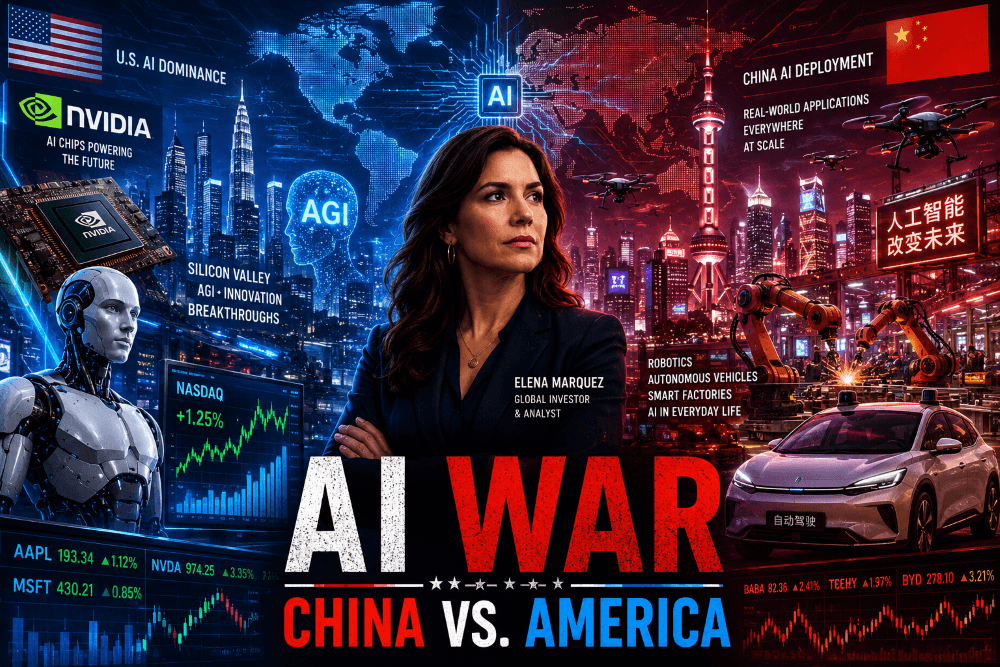
Artificial intelligence is rapidly becoming the most important technological and economic battleground of the 21st century. The question investors keep asking is simple: Who is winning the AI race — China or the United States?
The answer is surprisingly complicated.
The United States dominates the cutting edge of AI research, chips, and foundational models. China dominates the deployment of AI into the real economy. America is building the brains. China is building the infrastructure around those brains.
For investors, the real opportunity may not be choosing one side. It may be owning both.
The U.S. Leads in Innovation
The United States still holds the crown in advanced AI development.
Companies like NVIDIA, Microsoft, Alphabet, Amazon, and Meta Platforms are spending tens of billions of dollars building the future of artificial intelligence.
The U.S. advantage comes from three areas:
1. Advanced Chips
NVIDIA remains the most important company in AI today.
Its GPUs (Graphics Processing Unit) are the “picks and shovels” powering nearly every major AI model in the world. Chinese companies still rely heavily on NVIDIA chips because domestic Chinese alternatives are not yet competitive at the highest level.
This gives the U.S. a massive strategic advantage.
2. Talent Concentration
The world’s top AI researchers continue to gravitate toward Silicon Valley and American universities.
China produces enormous numbers of engineers, but many of the best researchers still choose the U.S. because of:
- Academic freedom
- Venture capital access
- Higher compensation
- More open research environments
3. AGI Ambition
American companies are chasing Artificial General Intelligence (AGI) — AI systems that could eventually reason at or beyond human capability.
Whether AGI is achievable remains unknown, but the U.S. is clearly ahead in frontier model development.
China Leads in AI Deployment
China, however, is approaching AI very differently.
Instead of focusing entirely on AGI, China is concentrating on practical applications:
- Driverless cars
- Robotics
- Smart factories
- AI healthcare
- Logistics
- Education tools
- Surveillance systems
- Industrial automation
In many Chinese cities, AI is already embedded into everyday life.
That matters because technology adoption often determines who ultimately wins economically.
Why China Cannot Be Ignored
Many Western investors underestimate China’s AI ecosystem.
That could be a mistake.
Chinese policymakers view AI as essential to solving major national challenges:
- Aging population
- Labor shortages
- Slower economic growth
- Healthcare inequality
- Manufacturing competitiveness
The Chinese government has made AI a national priority since at least 2017, when Beijing launched its “New Generation AI Development Plan.”
Today, AI is deeply embedded in China’s latest economic strategy.
DeepSeek Changed Everything
The arrival of DeepSeek shocked Silicon Valley.
DeepSeek demonstrated that Chinese AI models could compete with leading American systems at a fraction of the cost.
Even more importantly, DeepSeek embraced open-source development.
That raised fears in Washington that China could eventually dominate global AI adoption the same way Android dominated mobile operating systems.
Some investors dismissed DeepSeek as hype. That is dangerous.
China may still lag slightly behind the U.S. in frontier AI, but experts increasingly believe the gap is measured in months — not years.
The Biggest Risks for China
China still faces major structural disadvantages.
Government Control
Chinese AI companies operate under heavy political oversight.
The government can intervene suddenly, block acquisitions, impose censorship, or tighten regulations at any moment.
That creates uncertainty for investors.
Semiconductor Dependence
China still depends heavily on advanced chips from NVIDIA and other Western suppliers.
Until China develops world-class domestic semiconductors, it remains vulnerable to U.S. export restrictions.
Innovation Culture
China excels at scaling technologies rapidly.
The U.S. still appears stronger at breakthrough innovation.
Many analysts describe this as:
- China: excellent at “1 to 100”
- U.S.: stronger at “0 to 1”
That distinction matters enormously in AI.
So Who Is Winning?
The truth is that both countries may win — but in different ways.
The United States is leading the race toward frontier AI and AGI.
China is leading the race toward mass AI integration into daily life and industrial production.
If AGI becomes reality, the U.S. likely wins.
If AI becomes mainly a productivity tool embedded throughout the economy, China may have the edge.
Right now, nobody truly knows which future is more likely.
What Should Investors Do?
Investors should avoid ideological thinking.
This is not a winner-take-all scenario.
The smartest strategy may be building diversified exposure to the entire AI ecosystem.
U.S. AI Stocks to Watch
Semiconductor Leaders
- NVIDIA
- Advanced Micro Devices
- Broadcom
- Taiwan Semiconductor Manufacturing Company
Cloud & Infrastructure
- Microsoft
- Amazon
- Alphabet
AI Applications
- Palantir Technologies
- Open AI
- Anthropic
China AI Exposure
Direct investment in Chinese AI remains difficult and politically risky, but several names deserve attention:
- Alibaba Group
- Tencent
- Baidu
- Xiaomi
Investors seeking broader exposure may prefer China-focused ETFs rather than individual companies.
A Possible Hedge Strategy
One approach could be:
- Heavy allocation to U.S. semiconductor and infrastructure leaders
- Smaller exposure to Chinese AI adoption plays
- Some international semiconductor exposure through Taiwan
This creates a hedge against either outcome:
- U.S. dominance in AGI
- Chinese dominance in AI deployment
Are We Still Early?
Yes — very early.
The internet revolution lasted decades.
AI may be even bigger.
Right now, we are probably somewhere between:
- The 1995 internet era
- The 2007 smartphone era
Massive fortunes will likely still be made.
Massive bubbles will likely still form.
Many current AI leaders may not survive.
But the long-term transformation appears unavoidable.
Final Thoughts
Investors should resist simplistic narratives.
China is not “losing” the AI race.
The United States is not guaranteed victory.
Both nations are pursuing fundamentally different visions of artificial intelligence:
- America is building intelligence itself.
- China is embedding intelligence into society.
The most important takeaway for investors may be this:
You do not have to predict the final winner to profit from the race.
Other Stock Market blog posts