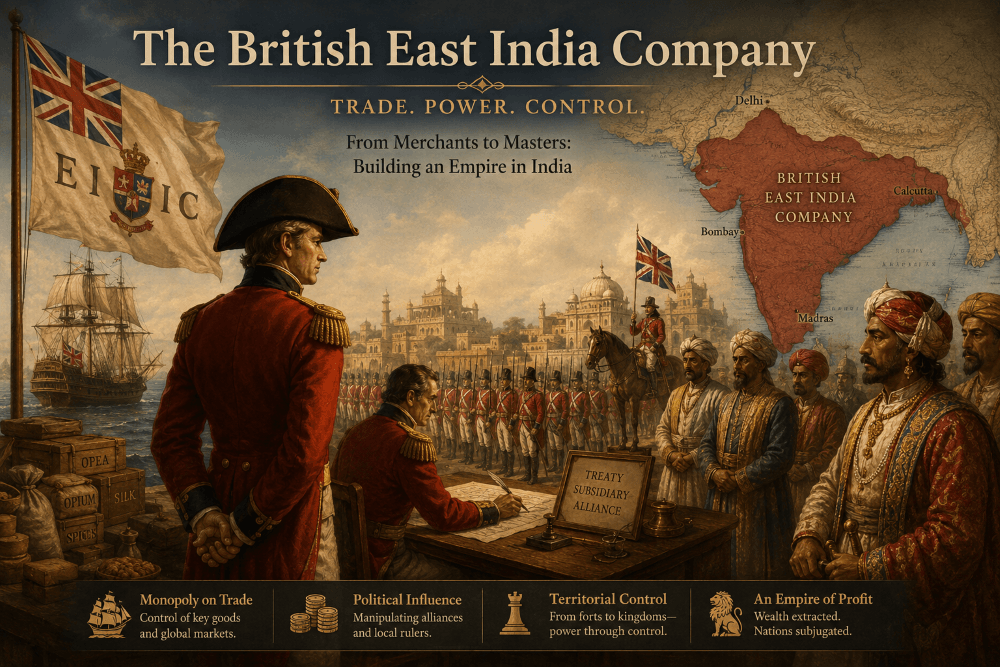
No single company in history blurred the line between commerce and government quite like the British East India Company. Founded in 1600 as a chartered trading venture, it eventually raised its own armies, administered vast territories, and effectively ruled large parts of India for over a century. Its story is a striking, cautionary example of how far a business, granted enough power and left unchecked, can expand beyond its original commercial purpose.
What Was the British East India Company?
The British East India Company began in 1600 when Queen Elizabeth I granted it a royal charter giving it exclusive rights to trade with Asia.
- The charter granted the company a monopoly over English trade east of the Cape of Good Hope.
- Its initial goal was straightforward: profit from the lucrative spice and textile trade with Asia.
- Like the Dutch VOC founded shortly after, it operated as a joint-stock company, allowing investors to fund voyages and share in the profits.
This structure gave the company enormous financial resources and legal privileges from the very beginning, setting it apart from ordinary merchant ventures.
From Trading Company to Territorial Power
Establishing a Foothold in India
The British East India Company initially focused on establishing trading posts and securing favorable agreements with local rulers across India.
- It built fortified trading posts in key coastal cities, including Bombay, Madras, and Calcutta.
- It negotiated trading privileges with regional Indian rulers, often through a mix of diplomacy and strategic gift-giving.
- Over time, these trading posts grew into significant, semi-permanent settlements with their own local administrative structures.
What started as modest trading outposts gradually accumulated real local influence and infrastructure.
The Turn Toward Military Power
The company’s transformation from trader to ruler accelerated dramatically in the mid-18th century.
- The company built and maintained its own private army, eventually larger than many European national armies.
- Its decisive military victory at the Battle of Plassey in 1757 gave it effective control over the wealthy region of Bengal.
- This victory marked a fundamental shift from trading company to territorial power, with direct control over tax collection and local governance.
This is the point where the British East India Company stopped resembling a business in any conventional sense and started functioning as a de facto government.
How the British East India Company Ran an Empire
Governing Through a Corporate Structure
Remarkably, the company administered enormous Indian territories using corporate governance structures rather than traditional state institutions.
- It collected taxes directly from Indian territories under its control.
- It maintained its own courts and legal systems in some regions.
- Company officials, answerable to shareholders back in London, made governing decisions affecting millions of Indian subjects.
This arrangement created a strange and troubling hybrid: a profit-driven corporation making decisions that shaped the lives of an entire subcontinent’s population.
Monopoly and Economic Control
The British East India Company’s economic power rested heavily on maintaining strict control over trade.
- It enforced its monopoly aggressively, working to eliminate or restrict competition from other traders.
- It controlled textile production and trade in ways that damaged traditional Indian industries.
- Profits flowed disproportionately back to British shareholders and the company’s leadership, rather than benefiting the regions it controlled.
The Costs and Consequences
Devastating Human Impact
The company’s pursuit of profit and control came at an enormous human cost that cannot be separated from its business history.
- Company policies contributed directly to devastating famines in Bengal, including a catastrophic famine in 1770 that killed millions.
- Local industries and traditional economic structures were deliberately undermined to benefit British commercial interests.
- Indian populations under company rule had little meaningful representation or recourse against company decisions.
Growing Government Oversight
As the company’s power and abuses became increasingly apparent, the British government gradually stepped in to assert greater control.
- Parliament passed regulatory acts in the late 18th century aimed at overseeing company governance.
- Growing public scandal over company abuses in India fueled political pressure for reform.
- Following the Indian Rebellion of 1857, the British government formally dissolved the company’s governing role, transferring control directly to the British Crown.
Lessons from the British East India Company
- Unchecked power expands. Given military and administrative capability, a commercial entity extended far beyond its original trading purpose.
- Monopoly enables exploitation. Strict market control allowed the company to prioritize shareholder profit over the welfare of those it governed.
- Corporate and governmental roles shouldn’t blur without accountability. The company’s dual role as business and government created outcomes with devastating human consequences.
Frequently Asked Questions
What was the original purpose of the British East India Company? It was founded in 1600 as a chartered trading company with a monopoly over English trade with Asia, primarily focused on spices and textiles.
How did the British East India Company gain control over India? Through a combination of trading posts, strategic alliances, and military force, culminating in its decisive victory at the Battle of Plassey in 1757, which gave it control over Bengal.
Did the British East India Company have its own army? Yes, the company built and maintained a large private army, which at times was larger than many European national militaries, allowing it to enforce control over Indian territories.
Why did the British government eventually dissolve the company’s rule? Following growing scandal over company abuses and the Indian Rebellion of 1857, the British government formally transferred governing authority from the company to the Crown.
Related Articles
- Tulipmania: What the Famous Bubble Really Teaches About Markets
- The Amsterdam Stock Exchange: Where Shares Were Born
- The Dutch East India Company: How the VOC Helped Create the Modern Corporation
- The Fall of Constantinople: The Trade Shock That Built Empires
- Vasco da Gama: Building the Portuguese Spice Monopoly
- Christopher Columbus: Exploration as a Business Pitch
- Prince Henry the Navigator: The First Venture Capitalist
About The History of Entrepreneurship
This article is part of The History of Entrepreneurship, an ongoing series exploring how civilizations, technologies, merchants, investors, institutions, and individual entrepreneurs gradually created the foundations of modern business.