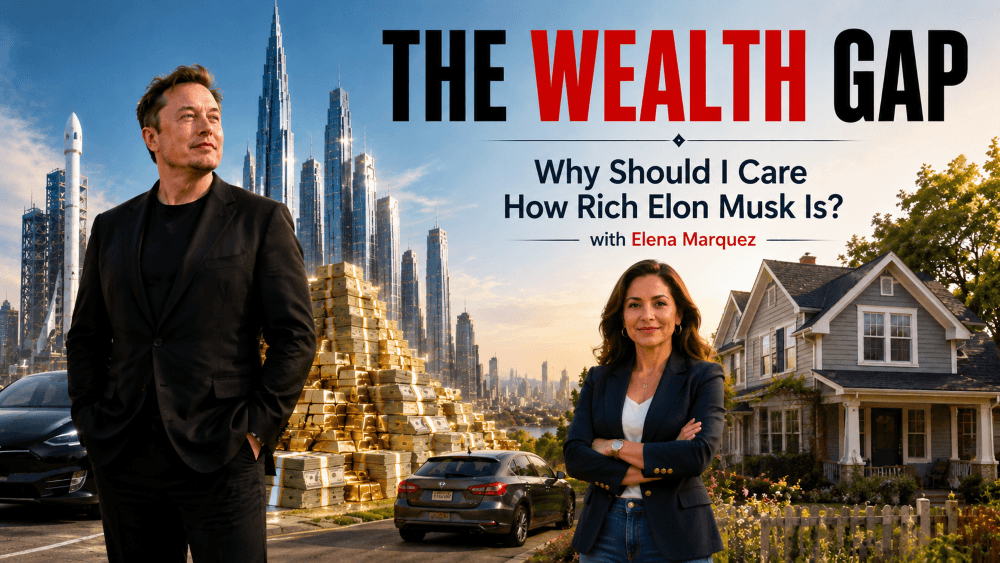
There is an obsession with the wealth gap that I have never completely understood.
Elon Musk is thousands of times wealthier than I am. So what? His enormous fortune doesn’t prevent me from having a comfortable home, eating good food, traveling, investing, enjoying my friends, or building the kind of life I want.
Why should his wealth make me unhappy?
I understand being concerned about poverty. I understand worrying about people who cannot afford food, housing, education, or medical care. Those are real problems affecting real human beings.
But the wealth gap is something different.
If tomorrow Elon Musk became twice as rich while my standard of living remained exactly the same, statistically the wealth gap between us would become larger.
But how exactly would I have become poorer?
I wouldn’t.
The Wealth Gap Is the Wrong Scoreboard
Imagine two hypothetical societies.
In Society A, the average working-class person earns $30,000 while the richest people earn $300,000.
In Society B, the average working-class person earns $70,000 while the richest people earn $70 million.
Society B has vastly greater inequality. But if ordinary people have better homes, better food, better healthcare, more leisure, more opportunities and higher standards of living, why should we automatically prefer Society A?
I wouldn’t.
This is the distinction between relative prosperity and absolute prosperity.
I care much more about whether people’s lives are improving than about how many times richer the richest person is than the poorest.
Margaret Thatcher Understood the Problem
Margaret Thatcher made this argument memorably during her final appearance as British prime minister in the House of Commons in 1990.
When challenged about the widening gap between rich and poor, she responded that her opponent seemed to prefer that “the poor were poorer, provided that the rich were less rich.”
Her argument was not that poverty doesn’t matter. It was that reducing inequality isn’t necessarily the same thing as improving people’s lives.
That distinction is crucial.
If you could magically confiscate $100 billion from Elon Musk tomorrow without giving a single dollar to anyone else, the wealth gap would shrink dramatically.
Would society suddenly be better?
Of course not.
A smaller wealth gap, by itself, creates nothing.
Poverty and Inequality Are Not the Same Problem
This is where political discussions often become confused.
There are at least two very different goals:
- Reducing poverty
- Reducing inequality
They can overlap, but they aren’t identical.
Suppose a poor person’s income rises from $25,000 to $50,000 while a billionaire’s fortune increases from $10 billion to $30 billion.
The poor person has become significantly better off.
But inequality has increased.
If your primary objective is reducing the wealth gap, you might describe this as a negative outcome. If your objective is improving human welfare, however, the improvement in the poorer person’s life should be something worth celebrating.
That is why I believe prosperity is a better objective than equality.
Why Should Elon Musk’s Wealth Bother Me?
Consider Elon Musk.
He could lose 99% of his fortune and still be dramatically wealthier than almost everyone reading this article.
But his bank account doesn’t determine my happiness.
My life is influenced by my income, savings, health, family, friendships, opportunities, freedom and ability to pursue the things that matter to me.
Constantly comparing myself with billionaires would accomplish nothing except make me miserable.
And this doesn’t apply only to billionaires.
There will always be someone with more.
Someone who is better looking than me.
Someone who is a better Salsa dancer than me.
Someone has a bigger house.
Someone drives a more expensive car.
Someone flies first class while I sit in economy.
Someone owns a private jet.
Someone has $10 million.
Someone else has $10 billion.
If happiness requires closing the distance between ourselves and everyone above us, we have created a game we can never win.
Envy Is a Terrible Economic Philosophy
There is also a psychological problem with obsessing over the wealth gap.
Envy is corrosive.
The more we measure our lives against people who have dramatically more than us, the easier it becomes to overlook everything we already have.
Social media has made this problem worse. We constantly see lifestyles that would have been invisible to previous generations: mansions, yachts, private aircraft, luxury vacations and celebrities spending more on dinner than some people earn in a month.
We can respond in two ways.
We can say:
“That person has more than me. How unfair.”
Or we can ask:
“Am I building a life that makes me happy?”
I find the second question far more useful.
When Politicians Turn the Wealth Gap Into Resentment
Politicians such as Bernie Sanders and Elizabeth Warren have made wealth concentration a major part of their political agendas.
In 2026, Sanders proposed a 5% annual tax on billionaire wealth, while Warren and other lawmakers renewed their proposal for an annual wealth tax beginning on fortunes exceeding $50 million.
Their argument deserves to be represented fairly.
Supporters of these policies argue that extreme concentrations of wealth can translate into political influence, that wealthy households should contribute more toward public services, and that additional tax revenue could finance healthcare, education and other programs.
Those are legitimate subjects for debate.
Where I disagree is with the idea that the existence of enormous fortunes is itself evidence that something is wrong. In fact, I believe that every should pay the same tax rate. No progressive tax, I believe there should be a flat tax rate for every one. That’s the only kind of fairness I can understand.
The question shouldn’t be:
“How much richer is the billionaire than everyone else?”
It should be:
“How well can ordinary people live, and how much opportunity do they have to improve their lives?”
Those are very different questions.
Wealth Isn’t Necessarily Taken From Someone Else
Another mistake is treating wealth as though the economy were a giant pie with a fixed number of slices.
If one person gets a bigger slice, someone else must receive a smaller one.
But much of modern wealth doesn’t work that way.
Entrepreneurs can become enormously wealthy because they own shares in companies whose value increases. If a company creates a product millions of people voluntarily buy, the founder’s ownership stake can become extraordinarily valuable.
That doesn’t automatically mean millions of other people became poorer.
Wealth can be created.
New businesses, technologies, medicines, software, entertainment, transportation systems and financial innovations can increase both the fortunes of their creators and the living standards of their customers.
This doesn’t mean every fortune is deserved or every market is fair. Fraud, political favoritism, monopoly protection and corruption should absolutely concern us.
But those are arguments against unfairly acquired wealth, not against wealth itself.
My Experience as an Immigrant to Canada
This issue is personal for me.
I came to Canada as an immigrant with little money and no important social connections.
Nobody was waiting to hand me success.
Yet I found opportunities.
I worked. I became self-employed. I built a life. I saved and invested. Over time, I created a standard of living that I am comfortable with.
There are hundreds of Canadians vastly wealthier than I am.
It doesn’t bother me.
Their wealth doesn’t diminish what I have accomplished.
I would much rather live in a society where someone can arrive with little money and build a good life—even if another person becomes a billionaire—than in a society where everyone is more economically equal because opportunities to become prosperous barely exist.
My objective isn’t to make the person above me poorer.
It is to make my own life better.
The Goal Should Be Equality of Opportunity
Of course, capitalism doesn’t produce perfectly equal outcomes.
It never will.
People have different abilities, ambitions, interests, risk tolerances, circumstances and luck. Some work 40 hours per week. Others build companies and work obsessively for decades. Some invest successfully. Others don’t.
The resulting outcomes will be different.
The important question is whether people have a reasonable opportunity to participate.
A healthy society should strive for:
- good education;
- public safety;
- reasonable access to healthcare;
- competitive markets;
- protection of property rights;
- low barriers to entrepreneurship;
- laws against fraud and corruption;
- opportunities for people to work, save and invest; and
- a basic safety net for people who genuinely need help.
Those things matter far more to me than whether the richest person owns $10 billion or $500 billion.
When the Wealth Gap Really Can Matter
There is one important qualification.
Extreme wealth concentration can become problematic when wealth buys political privilege.
If billionaires can purchase favorable regulations, prevent competitors from entering their industries, obtain government subsidies unavailable to others or manipulate the political system to protect themselves, that deserves scrutiny.
But notice the distinction.
The problem isn’t that someone is rich.
The problem is that the rules aren’t equal.
Similarly, if an economy produces billionaires while millions of willing workers have no realistic path toward improving their standard of living, policymakers should ask why economic mobility has broken down. This is NOT the case in Canada or the U.S. Anyone who wants to succeed has the opportunity to do so.
Here is Walmart manager, with no college education earning $400k/year.
Here is a cashier working at Costco who became a millionaire on his $33/hour.
You can take a look at my Self Made segment to find out about peole who have started with nothing and who became millionaire.
The objective should still be to expand opportunity, rather than simply destroy wealth at the top.
Stop Looking Up and Start Building
There is almost always going to be someone richer than you.
Unless your name happens to appear at the very top of the world’s billionaire rankings, comparison eventually leads to someone with more money.
So what?
I’d rather spend my energy improving my own financial situation.
Earn more.
Save more.
Invest.
Start a business.
Learn new skills.
Create something valuable.
Help your children get a better start.
Enjoy the wealth you already have.
Those actions can improve your life. Resenting a billionaire cannot.
A Better Definition of a Successful Society
My ideal society isn’t one in which everyone has roughly the same amount of money.
It is one in which people at the bottom can rise.
It’s a society where an immigrant can arrive without money or connections and still find opportunities. It’s one where entrepreneurs are allowed to experiment, workers can improve their skills, investors can take risks and people who succeed spectacularly aren’t automatically treated as villains.
Some will become wealthy.
A tiny number will become extraordinarily wealthy.
Good for them.
As long as their wealth was acquired legally and through voluntary economic activity rather than corruption or political favoritism, their fortune doesn’t diminish mine.
The wealth gap tells us how far apart two people are.
It doesn’t tell us whether their lives are getting better.
And ultimately, that’s the measurement I care about.
Frequently Asked Questions
Why does the wealth gap matter?
The wealth gap can matter when extreme wealth concentration contributes to political influence, reduced competition or low economic mobility. But inequality alone doesn’t tell us whether ordinary people’s living standards are improving.
Is reducing poverty the same as reducing the wealth gap?
No. Poverty can decline while the wealth gap increases. If lower-income households become substantially richer while wealthy households gain even more wealth, inequality may rise even though people’s material conditions have improved.
Does this mean billionaires shouldn’t pay taxes?
No. The debate over appropriate taxation is separate from whether billionaires should exist. Wealthy people should obey tax laws and contribute to financing government, but tax policy should be evaluated on its economic and social consequences rather than resentment toward wealth itself.
What matters more than the wealth gap?
Economic mobility, living standards, access to opportunity, competitive markets and the ability to improve one’s financial situation are more meaningful measures of a healthy society than simply comparing the fortunes of rich and poor.