| 📊 Alain’s Holdings — August 31, 2026 | ||||
|---|---|---|---|---|
| Symbol | Name | Price | Change | Change % |
| VOO | Vanguard S&P 500 ETF | 704.89 | -2.35 | -0.33% |
| QQQ | Invesco QQQ Trust | 716.76 | +0.33 | +0.05% |
| XIU.TO | iShares S&P/TSX 60 ETF | 53.65 | -0.40 | -0.74% |
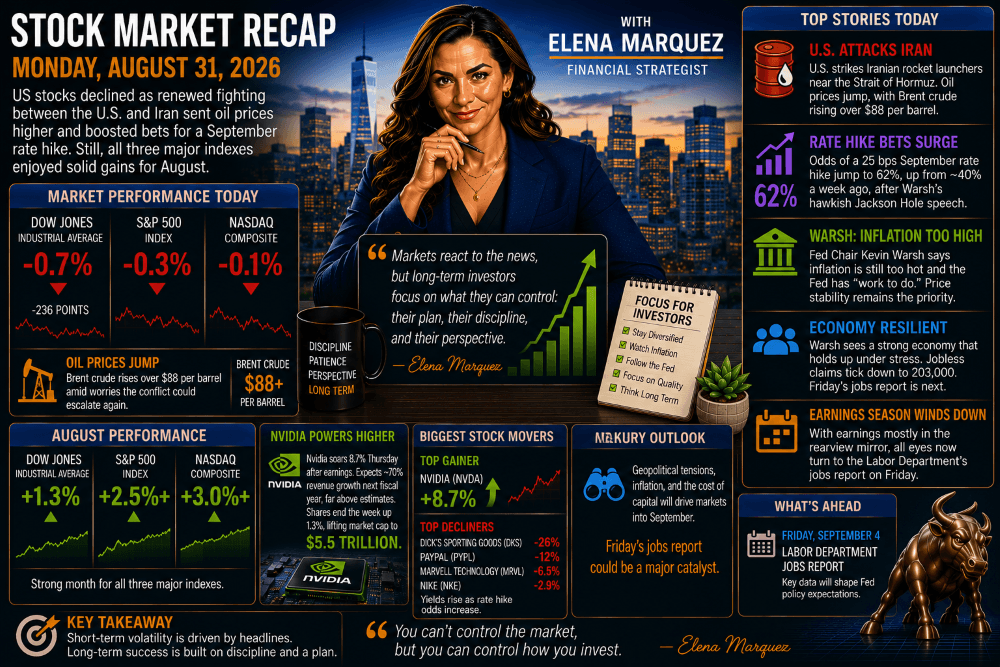
Wall Street ended August on a negative note Monday as renewed fighting between the United States and Iran sent oil prices higher and increased expectations that the Federal Reserve could raise interest rates in September.
The losses were relatively modest, however, and they didn’t erase what was otherwise another strong month for U.S. stocks.
Market Performance
- 📉 Dow Jones Industrial Average: -0.7%
- 📉 S&P 500: -0.3%
- 📉 Nasdaq Composite: -0.1%
The bigger picture looks considerably better.
August Performance
- 📈 Nasdaq: more than +3%
- 📈 S&P 500: more than +2.5%
- 📈 Dow: +1.3%
So while August ended with a geopolitical scare, investors who simply held through the month were rewarded.
The U.S. and Iran Exchange Fire Again
The immediate catalyst for Monday’s weakness came from the Middle East.
The United States struck Iranian rocket launchers that were reportedly preparing to deploy mines into the Strait of Hormuz, renewing direct hostilities after several weeks of relative calm.
The Strait of Hormuz remains one of the world’s most strategically important energy corridors.
Any threat to shipping through the region immediately raises concerns about global oil supplies.
That’s exactly what happened Monday.
Brent crude jumped above $88 per barrel, adding another layer of uncertainty to an inflation picture that was already making investors nervous.
Oil Is Becoming the Fed’s Problem
For stock investors, the Iran conflict isn’t simply a geopolitical story.
It’s increasingly becoming an inflation and interest-rate story.
Higher oil prices eventually work their way through transportation, manufacturing, agriculture and consumer prices.
And that complicates the Federal Reserve’s job.
Last week at Jackson Hole, Fed Chair Kevin Warsh made it clear that the central bank remains uncomfortable with inflation.
His message was straightforward: inflation is still running too hot and the Fed may still have work to do.
Monday’s oil rally makes that problem harder.
September Rate-Hike Odds Jump to 62%
Investors are responding accordingly.
Market expectations for a 25-basis-point September Fed rate hike have climbed to approximately 62%, according to the information provided, up from roughly 40% only a week ago.
That’s a substantial shift.
Just a few weeks ago, investors were debating when interest rates might eventually decline.
Now the market is seriously considering whether the Fed might need to raise them again.
That’s how quickly the economic narrative can change.
Persistent inflation was already a concern.
Add another oil shock, and the Fed has even less room to maneuver.
Yet Technology Stocks Were Surprisingly Resilient
One interesting feature of Monday’s session was the Nasdaq.
Despite renewed warfare, higher oil prices and rising rate-hike expectations, the technology-heavy index declined only 0.1%.
That’s notable.
Technology stocks—particularly expensive growth companies—are normally sensitive to higher interest-rate expectations.
But enthusiasm surrounding artificial intelligence remains powerful following Nvidia’s extraordinary earnings report last week.
Nvidia said it expects revenue to grow approximately 70% during its next fiscal year, reinforcing the argument that AI infrastructure demand remains exceptionally strong.
The AI trade hasn’t disappeared.
It simply has a new obstacle:
the cost of money.
August Was Still a Strong Month
It’s easy to focus on Monday’s headlines and forget what happened during the rest of August.
The Nasdaq gained more than 3%.
The S&P 500 gained more than 2.5%.
And the Dow advanced 1.3%.
Those gains came despite an extraordinary collection of risks.
Investors dealt with persistent inflation, high Treasury yields, expensive oil, trade tensions, concerns about massive AI capital expenditures and renewed fighting in the Middle East.
Yet stocks continued climbing.
That’s evidence of how resilient this market has been.
Corporate earnings have remained strong enough—and enthusiasm surrounding AI powerful enough—to offset many of the macroeconomic concerns.
Earnings Season Is Ending. Now the Economy Takes Over.
Another important transition is taking place.
Earnings season is largely behind us.
For the past several weeks, companies such as Nvidia, Microsoft, Amazon, Meta and other major corporations have dominated the market conversation.
Now economic data becomes increasingly important.
And the biggest report arrives Friday.
The Labor Department’s monthly jobs report could become the most important economic release before the September Fed meeting.
A strong employment report could reinforce Warsh’s argument that the economy can tolerate higher rates while the Fed continues fighting inflation.
A surprisingly weak report would complicate that picture.
The Fed could then find itself confronting two competing problems:
Inflation that remains too high.
And an economy that may be slowing.
September Could Be More Volatile
August was ultimately a good month for investors.
But September begins with considerably more uncertainty than August did.
The market now has several interconnected questions to answer:
Will the Iran conflict escalate again?
Will oil remain above $88?
Will inflation continue running hot?
Will Friday’s jobs report confirm economic resilience?
And will the Federal Reserve actually raise interest rates in September?
None of those questions has an easy answer.
The Bottom Line
Monday was a reminder that geopolitics, inflation and monetary policy are increasingly becoming the same market story.
The U.S. attack on Iranian military positions pushed oil higher.
Higher oil increases inflation risk.
Higher inflation increases the probability of another Fed rate hike.
And higher interest rates increase the cost of financing everything from mortgages to the enormous data centers powering the AI boom.
Yet investors shouldn’t lose sight of the larger picture.
Despite Monday’s decline, August was another winning month for all three major indexes.
The Nasdaq gained more than 3%.
The S&P 500 gained more than 2.5%.
The Dow gained 1.3%.
The market continues demonstrating remarkable resilience.
But as we enter September, the next major test isn’t another technology earnings report.
It’s whether the economy—and the bull market—can withstand expensive oil and potentially even more expensive money.
Other Stock Market blog posts