| 📊 Alain’s Holdings — August 28, 2026 | ||||
|---|---|---|---|---|
| Symbol | Name | Price | Change | Change % |
| VOO | Vanguard S&P 500 ETF | 707.24 | -1.51 | -0.21% |
| QQQ | Invesco QQQ Trust | 716.43 | -4.68 | -0.65% |
| XIU.TO | iShares S&P/TSX 60 ETF | 54.05 | -0.28 | -0.52% |
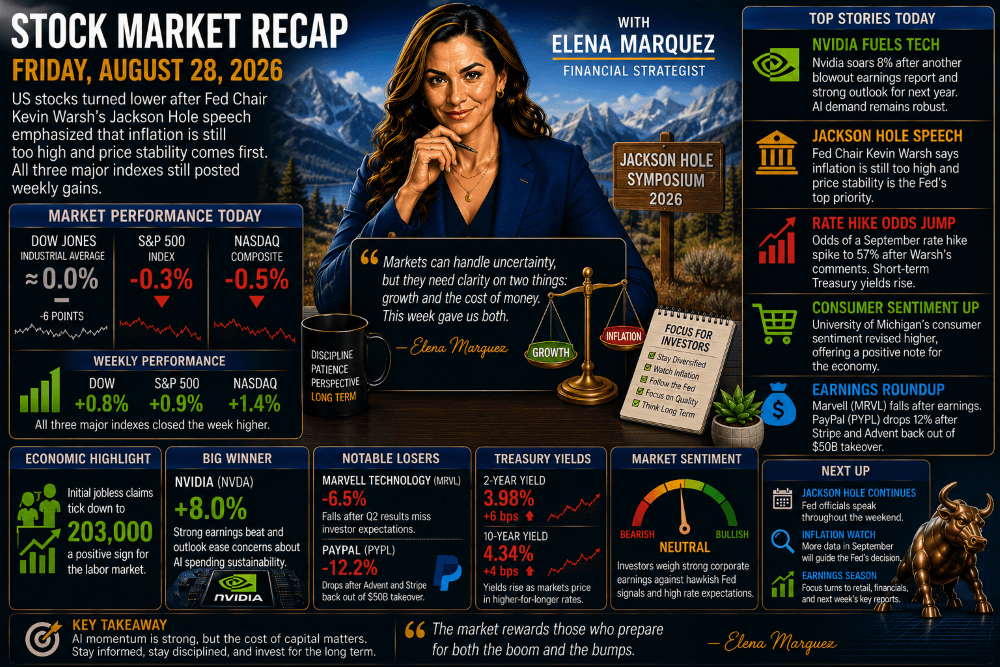
Wall Street ended Friday on a cautious note after Federal Reserve Chair Kevin Warsh delivered his first keynote address at Jackson Hole.
Investors interpreted Warsh’s message as mildly hawkish. His emphasis on inflation and price stability pushed expectations for a September interest-rate hike sharply higher, reversing an early stock-market rally.
Still, there’s good news: all three major indexes finished the week higher.
Market Performance
- ➖ Dow Jones Industrial Average: roughly flat
- 📉 S&P 500: -0.3%
- 📉 Nasdaq Composite: -0.5%
The Nasdaq had been up as much as 0.5% earlier in the session before reversing course.
Kevin Warsh Sends a Message: Inflation Comes First
The most important event of the day happened in Jackson Hole, Wyoming.
Fed Chair Kevin Warsh used his first keynote address at the annual central-banking gathering to emphasize that inflation remains too high and that restoring price stability will be the Federal Reserve’s predominant focus.
That was enough to move markets.
Following the speech, market-implied odds of a September interest-rate hike jumped to approximately 57%.
Short-term Treasury yields also moved higher.
Warsh didn’t necessarily promise a rate hike. But investors clearly heard something important:
The Fed isn’t ready to declare victory over inflation.
That’s significant after Wednesday’s core PCE report showed annual underlying inflation holding at 3.3%—well above the Fed’s 2% target.
Why Wall Street Didn’t Like the Message
Markets have been wrestling with two competing economic narratives.
On one side, there are reasons for the Fed to remain patient.
The labor market has softened. Retail sales have weakened. Housing activity has slowed. Consumers have become more cautious.
But the other side of the equation is inflation.
Energy prices remain elevated, government borrowing remains enormous, and underlying inflation continues running above target.
Warsh appears to be signaling that the second problem deserves priority.
For stock investors, that matters because higher interest rates increase the cost of capital and make expensive growth stocks somewhat less attractive.
That helps explain why the Nasdaq went from +0.5% earlier in the day to -0.5% by the close.
Nvidia Keeps the AI Story Alive
The market is also still digesting Nvidia’s blockbuster earnings report from Wednesday.
Nvidia delivered exactly what AI bulls wanted to see: strong results, strong guidance and evidence that demand for AI infrastructure remains robust.
That helped technology stocks rally Thursday.
Friday, however, provided an interesting reminder that even extraordinary corporate growth doesn’t exist in isolation.
Nvidia can deliver phenomenal results.
AI spending can continue growing.
But if interest rates rise, financing the hundreds of billions of dollars required to build data centers becomes more expensive.
That’s why the AI story and the interest-rate story are increasingly connected.
Marvell Shows That Nvidia Isn’t Everyone
Not every semiconductor company is enjoying Nvidia-like enthusiasm.
Marvell Technology fell following its second-quarter results, providing another reminder of how demanding investors have become with AI-related companies.
Wall Street is no longer rewarding every company simply because it has exposure to artificial intelligence.
Expectations matter.
Valuations matter.
And increasingly, investors want evidence that AI spending translates into sustainable revenue and cash flow.
Nvidia passed that test this week.
Other companies may find the bar considerably harder to clear.
PayPal Plunges More Than 12%
One of Friday’s biggest individual losers was PayPal.
Shares fell more than 12% following news that Advent and Stripe had backed away from a proposed $50 billion takeover.
The decline illustrates how quickly acquisition speculation can become embedded in a stock price.
Once investors begin pricing in the possibility of a takeover premium, removing that possibility can produce a painful adjustment.
PayPal investors are now back to evaluating the company primarily on its underlying business fundamentals.
Consumers Are Feeling Slightly Better
There was one encouraging economic development Friday.
The University of Michigan revised its consumer sentiment reading higher.
That’s welcome after several recent indicators suggested Americans were becoming increasingly pessimistic about the economy.
But one improved reading doesn’t erase the broader trend.
Consumers continue facing expensive gasoline, accumulated inflation and elevated borrowing costs.
Retail earnings have repeatedly shown that shoppers are increasingly searching for bargains—even among higher-income households.
The consumer is still spending.
But spending remains selective.
A Winning Week Despite Friday’s Decline
Perhaps the most important perspective is that Friday’s sell-off didn’t derail the broader week.
All three major indexes finished the week higher.
That’s impressive considering everything investors had to absorb:
Nvidia earnings.
Persistent inflation.
Jackson Hole.
U.S.-Canada trade tensions.
Iran sanctions.
High Treasury yields.
And continued concerns about the enormous cost of building AI infrastructure.
The market bent.
It didn’t break.
The Bottom Line
This week gave investors answers to two enormously important questions.
First:
Is AI demand still strong?
Nvidia answered emphatically: yes.
Then came the second question:
Is the Federal Reserve ready to relax its fight against inflation?
Kevin Warsh’s answer sounded much closer to: not yet.
And that’s the tension that could define markets heading into September.
Corporate earnings remain strong.
AI investment remains extraordinary.
Consumers are still spending.
But the cost of money remains high—and could potentially go higher.
For investors, that means the bull market still has fuel.
It may simply have to climb a steeper hill.
Other Stock Market blog posts