| 📊 Alain’s Holdings — August 26, 2026 | ||||
|---|---|---|---|---|
| Symbol | Name | Price | Change | Change % |
| VOO | Vanguard S&P 500 ETF | 704.20 | +0.18 | +0.03% |
| QQQ | Invesco QQQ Trust | 711.37 | +0.65 | +0.09% |
| XIU.TO | iShares S&P/TSX 60 ETF | 54.41 | -0.49 | -0.89% |
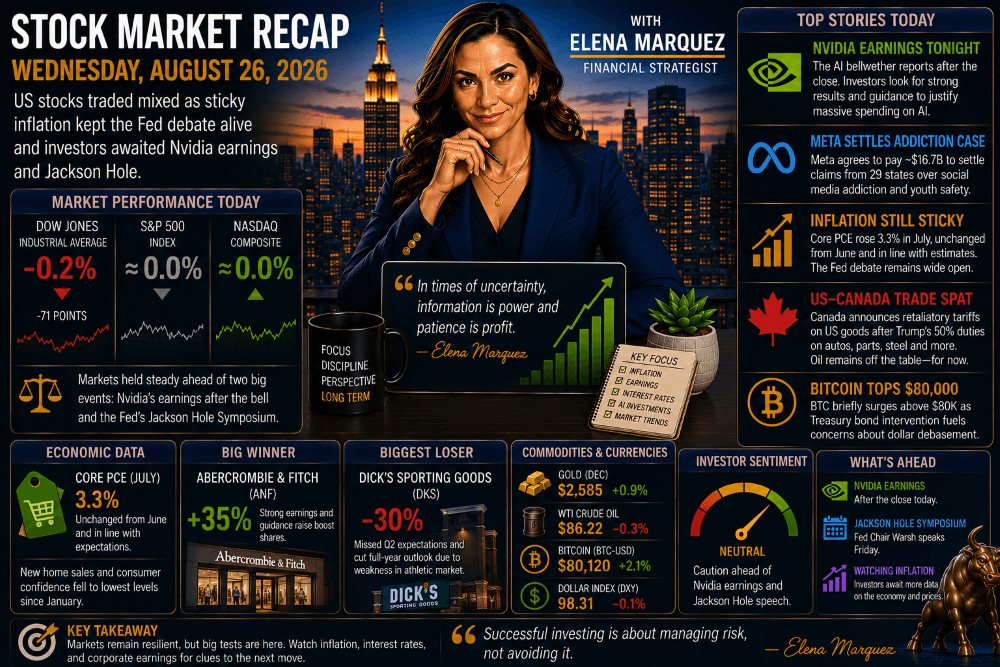
Wall Street finished mixed Wednesday as investors confronted two of the biggest questions hanging over the market: Is inflation still too high for the Federal Reserve, and can Nvidia continue justifying the extraordinary expectations surrounding artificial intelligence?
The Fed’s preferred inflation gauge provided no clear answer on interest rates, while Nvidia’s highly anticipated earnings report loomed after the closing bell.
Market Performance
- 📉 Dow Jones Industrial Average: -0.2%
- ➖ S&P 500: roughly flat
- ➖ Nasdaq Composite: roughly flat
After Tuesday’s broad rally, investors appeared reluctant to make big moves before Nvidia’s results and the Federal Reserve’s Jackson Hole gathering.
Inflation Is Still Stubborn
Wednesday’s most important economic report was the Personal Consumption Expenditures Price Index, the Federal Reserve’s preferred inflation measure.
Core PCE, which excludes volatile food and energy prices, rose 3.3% year over year in July, unchanged from June and in line with expectations.
That’s not terrible news.
But it’s not particularly good news either.
Inflation isn’t accelerating—but it also isn’t moving convincingly toward the Fed’s 2% target.
And that creates a problem.
Recent economic data has shown consumers becoming more cautious, housing weakening, retail sales declining and the labor market softening.
Normally, those would all argue for easier monetary policy.
But 3.3% core inflation makes cutting rates difficult and keeps the possibility of another rate hike alive.
Nvidia: The Earnings Report Everyone Is Waiting For
After today’s closing bell comes perhaps the most important earnings report of the quarter:
Nvidia.
At this point, Nvidia isn’t simply another large technology company reporting earnings.
It has become something close to a quarterly referendum on the entire AI investment boom.
The question is no longer whether demand for artificial intelligence is growing.
Clearly it is.
The question is whether the hundreds of billions of dollars being spent on chips, data centers, electricity and other AI infrastructure will ultimately produce sufficient returns.
That’s why Nvidia’s guidance may matter even more than its quarterly results.
Wall Street wants evidence that demand remains strong enough to support this enormous investment cycle.
And expectations are extremely high.
A good quarter might not be good enough.
The AI Trade Faces a Different Test
This earnings season has revealed an interesting change in investor psychology.
Earlier in the AI boom, companies were rewarded simply for announcing massive AI investments.
Now Wall Street is asking:
Where are the profits?
Alphabet, Meta, Microsoft, Amazon and others are committing extraordinary amounts of capital to AI infrastructure.
Investors increasingly want to understand when that investment will generate meaningful free cash flow.
Nvidia sits at the center of that spending cycle.
If Nvidia reports exceptional demand, it could reassure investors that the AI build-out remains healthy.
If demand shows signs of slowing, the effects could extend far beyond Nvidia itself.
Semiconductors, memory manufacturers, data-center operators, utilities, power-equipment companies and other AI-related stocks could all react.
Jackson Hole Is the Other Big Event
Immediately after Nvidia comes another potential market mover: Jackson Hole.
Fed Chair Kevin Warsh will deliver a closely watched speech about the outlook for monetary policy.
Today’s PCE report makes his job more difficult.
Inflation remains above target.
Consumers are weakening.
The labor market has softened.
Oil remains expensive.
And long-term Treasury yields have recently reached levels not seen in years.
The Fed therefore has to balance two very different risks.
Raise rates too aggressively and it could further weaken economic growth.
Remain too patient and inflation could become entrenched above 2%.
Investors will listen carefully for any indication of which risk Warsh considers more dangerous.
Abercrombie & Fitch Surges 35%
One of Wednesday’s biggest individual winners came from a decidedly non-AI corner of the market.
Abercrombie & Fitch surged approximately 35% after raising its financial guidance.
The move is particularly interesting given recent concerns about consumer spending.
Retail earnings have been sending mixed signals.
Walmart has warned that shoppers are making trade-offs.
DICK’S Sporting Goods plunged after cutting its outlook.
Value-oriented retailers have generally performed better.
Yet Abercrombie’s results demonstrate that consumers haven’t simply stopped spending.
Strong brands can still persuade people to open their wallets.
Meta Settles Its Addiction Case
Meta also attracted attention after agreeing to settle litigation brought by U.S. states concerning allegations about social-media addiction and young users.
The reported settlement totaled roughly $16.7 billion.
Despite the enormous figure, Meta shares moved higher.
That reaction suggests investors may value the reduction of a major source of legal uncertainty more than the immediate financial cost of settling the case.
For a company Meta’s size, removing a potentially unpredictable legal overhang can itself have considerable value.
The Bottom Line
Wednesday was a waiting game.
Inflation didn’t provide enough improvement to settle the Federal Reserve debate.
Stocks barely moved.
And investors avoided making large bets ahead of two potentially market-moving events.
First comes Nvidia.
Then comes Jackson Hole.
One will tell us more about the health of the artificial intelligence boom.
The other will tell us more about the future price of money.
Those two forces—AI profits and interest rates—have become deeply intertwined.
Building the AI economy requires enormous amounts of capital.
And the higher interest rates remain, the more expensive that capital becomes.
For months, investors have been asking whether AI can transform the economy.
Tonight, Nvidia faces a more immediate question:
Can AI generate enough money to justify what we’re spending on it?
Other Stock Market blog posts