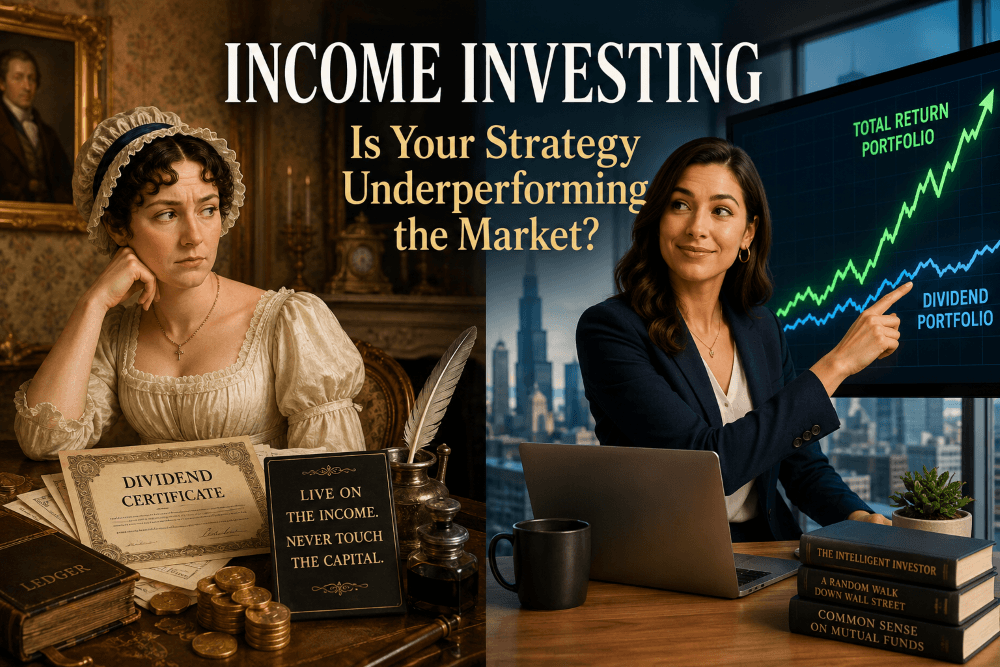
Income investing sounds like the perfect retirement strategy: build a large portfolio, collect the dividends and interest, and never touch the principal.
There is something psychologically comforting about that idea. Your investments produce income, you spend the income, and your pile of money remains safely intact.
Jane Austen would understand perfectly.
In Austen’s novels, wealth was often measured by the annual income an estate could produce. A gentleman might be described as having £5,000 or £10,000 a year, and everyone immediately understood his economic position.
The capital itself was almost sacred.
Two hundred years later, many investors still think the same way.
But I believe we should ignore Jane Austen when managing a modern investment portfolio.
The objective shouldn’t necessarily be to protect every dollar of principal, or to inviest primorially in dividend/interest producing securities. The objective should be to maximize the usefulness of our money during our lifetime.
Why Income Investing Feels So Safe
There are good reasons why people like income investing.
Imagine retiring with a $1 million portfolio producing $40,000 per year in dividends and interest.
You could tell yourself:
“I will spend the $40,000 and never touch my $1 million.”
That feels sustainable.
It also eliminates a difficult psychological decision. You don’t have to ask yourself every year how many shares you should sell.
The dividends simply arrive in your brokerage account.
But this distinction between income and capital is partly psychological.
A dollar received as a dividend and a dollar obtained by selling a small portion of an investment are still dollars.
What ultimately matters is your total return.
The Biggest Problem With Income Investing: Opportunity Cost
This is where strict income investing can become expensive.
Some of America’s most successful companies historically paid small dividends or no dividends at all during important periods of their growth.
A company may earn enormous amounts of money and decide that instead of distributing those profits to shareholders, it can create more value by:
- reinvesting in the business,
- acquiring competitors,
- developing new products,
- expanding internationally,
- paying down debt, or
- buying back its own shares.
If you automatically reject a great company because it doesn’t pay a 4% dividend, you may be eliminating some of the best businesses from your portfolio.
The investor should ask:
“What investment is most likely to produce the best risk-adjusted total return?”
Not:
“Which investment sends me the biggest check every quarter?”
Those are very different questions.
Dividends Are Not Free Money
This is something many investors misunderstand.
Suppose a company is worth $100 per share and distributes $4 per share to shareholders.
That $4 did not magically appear.
The company had $4 of cash that belonged to its shareholders, and now that money has left the company.
In economic terms, you now have approximately:
$96 of stock + $4 of cash.
Of course, actual stock prices fluctuate continuously for many other reasons, but the basic principle remains: a dividend is a transfer of value, not free money.
This is why I don’t understand the almost religious attachment some investors have to dividends.
I like dividends.
I just don’t worship them.
Income Investing Can Require a Huge Portfolio
There is another problem.
You need a lot of money to live exclusively from investment income.
Imagine you want $60,000 per year from your portfolio.
At a 3% yield, you need:
$2,000,000
At a 4% yield, you need:
$1,500,000
At a 5% yield, you need:
$1,200,000
And that is before considering taxes, inflation and fluctuations in dividend payments.
Someone with a $1 million portfolio might therefore conclude that retirement is impossible because the portfolio “only” produces $30,000 or $40,000 of income.
But why should that person refuse to spend some of the capital?
That money was accumulated for a purpose.
You Are Allowed to Spend Your Money
This is where my philosophy differs from traditional income investing.
If I spend decades saving and investing money, I don’t necessarily want to die with the entire portfolio untouched, in fact, I want to die with zero.
What would be the point?
Money is stored purchasing power. Eventually, some of that purchasing power should be used.
A retiree with a diversified portfolio can potentially fund retirement through a combination of:
- dividends,
- bond interest,
- Social Security,
- pensions or other income, and
- periodic sales of investments.
Selling shares is not necessarily a sign that your retirement plan has failed.
It can be part of the plan from the beginning.
How I plan my spending
I use artificial intelligence to calculate my monthly budget. Each month, I provide my favorite chatbot with the following details:
- Net Worth: The total value of my portfolio
- Target Age: 100 years
- Current Age: My present age
- Expected Market Return: 6% annually
The Goal: Calculate the exact amount I can spend each month to hit “die with zero.”
The AI gives me the target figure, and I repeat this exercise every month to keep my spending on track.
Total Return Investing Gives You More Choices
Suppose Portfolio A generates a 4% dividend and appreciates 2%.
Its total return is approximately 6%.
Portfolio B generates a 1% dividend and appreciates 7%.
Its total return is approximately 8%.
Which portfolio would you rather own?
A strict income investor may prefer Portfolio A because it produces four times as much cash income.
I would rather look at the entire picture.
With Portfolio B, I can collect the 1% dividend and sell some shares when I need additional money.
I have effectively created my own dividend.
This is sometimes called a homemade dividend.
What About Social Security?
For American retirees, Social Security already provides something resembling an income-producing asset.
Social Security benefits generally arrive every month and are adjusted periodically for inflation through cost-of-living adjustments.
That changes the retirement-income equation.
Suppose a retired couple needs $80,000 per year and receives $40,000 from Social Security.
Their investment portfolio doesn’t necessarily need to generate $40,000 in dividends.
It needs to provide approximately $40,000 of additional spending power.
That money can come from dividends, interest and capital gains.
The source matters less than whether the overall financial plan is sustainable.
High Dividend Yields Can Be Dangerous
There is another trap in income investing: chasing yield.
A stock yielding 8%, 10% or 12% can look irresistible.
But sometimes the yield is high precisely because investors believe the dividend is in danger.
Imagine a company paying a $5 annual dividend.
When its stock trades at $100, the yield is 5%.
But suppose serious problems emerge and the stock falls to $50.
Suddenly the yield appears to be 10%.
Did the investment become twice as attractive?
Probably not.
The market may be anticipating that the company will reduce its dividend.
Look Beyond the Dividend Yield
When evaluating a dividend-paying company, I would look at several factors.
Dividend payout ratio: How much of the company’s profits are being distributed?
Free cash flow: Is the company actually generating enough cash to fund the dividend?
Debt: Is the company borrowing heavily while simultaneously paying shareholders?
Dividend history: Has management maintained or increased the dividend through difficult economic periods?
Business quality: Most importantly, is this actually a good company?
A mediocre business doesn’t become a wonderful investment simply because it has a large dividend yield.
Bonds Have a Place Too
If your objective really is predictable income, bonds may sometimes make more sense than dividend stocks. I have written serveral times about how much I hate the idea of investing in bonds, but I don admit that it gives peace of mine to some investors.
U.S. Treasury securities, high-quality corporate bonds and diversified bond funds can provide income without requiring investors to chase questionable dividend stocks.
Of course, bonds have their own risks.
Interest rates change. Bond prices fluctuate. Corporate issuers can default. Inflation can reduce the purchasing power of fixed payments.
There is no magical asset that provides high income, high growth, perfect safety and zero volatility.
Investing always involves trade-offs.
Share Buybacks Changed the Income Investing Equation
American companies also increasingly return capital to shareholders through share repurchases.
Instead of paying shareholders a $5 billion dividend, for example, a company might use $5 billion to buy back its own stock.
That reduces the number of shares outstanding.
If the business remains equally valuable, each remaining shareholder owns a slightly larger percentage of it.
The shareholder receives no immediate check in the mail, but value has still been returned to shareholders.
Again, focusing exclusively on dividends can cause us to miss the bigger picture.
Income Investing Still Has a Place
None of this means dividend investing is bad.
I own investments that pay dividends, and I am perfectly happy when those payments arrive. Most of my investment are in broad based ETFs, more precisely VOO and XIU. Although the goal of those ETF is not necessarily to invest in dividend paying stocks, there are some dividend paying stocks in those portfolio and thus the reason why I receive dividend payments every three months.
Dividend-paying companies can provide diversification, and mature profitable businesses often return cash because they simply don’t have enough attractive opportunities to reinvest all their profits.
That can be perfectly sensible.
My objection is to building an entire financial philosophy around one arbitrary rule:
Never touch the principal.
Why not?
It is your money.
Jane Austen Was Investing in a Different World
Jane Austen lived from 1775 to 1817.
Her characters lived in a society where inherited estates could produce income across generations. Preserving capital made enormous sense because the estate wasn’t necessarily considered personal retirement savings.
It represented family wealth.
Modern investors face a completely different financial system.
We have index funds, ETFs, retirement accounts, Social Security, publicly traded companies, global diversification and extremely liquid financial markets.
We can sell $2,000 worth of an ETF with a few clicks.
Elinor Dashwood couldn’t.
Trying to manage a 21st-century retirement portfolio according to the financial customs of Georgian England seems unnecessarily restrictive.
Jane Austen understood human nature brilliantly.
I am less convinced we should take retirement advice from her characters.
The Goal Is Not Income. The Goal Is Financial Freedom.
This is the distinction that matters most.
Investment income is not the objective.
Financial freedom is the objective.
Dividends can help you achieve it. Interest can help. Social Security can help. Capital appreciation can help. Selling investments can help.
What matters is whether your assets can sustainably finance the life you want.
If you spend your entire retirement terrified of touching your principal, you may eventually discover something ironic.
You spent your whole life accumulating money you were afraid to spend.
Jane Austen’s landed gentry needed to preserve the family estate.
You don’t.
Your portfolio should serve your life—not the other way around.
Frequently Asked Questions
Is income investing a good retirement strategy?
Income investing can be part of a retirement strategy, but relying exclusively on dividends and interest may unnecessarily restrict your investment choices. A total-return strategy considers income, capital appreciation and withdrawals together.
Is it bad to sell stocks during retirement?
No. Selling investments can be a normal part of a well-designed retirement withdrawal strategy. The important question is whether your withdrawal rate and asset allocation are sustainable over your expected lifetime.
What is the difference between income investing and total return investing?
Income investing focuses primarily on dividends and interest. Total return investing considers all sources of investment return, including dividends, interest and capital appreciation.
Are high-dividend stocks safer?
Not necessarily. An unusually high dividend yield can sometimes indicate financial trouble or expectations that the dividend will be reduced. Investors should examine cash flow, earnings, debt and the overall quality of the business.
Other personal finance blog posts