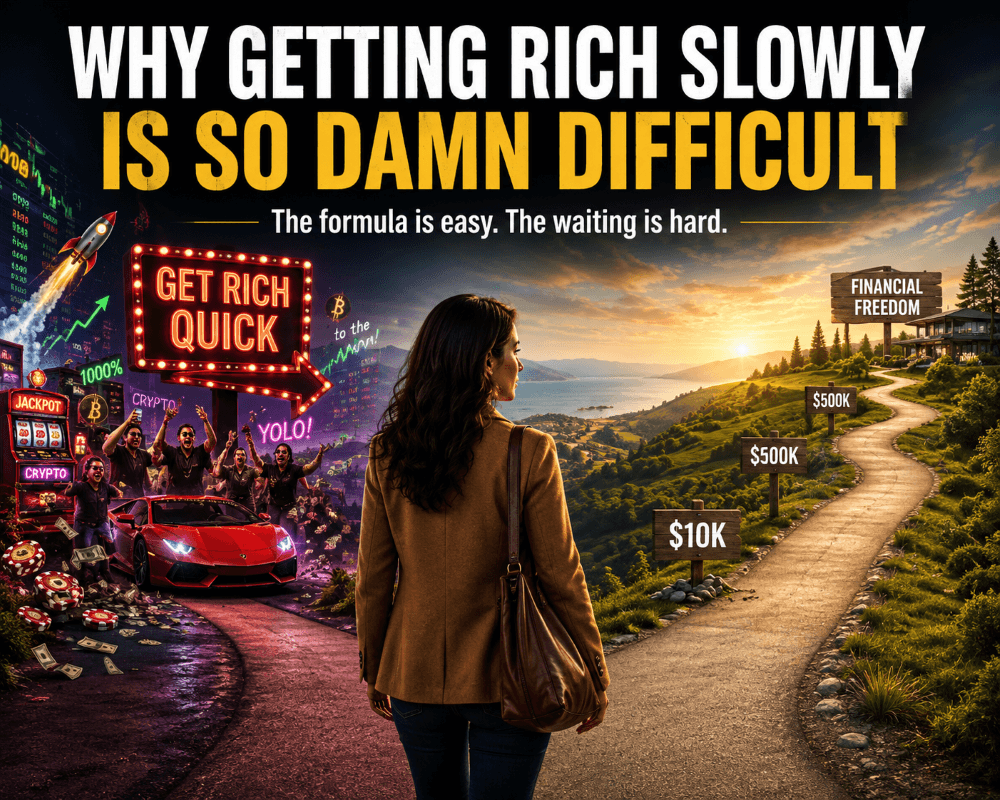
Getting rich slowly might be one of the simplest financial strategies ever invented.
Earn money. Spend less than you earn. Invest the difference. Keep doing it for decades. You can put all your money in the S&P 500 and just watch it grow over time.
That’s basically it.
There are no secret formulas. You don’t need to predict the next recession, discover the next Nvidia, trade options, flip houses, or spend your evenings staring at candlestick charts.
Yet getting rich slowly is incredibly difficult.
Not because the mathematics are complicated.
Because waiting is difficult.
Getting Rich Slowly Is Boring
Imagine you are 25 years old and decide to invest $500 every month.
After the first month, you have $500.
Nothing exciting happens.
Next month you invest another $500.
Still nothing exciting happens.
You continue doing this while one friend buys a beautiful new car. Another travels around Europe. Someone on social media claims to have made $100,000 trading crypto.
Meanwhile, you’re buying an index fund.
Again.
And again.
And again.
There is no applause.
There are no Instagram photos.
Nobody at a dinner party is impressed when you say:
“I automatically contributed another $500 to my retirement account this month.”
That’s the fundamental problem with getting rich slowly.
For a very long time, it doesn’t feel like you’re getting rich at all.
Compounding Is Back-Loaded
Compound interest has an annoying characteristic: most of the magic happens near the end.
Suppose you have $20,000 invested and earn 6% in a year.
Your money produces about:
$1,200.
Nice, but hardly life-changing.
Now imagine you’ve accumulated $100,000.
At 6%, your money produces:
$6,000.
At $500,000:
$30,000.
At $1 million:
$60,000.
Suddenly something extraordinary has happened.
At the beginning of your investing journey, you were building your portfolio.
Eventually, your portfolio starts building itself.
But reaching that crossover point can take decades.
That’s why so many people quit before the interesting part begins.
Warren Buffett’s Secret Weapon Was Time
Warren Buffett is obviously an extraordinary investor. His ability to evaluate businesses, allocate capital and remain rational while other investors panic contributed enormously to his success.
But Buffett has enjoyed another tremendous advantage:
time.
Buffett bought his first stock at age 11 in 1942. He later joked that he had gotten a “very slow start” by waiting until 11.
Think about what that means.
Buffett has been investing for more than eight decades.
In 1999, when someone asked how to replicate his success, Buffett’s first advice was simply: “Start young.” He compared compound interest to a snowball rolling down a very long hill.
His investing skill mattered enormously. But so did the length of the hill.
Consider Berkshire Hathaway itself. During the first 50 years after Buffett’s management took control, Berkshire’s per-share book value grew at a compounded annual rate of 19.4%.
That is an extraordinary rate of return.
But combine an extraordinary return with 50 years of compounding, and the results become almost difficult to comprehend.
This is one of the most overlooked lessons from Buffett’s success.
We focus on which companies he bought.
We study Coca-Cola, American Express, Apple and his famous acquisitions.
But perhaps one of Buffett’s greatest investing decisions was much less exciting:
He kept going.
Year after year.
Decade after decade.
He allowed boring compound interest to do its work.
The World Keeps Offering You Shortcuts
Unfortunately, while you are getting rich slowly, somebody is always promising to help you get rich quickly.
There’s always something.
Crypto.
Options.
Day trading.
Penny stocks.
Hot technology stocks.
Leveraged real estate.
Some new investment strategy that supposedly makes traditional investing obsolete.
Occasionally, someone really does become rich quickly.
That’s precisely what makes the temptation so powerful.
You hear about the person who bought Bitcoin early. You hear about the trader who turned $20,000 into $2 million.
You rarely hear from the thousands of people who tried similar strategies and lost their money.
Getting rich slowly has terrible marketing.
Getting rich quickly sells courses.
Your Neighbors Look Richer Than You
There is another psychological problem.
Wealth is mostly invisible.
You can see someone’s Porsche.
You cannot see their Vanguard account.
You can see their $15,000 vacation.
You cannot see that someone else quietly invested $15,000.
This creates a strange illusion.
The person consuming wealth often looks richer than the person accumulating it.
Imagine two people earning $100,000 per year.
One spends $98,000.
The other spends $65,000 and invests $35,000.
Who looks richer?
Probably the first person.
Who is becoming richer?
Almost certainly the second.
Getting rich slowly requires accepting that sometimes you will look poorer than people who actually have less money than you.
That’s psychologically difficult.
Markets Occasionally Punish Good Behavior
Then there are market crashes.
You spend ten years diligently investing.
Your portfolio reaches $300,000.
You’re proud of yourself.
Then the stock market falls 30%.
Suddenly you’ve “lost” $90,000 on paper.
Ten years of responsible behavior appears to have been punished.
This is when getting rich slowly becomes emotionally difficult.
The temptation is to sell.
But long-term investing requires doing something profoundly unnatural:
You must remain calm while everyone around you is panicking.
Sometimes you must continue buying the very asset everyone else is desperately trying to sell.
Lifestyle Inflation Is the Silent Wealth Killer
There is another enemy that receives less attention.
As people earn more money, they frequently spend more money.
The $40,000 lifestyle becomes a $60,000 lifestyle.
Then $80,000.
Then $120,000.
The house gets bigger.
The car gets nicer.
Restaurants become more expensive.
Vacations become more elaborate.
None of these things are necessarily bad.
Money exists partly to improve our lives.
But if every increase in income produces an equal increase in spending, wealth never gets the opportunity to compound.
The secret isn’t necessarily extreme frugality.
It is allowing some of your income growth to become investment growth instead of lifestyle growth.
The First $100,000 Feels Almost Impossible
This is why building the first meaningful chunk of wealth can feel so frustrating.
When you have little capital, nearly everything depends on you.
You have to work.
You have to save.
You have to make sacrifices.
Your money contributes almost nothing.
But eventually the relationship changes.
Your investments start earning thousands.
Then tens of thousands.
Eventually, a sufficiently large portfolio can produce more in an average year than you could reasonably save from your salary.
That is when compounding stops feeling theoretical.
It becomes a partner.
Getting Rich Slowly Requires Doing Almost Nothing
Perhaps this is the strangest part.
We associate success with action.
Work harder.
Move faster.
Make decisions.
Find opportunities.
Do something!
But successful long-term investing frequently requires the opposite.
Don’t panic.
Don’t chase the hot stock.
Don’t sell because of scary headlines.
Don’t completely change your strategy every six months.
Don’t try to predict every recession.
Don’t compare yourself with your neighbor.
Just keep investing.
There is tremendous psychological difficulty in doing almost nothing while everyone around you appears to be doing something.
Boring Can Be Beautiful
Imagine investing $1,000 every month for 40 years and earning an average 7% annual return.
You would personally contribute:
$480,000.
But the portfolio would grow to roughly:
$2.6 million.
About $2.1 million would come not from your contributions, but from investment growth.
That is the extraordinary power of getting rich slowly.
Nothing dramatic needed to happen.
There was no lottery ticket.
No inheritance.
No miraculous stock pick.
Just thousands of ordinary decisions repeated over a very long period.
The Formula Isn’t Difficult. The Waiting Is.
Getting rich slowly requires an unusual skill.
The ability to tolerate boredom.
You have to keep investing when markets are exciting, frightening, expensive, cheap, euphoric and depressing.
You have to watch other people get rich faster than you.
Occasionally, you’ll have to watch them get poor again.
You have to accept that for many years your financial progress might be nearly invisible to everyone except you.
And perhaps most difficult of all, you have to trust your future self enough to give that person money you could spend today.
Warren Buffett didn’t become Warren Buffett because of compound interest alone. He combined extraordinary investing ability with discipline, intelligence and excellent capital allocation.
But he also gave compounding something it desperately needs:
time.
More than 80 years of it.
Getting rich slowly isn’t complicated.
Earn.
Save.
Invest.
Wait.
Repeat.
The formula isn’t difficult.
The waiting is.
Frequently Asked Questions
What does getting rich slowly mean?
Getting rich slowly means accumulating wealth gradually by consistently saving and investing over many years rather than relying on speculation, leverage or get-rich-quick strategies. Compound returns become increasingly powerful as your portfolio and investment horizon grow.
How does compound interest help you become wealthy?
Compound interest allows you to earn returns not only on your original investment but also on previous investment gains. Over long periods, those gains can eventually represent a much larger portion of your wealth than the money you personally contributed.
How long did Warren Buffett invest?
Warren Buffett bought his first stock at age 11 in 1942. His extraordinarily long investing career demonstrates why time can be such a powerful ingredient in compounding wealth.
Can an average person get rich slowly?
It is possible to accumulate substantial wealth through consistent long-term investing, although results depend on income, savings, investment returns, taxes, fees and time. The key advantage ordinary investors can exploit is not necessarily superior stock-picking ability but decades of consistent saving and compounding.
Other personal finance blog posts