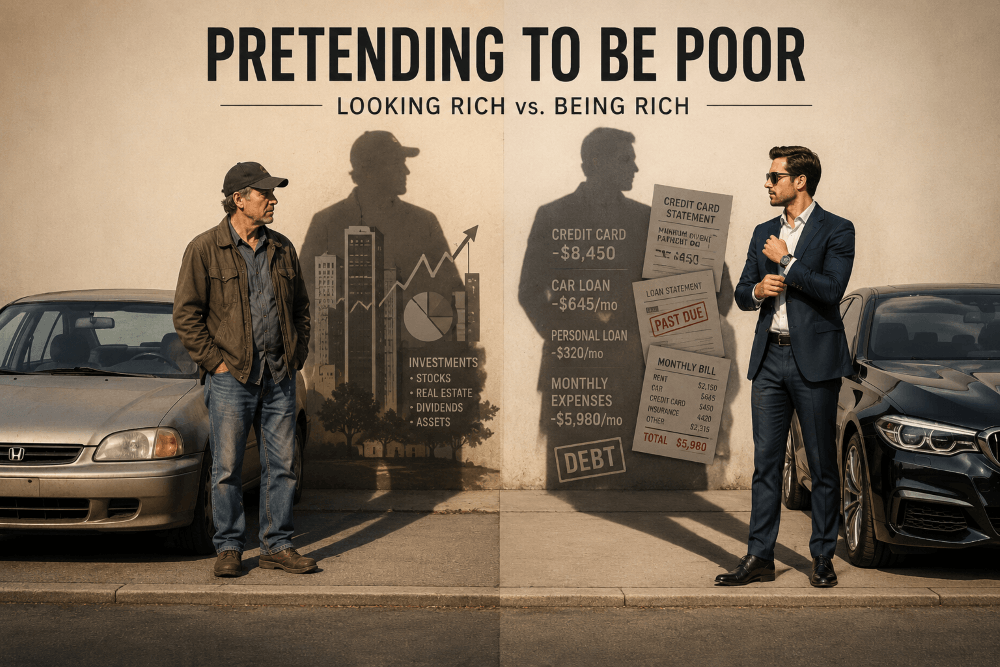
There is a strange paradox about money that I have noticed throughout my life:
Some rich people pretend to be poor, while some poor people pretend to be rich.
The person driving the old Toyota may have a million-dollar investment portfolio. Meanwhile, the person driving the brand-new luxury SUV may be struggling to make the monthly payments.
Appearances can be deceiving.
People who have accumulated wealth often feel less need to display it. They may live in ordinary houses, wear inexpensive clothes, drive their cars for 15 years, and rarely talk about money.
People who don’t have much money sometimes do the opposite. They buy expensive clothes, finance luxury cars, upgrade their phones, and spend money they don’t have to project an image of success.
Of course, these are generalizations. Plenty of wealthy people enjoy luxury, and plenty of people with modest incomes are careful with their money.
But the contradiction raises an interesting question:
Why would a rich person want to look poor—and why would someone without money want to look rich?
What Does “Pretending to Be Poor” Mean?
Pretending to be poor doesn’t necessarily mean lying about your income or telling people you have no money.
Usually, it is much subtler.
A wealthy person may simply choose not to advertise their wealth.
They might:
- Drive an older car even though they could easily afford a new one.
- Live in a modest house.
- Avoid designer clothing and expensive watches.
- Fly economy.
- Rarely discuss their investments or net worth.
- Continue looking for bargains.
- Keep using things long after they could afford to replace them.
Some people call this stealth wealth.
But I don’t think everyone who behaves this way is actually pretending.
Sometimes people who have money simply don’t feel the need to prove that they have it.
Two Wealthy People Who Taught Me This Lesson
I’ve seen this behavior firsthand.
One of my former landlords owned more than 100 properties.
If you met him on the street, you would never have guessed it. He dressed simply, lived modestly, and didn’t behave like the stereotypical rich person.
I have also taught dance to a man whose family fortune was worth more than $100 million.
He became a friend.
Again, you would never know from looking at him that he has extraordinary wealth. He didn’t need to walk into a room and prove his financial status to everyone.
These experiences taught me something important:
Having money and looking like you have money are two completely different things.
Why Do Rich People Pretend to Be Poor?
There isn’t one explanation. Different people have different motivations.
1. They Don’t Need to Impress Anyone
When you’re trying to establish your status, symbols can become important.
The right car, house, watch, clothes, restaurant, or vacation can communicate:
“I’m successful.”
But once someone becomes financially secure, that signal may become less important.
If you know that you have $2 million invested, does it really matter whether the stranger beside you at the traffic light knows?
True financial security is invisible.
Your brokerage account doesn’t make noise when you enter a room.
2. Spending Less Helps Them Stay Rich
There is also a mathematical explanation.
Every dollar you spend is a dollar you cannot invest.
Someone who earns $150,000 and spends $150,000 isn’t building much wealth.
Someone who earns $100,000 and spends $60,000 has $40,000 available to save and invest.
Repeat that process for 10, 20, or 30 years and the difference can become enormous.
Ironically, some of the behaviors that make a person look less wealthy are precisely the behaviors that can make them become more wealthy.
3. Wealth Creates Privacy Concerns
There are advantages to people not knowing how much money you have.
Visible wealth can attract unwanted attention.
Friends and relatives may ask for loans. Salespeople may try harder to sell you expensive products. People may make assumptions about what you should pay for. Some relationships can even change once money enters the equation.
Keeping wealth private can make life simpler.
4. They Have Learned What Doesn’t Make Them Happy
Buying something expensive can be exciting.
But the excitement often fades quickly.
The tenth luxury purchase doesn’t necessarily provide ten times the happiness.
Many people eventually discover that what they value most isn’t another expensive object. It may be independence, time, relationships, travel, meaningful work, or simply the freedom to wake up in the morning without worrying about money.
That leads to an important distinction.
Pretending to Be Poor Is Not the Same as Being Frugal
If a millionaire drives a 15-year-old Honda, is he really pretending to be poor?
Maybe not.
Perhaps he simply doesn’t care about cars.
If his Honda works perfectly well, replacing it might provide almost no additional happiness.
This is where frugality differs from deprivation.
Frugality isn’t about refusing to spend money.
It’s about spending money intentionally on the things you value and refusing to waste it on the things you don’t.
A wealthy person might drive an old car but spend $20,000 traveling every year.
Another might live in a modest house but happily spend thousands on restaurants.
Someone else might spend almost nothing because financial independence itself is what gives them satisfaction.
None of these people is necessarily pretending to be poor.
They simply aren’t using consumption to advertise their wealth.
Why Do Poor People Pretend to Be Rich?
Now let’s look at the opposite side of the paradox.
Why would someone struggling financially spend money trying to look wealthy?
Because human beings care about status.
We compare ourselves with other people.
We see the neighbor’s new car.
A coworker goes to Europe.
Someone posts photos from an expensive restaurant.
A friend buys the latest iPhone.
Social media has intensified this enormously because we are constantly exposed to carefully selected images of other people’s lifestyles.
The temptation is to keep up.
The problem is that we see the consumption but rarely see the balance sheet.
The person driving the $70,000 vehicle might be a millionaire.
Or they might have a $1,200 monthly car payment.
You can’t tell by looking at the car.
Pretending to Be Rich Can Keep You Poor
This is where appearances become financially dangerous.
Looking rich costs money.
Being rich requires keeping some of it.
Suppose you earn an extra $10,000.
You could use it to upgrade your lifestyle. A nicer vacation. More expensive clothes. A newer car.
People might perceive you as being more successful.
Or you could invest the $10,000.
Nobody notices.
There are no compliments.
There are no Instagram photos.
There is nothing impressive to show your neighbors.
But that invisible $10,000 can produce dividends, interest, and capital appreciation for decades.
That’s the strange thing about building wealth:
Much of the process is invisible and boring.
I Didn’t Earn a Lot of Money—But I Saved Relentlessly
This subject is personal to me.
I spent most of my life earning a relatively low income.
I wasn’t a high-powered executive. I didn’t receive an enormous salary. I didn’t build a billion-dollar technology company.
But I did something much less exciting:
I saved relentlessly.
I lived below my means and invested the difference.
I did it year after year.
After about 25 years, something interesting happened.
The capital I had accumulated began earning more money than I could earn through my labor.
That changed my relationship with work.
I no longer needed to exchange all of my time for money because money I had saved years earlier was now working for me.
That’s one of the great lessons of personal finance.
You don’t necessarily need to look rich.
You need to accumulate assets.
The Difference Between Looking Rich and Being Rich
Imagine two people.
Person A earns $200,000 per year. They drive a luxury vehicle, live in an expensive house, take elaborate vacations, and spend almost everything they earn.
Net worth: $50,000.
Person B earns $80,000. They drive an old car, live in a modest home, buy ordinary clothes, and consistently invest 20% of their income.
Net worth: $800,000.
Who is richer?
If you saw them at a restaurant, you might guess Person A.
Their balance sheets would tell you otherwise.
Income is not wealth. Consumption is not wealth. Appearance is not wealth.
Wealth is what remains after years of earning, saving, investing, and compounding.
Stop Trying to Look Rich
If you’re tired of being poor, one of the first things you can do is stop spending money trying to convince other people that you’re not.
You don’t need to pretend to be poor.
You don’t need to pretend to be rich either.
Forget the performance altogether.
Instead, concentrate on the fundamentals:
Earn more when you can.
Spend less than you earn.
Avoid high-interest consumer debt.
Save consistently.
Invest in productive assets.
Give those investments time to compound.
And don’t worry too much about whether strangers think you’re successful.
There is an old idea expressed in Proverbs 13:7:
Some people pretend to be rich but have nothing, while others pretend to be poor but possess great wealth.
Human nature apparently hasn’t changed much.
Thousands of years later, we are still playing the same status game.
But you don’t have to participate.
I’d rather have an old car and a large investment account than an expensive car and a large monthly payment.
Don’t try to look wealthy. Build wealth.
Frequently Asked Questions
Why do rich people pretend to be poor?
Some wealthy people deliberately avoid displaying their wealth because they value privacy, don’t feel a need to impress others, or prefer saving and investing over conspicuous consumption. Others aren’t actually pretending to be poor—they simply live modestly despite having substantial assets.
What does pretending to be poor mean?
Pretending to be poor generally means appearing to have less money than you actually have. This might include driving an inexpensive car, wearing ordinary clothing, living modestly, or avoiding discussions about wealth. It is sometimes referred to as stealth wealth.
Why do people pretend to be rich?
People may try to appear richer because of social status, peer pressure, insecurity, or the desire to signal success. Social media can amplify this behavior by constantly exposing people to other people’s consumption and lifestyles.
How can I stop being poor and start building wealth?
There is no guaranteed formula, but the fundamentals are straightforward: increase your income when possible, spend less than you earn, control high-interest debt, consistently save and invest the difference, and allow your investments time to compound. Building genuine wealth usually takes years rather than appearing overnight.
Other Personal Finance Posts