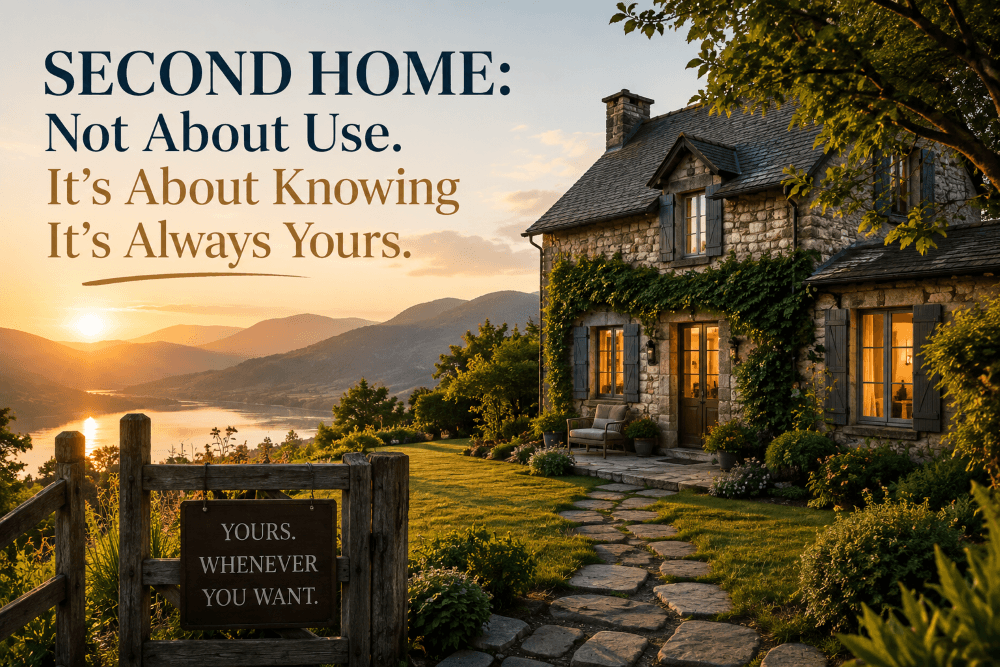
A second home is one of those purchases that often makes very little financial sense—and yet millions of people dream of owning one.
Think about a country house, a cottage by a lake, a condo in Florida, or a little apartment in Paris. You might use it a few weekends a year and perhaps a few weeks during the summer.
The rest of the time, it sits empty.
Financially, you would probably be better off staying in a nice hotel or Airbnb whenever you want to get away. You could travel to different places, avoid maintenance, and probably spend less money.
And yet, given enough money, many of us would still prefer to own the house.
Why?
I think the answer has less to do with real estate and more to do with a very human desire: we want something that is ours and ours alone.
A Second Home Is Often a Terrible Financial Investment
Let’s start with the numbers.
Imagine buying a $500,000 country house that you use 30 days per year.
You have tied up half a million dollars in a property that remains empty more than 90% of the time.
And the purchase price is only the beginning.
There are:
- Property taxes
- Insurance
- Electricity and heating
- Repairs
- Furniture
- Landscaping
- Cleaning
- Renovations
- Transportation to and from the property
- The opportunity cost of the money invested in the house
Put that same $500,000 into an investment earning 6% annually, and theoretically it could generate about $30,000 per year before taxes.
You can stay in some very nice hotels and Airbnbs for $30,000.
And you don’t have to fix the roof.
Airbnb Has Made Second Homes Even Harder to Justify
Years ago, there was a stronger practical argument for owning a vacation property.
If you wanted to spend every summer in a particular village or every winter near a particular ski resort, finding a good rental wasn’t always easy.
Today, platforms such as Airbnb and other vacation-rental services have dramatically increased our choices.
Want a cabin in the mountains?
Rent one.
Want a house beside a lake?
Rent one.
Want to spend a month in Italy?
Rent an apartment.
The beauty of renting is that next year you can go somewhere completely different.
Owning a second home, on the other hand, can create a strange obligation.
You bought it, so you feel that you should use it.
Suddenly, instead of asking, “Where would I like to go this summer?” you start asking, “When are we going to the country house?”
The asset that was supposed to give you freedom can end up limiting your freedom.
Then Why Do We Want a Second Home?
Because financial efficiency isn’t everything.
There is something emotionally satisfying about arriving at a house and knowing that nobody else has slept in your bed, moved your furniture, used your kitchen, or left their belongings in the closet.
You don’t have to make a reservation.
You don’t have to check availability.
You don’t have to read reviews.
You don’t have to wonder whether the beautiful Airbnb photos are misleading.
You simply arrive.
The key is certainty.
Your place is waiting for you.
The Luxury Is Not the House. It’s Availability.
I think this is the part we often underestimate.
When someone buys a second home, they’re not merely buying square footage, land, or a beautiful view.
They’re buying permanent availability.
Imagine that you love spending weekends in a particular mountain village.
You could rent a house whenever you visit. That would probably be cheaper.
But what happens on the most beautiful weekend of the year?
Everything might be booked.
What happens during Christmas?
Prices might triple.
What happens when you suddenly decide on Thursday afternoon that you want to leave Friday morning?
Your favorite rental might not be available.
With your own house, none of that matters.
You have effectively purchased a permanent reservation.
The house says:
Whenever you want me, I’m here.
That has value, even if it is difficult to put into a spreadsheet.
Exclusivity Is Part of What We’re Buying
There is another element that makes a second home appealing: exclusivity.
Human beings place enormous emotional value on things that belong exclusively to us.
“My house.”
“My chair.”
“My bedroom.”
“My garden.”
“My view.”
A hotel suite might be much more luxurious than your country house, but you know that someone else slept there yesterday and someone else will sleep there tomorrow.
An Airbnb might have a better view and a nicer kitchen.
But it isn’t yours.
There is something deeply satisfying about leaving your toothbrush in the bathroom, your favorite bottle of wine in the kitchen, your books beside the bed, and your old sweater hanging behind the door.
You can return six months later and everything is still there.
The second home becomes an extension of your primary home.
We Don’t Always Buy Things Because They Make Financial Sense
Personal finance discussions sometimes make the mistake of assuming that every decision should maximize financial returns.
But money is ultimately supposed to buy things we value.
A swimming pool rarely makes financial sense.
Neither does a luxury car.
Neither does flying business class.
Neither does eating at an expensive restaurant when we could cook at home.
We willingly sacrifice financial efficiency for comfort, pleasure, convenience, status, memories, and control.
A second home belongs in the same category.
The mistake isn’t buying one.
The mistake is pretending that it is necessarily a great investment when the real reason for buying it is emotional.
A Second Home Can Become an Expensive Chore
There is also a downside to having a place permanently waiting for you.
It requires attention even when you’re not there.
The roof leaks.
The grass grows.
The plumbing freezes.
A tree falls.
The refrigerator stops working.
Property taxes arrive whether you spent six months there or six days.
Hotels have maintenance problems too, of course. The difference is that they’re someone else’s problems.
If the air conditioning breaks in your hotel room, you call reception.
If the air conditioning breaks at your country house, you call a technician—and pay the bill.
That’s one of the great luxuries of staying in hotels and Airbnbs: you temporarily enjoy the asset without assuming all the responsibilities of ownership.
Renting Gives You Variety; Ownership Gives You Familiarity
This may be the fundamental trade-off.
Renting gives you variety.
Ownership gives you familiarity.
With Airbnb and hotels, you could spend this summer in the mountains, next summer at the beach, and the following year traveling through Europe.
Your money buys flexibility.
With a second home, you return to the same place again and again.
But maybe that’s precisely what you want.
You learn where the sunlight comes through the windows in the morning. You know the best place to buy bread. You know your neighbors. You have your favorite walking route.
Over time, the property accumulates memories.
Children grow up spending summers there.
Friends visit.
Traditions develop.
Eventually, the house isn’t simply a piece of real estate.
It becomes part of the family’s history.
That is something an Airbnb can never completely reproduce.
When Does a Second Home Make Sense?
I don’t think the right question is simply whether a second home is a good investment.
A better question is:
What exactly are you buying?
If your objective is inexpensive vacations, buying a second property might be a poor solution.
If your objective is maximizing investment returns, there may be much better places for your capital.
If your objective is exploring the world, ownership might actually get in your way.
But if what you want is a place that is permanently yours—a place where you can leave your clothes, books, furniture and memories—then the calculation changes.
You’re purchasing certainty, familiarity, privacy, control, and exclusivity.
Those things have economic value even though they’re difficult to measure.
The Rich Don’t Have to Choose
There is also an interesting wealth dimension to this question.
For most people, money forces a choice.
Should I buy the country house or use that money to travel?
Should I own a beach condo or invest the money?
But as people become wealthier, the financial inefficiency matters less.
Someone with $500,000 might reasonably worry about putting $300,000 into a vacation property.
Someone worth $50 million probably doesn’t care very much whether the beach house produces an adequate financial return.
At that level, efficiency is no longer the primary objective.
The ability to say, “That place is mine whenever I want it,” becomes the luxury.
Perhaps that’s why wealthy people often own several homes despite spending relatively little time in each one.
They aren’t buying utilization.
They’re buying optionality.
The Real Value of Owning a Place You Don’t Use
From a purely financial perspective, owning a second home that sits empty most of the year can look absurd.
Hotels and Airbnbs can be cheaper, more convenient, and more flexible.
But humans don’t live inside spreadsheets.
Sometimes we want the inefficient option precisely because it gives us something efficiency cannot provide.
We want to open a door with our own key.
We want our books exactly where we left them.
We want to decide on Friday afternoon that we’re going to the country house without checking whether someone else booked it first.
Most of all, we want to know that somewhere out there is a little piece of the world reserved exclusively for us.
Maybe that’s what a second home really is.
Not a place we need to use all the time, but a place we want to know is always there.
Frequently Asked Questions
Is owning a second home worth it?
It depends on why you want it. Financially, renting hotels or vacation properties can often be cheaper. A second home can still be worthwhile if you highly value familiarity, availability, privacy, and having a permanent place of your own.
Is Airbnb cheaper than owning a second home?
For people who vacation only a few weeks per year, renting can often be more economical because ownership includes taxes, insurance, maintenance, repairs and the opportunity cost of the capital invested in the property.
Is a second home a good investment?
A second home can appreciate in value, but appreciation isn’t guaranteed. It should be evaluated separately as an investment and as a lifestyle purchase rather than assuming that owning real estate automatically makes it a good investment.
Why do people buy vacation homes they rarely use?
People aren’t necessarily buying them for frequent use. They may value guaranteed availability, privacy, familiarity, exclusivity and the emotional satisfaction of having a place that belongs entirely to them.