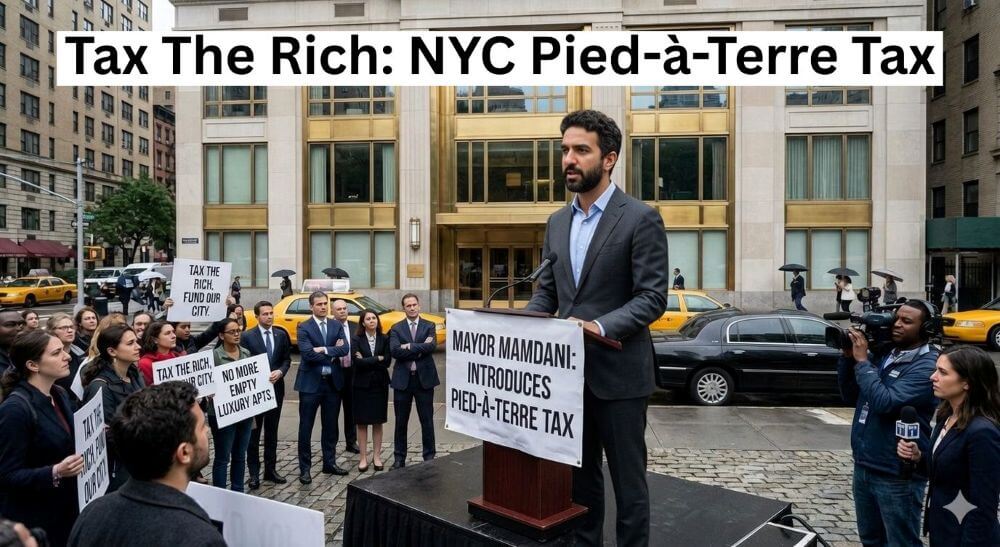
New York is at it again. The latest proposal — a NYC pied-à-terre tax — would impose an annual surcharge on second homes valued at $5 million or more, owned by people whose primary residence is outside the five boroughs. Mayor Zohran Mamdani and Governor Kathy Hochul announced the measure on April 15, 2026, projecting it will raise $500 million per year.
It sounds like a win. It is not.
This is another chapter in a long story of fiscal mismanagement dressed up as social justice. And like every previous chapter, it will end the same way: fewer wealthy taxpayers, less revenue, and a city wondering where everyone went.
The NYC Pied-à-Terre Tax Is a Political Statement, Not a Solution
Let’s be honest about what this is. This is not a serious budget strategy. This is a soundbite.
New York City is facing a $5 billion budget gap. Rather than asking hard questions about spending, the political class reaches for the easiest target: wealthy people who don’t vote in city elections.
The proposal targets non-resident owners of luxury properties — people who, by definition, already live somewhere else. The message couldn’t be clearer: You are not welcome here. Now pay up.
That is not how you run a great city.
What Wealthy Property Owners Actually Contribute
Before we celebrate taxing the “global elites,” let’s look at what these property owners actually bring to New York City.
- They pay enormous property taxes — already among the highest in the country — on properties they use only part of the year.
- They spend money — in restaurants, hotels, shops, and cultural institutions every time they visit.
- They maintain luxury buildings, employing doormen, superintendents, cleaners, and maintenance staff.
- They bring capital — real estate investment at the high end supports construction jobs, architect fees, and the broader property market.
- They use almost no city services — no public schools, minimal infrastructure strain, no welfare benefits.
Think about that last point. These are people who contribute far more than they consume. Driving them away doesn’t just lose the pied-à-terre tax — it loses everything else they bring with them.
New York Is Already One of the Highest-Tax Jurisdictions in the World
New York City residents already pay:
- Federal income tax — up to 37%
- New York State income tax — up to 10.9%
- New York City income tax — up to 3.876%
- Mansion taxes on high-value property purchases
- Transfer taxes on real estate sales
- Some of the highest property taxes in the nation
At what point is enough, enough?
The pied-à-terre tax is not being proposed because the wealthy aren’t paying their share. It’s being proposed because New York cannot control its spending — and someone has to foot the bill.
As Margaret Thatcher once wisely observed: “The problem with socialism is that eventually you run out of other people’s money.”
New York is getting very close to that point.
Florida Is Rolling Out the Red Carpet
While New York adds new taxes, Florida is doing the opposite.
Florida has no state income tax. No city income tax. Lower property taxes. Better weather. And a government that does not treat wealth as a moral failure.
The migration is already happening. Thousands of high-net-worth individuals and financial firms have relocated to Miami, Palm Beach, and other Florida cities over the past decade. Goldman Sachs, Citadel, and countless hedge funds have moved operations south.
What New York Gets Wrong That Florida Gets Right
- Florida welcomes wealth creators. New York taxes them into exile.
- Florida’s cost of living is lower at every level.
- Florida’s political climate is stable and business-friendly.
- Florida doesn’t lecture wealthy people about inequality every time they try to invest.
New York’s response to this exodus? More taxes. More rhetoric. More chasing away the people who pay the bills.
The Avoidance Problem — And Why This Tax Won’t Work
Even setting aside the moral argument, the NYC pied-à-terre tax simply won’t deliver what it promises.
Here is what wealthy property owners will actually do:
- Declare their NYC unit as a primary residence to avoid the surcharge — putting them in a lower tax bracket elsewhere.
- Sell the property outright, removing it from the tax rolls entirely.
- Stop buying in New York — dampening a high-end market that generates massive transfer tax and mansion tax revenue on each transaction.
- Move their spending to other cities where their money is appreciated.
The city projects $500 million in revenue. The real number could be a fraction of that — and the knock-on damage to real estate markets, construction, and retail could cost far more.
The Bigger Problem: New York Refuses to Manage Its Budget
Every time New York faces a fiscal crisis, the answer is the same: find someone new to tax.
But the structural problem never gets addressed. The city’s spending keeps growing. The bureaucracy expands. Unfunded pension obligations balloon. And the political class pats itself on the back for “taxing the ultra-wealthy” while the real issues go untouched.
A serious city would ask:
- Why is the budget gap $5 billion in the first place?
- Where is the money going?
- What services can be delivered more efficiently?
- How do we attract more taxpayers, not drive them away?
These are not the questions being asked. Instead, we get press conferences about pied-à-terre taxes and banners reading “Tax the Rich.”
New York Needs to Change Its Relationship With Wealth
Here is the uncomfortable truth: New York City needs wealthy people more than wealthy people need New York City.
A Boston executive with a Manhattan pied-à-terre has options. A foreign investor with a Midtown condo has options. They can sell tomorrow and find somewhere warmer, cheaper, and more welcoming.
New York, on the other hand, cannot easily replace those tax dollars, that property maintenance, that spending, or that capital investment.
The city’s attitude toward wealth — this culture of resentment, of treating success as exploitation — is its single biggest fiscal threat. Not the pied-à-terre owners. Not the hedge funds. The attitude.
The golden geese are already flying south. New York can tax them on the way out, or it can give them a reason to stay.
The choice should be obvious.
FAQ: NYC Pied-à-Terre Tax
Q: What exactly is the NYC pied-à-terre tax? A: It is a proposed annual surcharge on one- to three-family homes, condominiums, and co-ops in New York City valued above $5 million, where the owner’s primary residence is outside the five boroughs. Announced April 15, 2026 by Mayor Mamdani and Governor Hochul, it is projected to raise $500 million per year — though critics dispute this figure.
Q: Will wealthy people actually leave New York because of this tax? A: Many already have. The pied-à-terre tax accelerates a trend already underway. High-net-worth individuals have been relocating to Florida, Texas, and other low-tax states for years. This tax gives non-resident property owners one more reason to sell and stop spending in New York.
Q: Can wealthy property owners avoid the pied-à-terre tax? A: Yes, fairly easily. The most common strategies include declaring the NYC property as a primary residence, selling the unit outright, or simply not purchasing New York real estate going forward. Each of these outcomes reduces, not increases, the city’s tax revenue overall.
Q: Is New York’s budget problem really a spending problem? A: The numbers suggest yes. New York City’s budget has grown dramatically over the past decade, with spending on administration, pensions, and social programs outpacing economic growth. A $5 billion gap is a symptom of structural spending excess, not insufficient taxation of second-home owners.
Mamdani is very dumb
Socialist NYC Mayor’s War on the Rich Will Devastate Working-Class New Yorkers
New York City Mayor Zohran Mamdani is proving once again that socialist “tax the rich” schemes are nothing but economic self-sabotage.
In a stunt outside Ken Griffin’s $238 million Central Park penthouse, Mamdani declared “we’re taxing the rich” while pushing a pied-à-terre tax on luxury second homes.
John LeFevre rightly called it out: “Mamdani declaring war on Ken Griffin proves how obtuse, fanatical, or simply dumb he is.”
Citadel employs roughly 5,000 people in NYC, with mean compensation around $2 million and median about $400,000. If Griffin decides to relocate to low-tax Miami, the fallout would be brutal.
As LeFevre warned, it “would be catastrophic for the New Yorkers Mamdani claims to champion – bars, restaurants, small businesses, support jobs, etc… not to mention philanthropy, secondary/spillover spending, and the obvious tax revenue hit.”
While Griffin continues investing in the city with a major Park Avenue tower, Mamdani’s fanatical policies risk chasing away the very wealth that funds the bars, restaurants, and jobs his voters rely on. History shows high taxes drive the productive out – just look at what happened in Chicago. New Yorkers will be the ones left holding the bag.
What do you think? Is the pied-à-terre tax a fair contribution from the ultra-wealthy, or is New York making another costly mistake? Leave your comment below.