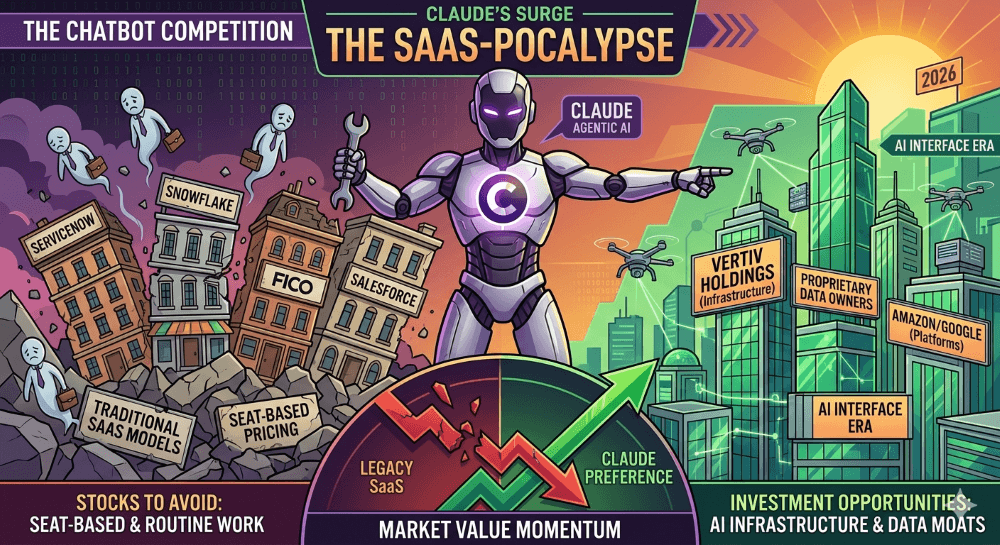
The global chatbot competition has entered a volatile new phase in 2026. While ChatGPT once held an undisputed monopoly on our attention, a massive shift in user intent is currently reshaping the tech landscape.
Recent data suggests that Claude, developed by Anthropic, is seeing a surge in professional adoption. This isn’t just a battle for “cool” features; it is the catalyst for a structural market event known as the SaaS-pocalypse.
The Rise of Claude: From Challenger to Leader
Starting in late 2025, the chatbot competition saw a dramatic “cross” in momentum. While ChatGPT’s growth began to plateau at roughly 10%, Claude experienced a sharp increase, with nearly 40% of users reporting they plan to use the platform even more in the coming months.
This shift is driven by Claude’s superior reasoning, its “Artifacts” workspace, and its agentic capabilities. Users are moving away from simple “chatting” and toward “doing,” using Claude to automate complex coding, legal, and financial workflows.
What is the SaaS-pocalypse?
The SaaS-pocalypse refers to the rapid devaluation of traditional Software-as-a-Service (SaaS) companies. For a decade, these companies thrived by charging “per seat” for tools that organized human work.
Now, AI agents can perform that work directly. If an AI agent can manage your IT tickets or analyze your data without a human interface, the need for expensive software licenses evaporates.
Why the “Kiss of Death” is Real
In the financial sector, being labeled “disruptible by Anthropic” has become a red flag for institutional investors. Stocks that rely on routine human data entry or manual workflows are seeing their multiples collapse as AI agents prove they can do the same tasks faster and for a fraction of the cost.
Companies Falling Victim to the Shift
Several established giants are currently in the crosshairs of this transition. Here is how they are being affected:
- ServiceNow (NOW): Their IT and HR workflow dominance is challenged by Claude’s ability to resolve employee tickets autonomously.
- Snowflake (SNOW): As Claude becomes capable of querying raw data directly, the need for high-cost data warehousing and proprietary processing layers is shrinking.
- FICO (FICO): Traditional credit scoring is being challenged by AI models that can analyze real-time financial behavior more accurately than a legacy score.
- Salesforce (CRM): When AI agents can update records and manage leads via desktop automation, the “seat-based” revenue model of a CRM faces an existential threat.
Investor Strategy: Stocks to Avoid and Opportunities to Grasp
Stocks to Approach with Caution
Investors should stay away from “Middleman SaaS”—companies that simply provide a pretty interface for a database. If the primary value of the software is “organizing human tasks,” it is highly vulnerable to Claude’s agentic automation. Specifically, keep a wary eye on companies with high seat-based pricing and low proprietary data moats.
The New Opportunities
The real opportunities lie in the Infrastructure and Proprietary Data layers:
- The “Shovels” of AI: Companies like Vertiv Holdings (VRT), which provide the cooling and power infrastructure for the massive data centers Claude and Gemini require.
- Proprietary Data Moats: Companies that own data that AI needs but cannot freely scrape (e.g., medical journals, legal archives, or specialized financial terminals).
- The Platforms: Major backers of the winners, such as Amazon and Google, who benefit from the cloud consumption of these new AI agents.
FAQ: Understanding the Chatbot Race
What makes Claude different from ChatGPT? Claude focuses on high-level reasoning, larger context windows (memory), and “agentic” features that allow it to perform tasks within a dedicated workspace, whereas ChatGPT remains a versatile general assistant.
How does the SaaS-pocalypse affect regular workers? It shifts work from “performing tasks” to “managing agents.” Workers will spend less time on manual data entry and more time overseeing the AI agents that handle the “plumbing” of their jobs.
Is it too late to invest in AI? No. While the “first wave” (chips and base models) is well underway, the “second wave”—the displacement of legacy software and the rise of AI-native infrastructure—is just beginning.
Previous stock market posts