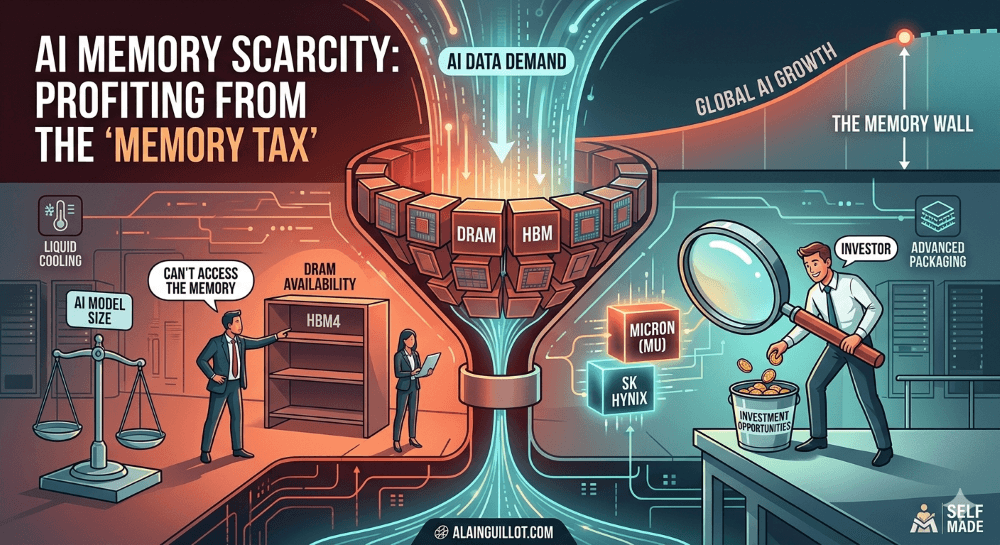
As a long-term investor focused on the “picks-and-shovels” of digital infrastructure, I’ve seen many cycles, but the current landscape is unprecedented. While most people are distracted by the flashiest new AI apps, the real story is happening in the hardware layers.
We have officially hit the “Memory Wall.” In 2026, the primary keyword for any strategic investor isn’t just “AI”—it’s AI Memory Scarcity. This isn’t a temporary supply chain glitch; it is a structural deficit that is imposing a “tax” on every technology company on the planet. If you want to understand where the next wave of wealth is being created, you have to look at the physical bottleneck.
What is the “DRAM Drain”?
DRAM (Dynamic Random Access Memory) is a type of volatile semiconductor memory used as a computer’s main memory (RAM) to temporarily store data for active programs. It is known for high density and low cost per bit, using one transistor and one capacitor per memory cell, requiring constant electrical refreshing to retain data.
The AI Memory Scarcity we are seeing today is the result of a massive architectural mismatch. Modern AI models have grown so large that they require “High Bandwidth Memory” (HBM) to function. Without this specialized memory, even the most powerful GPUs sit idle, waiting for data.
- The Insatiable Appetite: A single high-end AI server now requires up to 10x the memory of a standard server from just three years ago.
- The Supply Gap: As of mid-2026, there is only enough DRAM production to support about 30% of the planned data center builds globally.
- The Pricing Power: Because supply is so tight, manufacturers like Micron and SK Hynix are seeing record-breaking profit margins. They aren’t just selling chips; they are auctioning off the ability for AI to “think.”
Owning the Chokepoints of 2026
As an investor, you don’t chase the crowd; you find the chokepoint and own it. During the Gold Rush, the millionaires weren’t the miners—they were the people selling the shovels. In the 2026 AI rush, the “shovels” are the memory chips.
Why Memory is the New Oil
Memory has transitioned from a boring commodity to a strategic resource.
- Sovereign AI Stockpiles: Countries are now stockpiling high-end memory chips like they used to stockpile petroleum to ensure their national AI projects don’t go dark.
- The Yield Crisis: Manufacturing the latest HBM4 (16-layer stacks) is so complex that nearly 40% of the chips produced are discarded as scrap. This keeps supply low and prices high.
- Thermal Management: Denser memory generates extreme heat. This is why infrastructure plays like Vertiv (VRT) are surging—you cannot have the memory without the liquid cooling systems to keep it from melting.
How to Invest in Scarcity
For a “Lean FIRE” investor or someone focused on intentional living, the goal is to find assets with high “moats.” You want to own the things the world cannot function without.
- The “Core 4” Strategy: Look for the leaders in Chips, Memory, Connectivity, and Power. While my core remains in VOO and QQQ, I am paying close attention to individual “bottleneck” winners.
- Micron Technology (MU): They have moved from a cyclical memory maker to an AI essential. Their 2026 guidance is simple: they will sell every single chip they can physically make.
- Advanced Packaging: Look at the firms that “stack” the memory. Without the advanced packaging tech from companies like TSMC, these memory chips can’t communicate with the processors fast enough.
Summary: Don’t Fight the Tax, Collect It
The AI Memory Scarcity is the defining economic hurdle of 2026. By shifting your perspective from “software hype” to “hardware reality,” you can position your portfolio to benefit from the very bottleneck that is slowing everyone else down.
- Check your exposure: Ensure your tech ETFs have sufficient weighting in the semiconductor equipment and memory sectors.
- Focus on Yields: The companies that can produce these complex chips with the least waste will be the ultimate winners.
- Watch the Infrastructure: As memory stacks get higher, the companies that keep them cool will see consistent, non-negotiable demand.
FAQ: Surviving the Memory Crunch
Why can’t we just build more factories?
A modern “Fab” (chip factory) costs upwards of $20 billion and takes years to build. The capacity we need today should have been started in 2022.
Will this make my next laptop more expensive?
Yes. Analysts expect a “Memory Surcharge” of 15-20% on consumer electronics throughout late 2026.
Is this a good time to buy semiconductor stocks?
While prices are at historical highs, the “sold-out” status of the industry provides a level of revenue certainty we rarely see in the tech sector.
Previous stock market posts