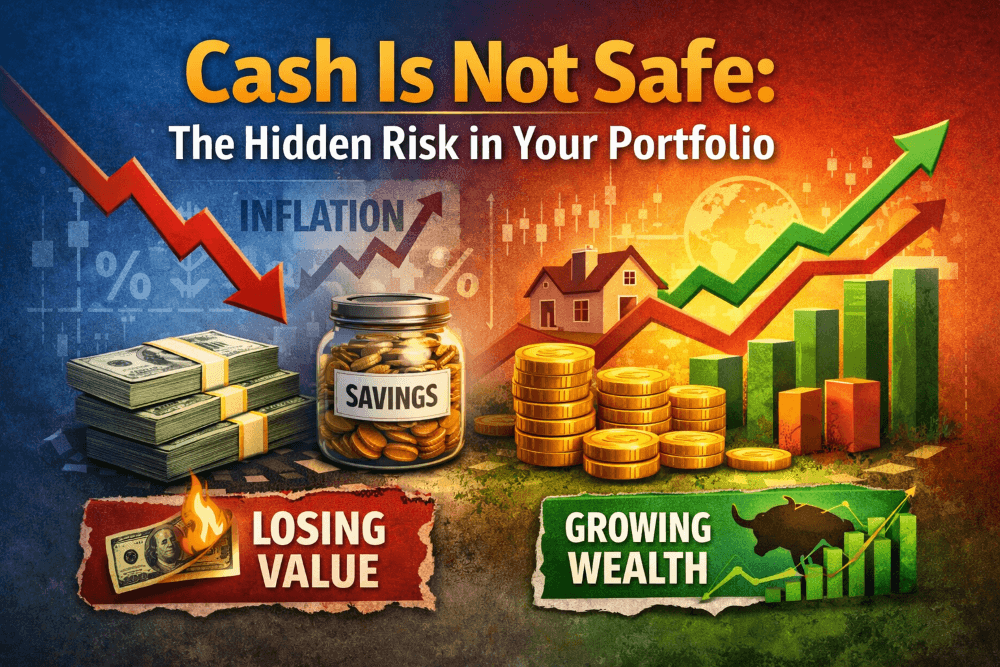
As a person who ofter helps my friends with financies decisions, I’ve always told them that cash is trash, cash is the one thing is a portfolio that is guaranteed 100% to lose value over time.
In general, people think that cahs is safe because it doesn’t fluctuate. It sits quietly in your account. No volatility, no drama. But every day is losing a little bit of value. It’s not visible at the moment, but after a period of time, it becomes obvious.
At one of my meetings with a friend, I remember reviewing his asset allocation: bonds, real estate, equities, private investments. Then we came to cash. Then I saw how much cash he was holding and told him, “This is your most dangerous holding.”
It sounded extreme. It wasn’t.
The Silent Killer: Inflation
The real danger behind the idea that cash is not safe is inflation.
Inflation erodes value slowly but relentlessly. In the United States, inflation has exceeded the Federal Reserve (the Fed) base rate for long stretches over the past decade.
Let’s put that into perspective:
- $10,000 in 2016 now requires roughly $13,900 to maintain the same purchasing power
- That’s nearly a 40% loss in real value if your money sat idle
Even if you earned a modest 2% annually in a high-yield savings account:
- $10,000 becomes about $12,200
- Still below inflation-adjusted reality
Now compare that to investing:
- U.S. broad market (like an S&P 500 index fund): ~$40,000
- Annualized Rate of Return (10 Years): 11.3% – 14.16%
- Total 10-Year Return: Over 250% (approx.
272%)
- Historical Average (Long Term): Approx.
10%-11% annually
The conclusion is simple. Cash preserves nominal value, not real value.
Why Investors Still Hold Too Much Cash
Despite the evidence, many investors behave as if cash is not safe doesn’t apply to them.
Why?
1. Psychological comfort
Cash feels stable. No drawdowns. No headlines.
2. “Waiting for the right time”
Investors hold cash expecting market crashes. They call it “dry powder.”
The problem is execution.
When markets fall, fear increases—not confidence. Some times whey they go back into the market, they lost a big chunk of the market uptrend.
3. Cultural conditioning
People are comfortable leveraging into real estate but hesitant to invest in equities.
Consider this:
- You buy a $400,000 home with $80,000 down
- A 5% drop wipes out 25% of your equity
That’s real risk. Yet people accept it.
4. The news sell fear
The news thrive on fear. When people are afraid, they listen more attentively to the news. Any regular day, if the economic news are bad, then they are magnified. If the news are good, they they seed fear in people hear by claiming that the market might be too expesive and that maybe now is the time to get out.
The Real Cost of Playing It Safe
When you accept that cash is not safe, the implications go beyond your personal portfolio.
For individuals:
- Underfunded retirement
- Loss of purchasing power
- Missed compounding opportunities
For the economy:
- Lower investment in businesses
- Slower productivity growth
- Reduced long-term wealth creation
Risk avoidance has a cost. It just doesn’t show up immediately.
How I Manage the “Cash Is Not Safe” Reality
As an investor, I don’t eliminate cash. I control it.
1. Maintain strategic reserves
Cash is essential for liquidity and emergencies.
- Target: 3 to 6 months of expenses
2. Invest for the long term
If your horizon is over five years, cash should not dominate your portfolio.
3. Just buy the index
To combat the fact that cash is not safe, I allocate to:
- U.S. equities (via index funds like S&P 500 ETFs). I like VOO
- If you are Canadian, buy a canadian index such as XIU.TO or VCN.TO
- If you can tolerate a bit more of volatility buy a techology index such as QQQ
4. Use dollar-cost averaging
If timing worries you:
- Invest monthly
- Remove emotion from the process
The Core Principle
The idea that cash is not safe is uncomfortable, but necessary.
Cash protects you from volatility.
Investments protect you from inflation.
Those are not the same thing.
The best portfolios balance both—but lean toward growth when time is on your side.
FAQ: Cash Is Not Safe
1. Why is cash not safe over the long term?
Because inflation reduces purchasing power, meaning your money buys less over time even if the balance stays the same.
2. How much cash should I hold?
Typically 3–6 months of living expenses for emergencies. Beyond that, long-term capital should be invested.
3. Is investing riskier than holding cash?
In the short term, yes. In the long term, holding cash often carries greater risk due to inflation.
4. What are the best alternatives to cash?
Diversified investments such as equities, bonds, real estate, and commodities provide better long-term protection.
Other personal finance blog posts