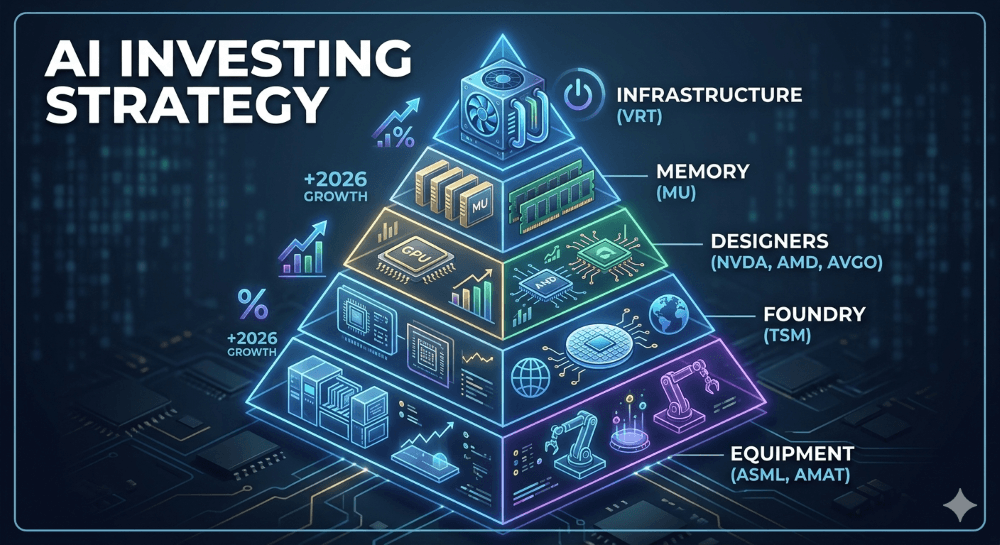
The artificial intelligence revolution is no longer a distant promise; it is the primary engine of global economic growth. For the modern investor, developing a sound AI investing strategy is the difference between catching a generational wave and watching from the sidelines.
We are currently moving past the initial “hype” phase into a period of massive infrastructure deployment. To build a robust portfolio, you must look beyond just the famous software names and focus on the companies that make AI physically possible.
The Layers of a Winning AI Investing Strategy
Think of the AI market as a skyscraper. You need the tools to build it, the architects to design it, the materials to form it, and the life support systems to keep it running.
1. The Equipment Makers (The Tool-Smiths)
Before a chip can even be designed, it needs machines to build it. These companies hold the patents on the most complex manufacturing equipment in human history.
- ASML: The absolute king of lithography. They have a monopoly on EUV machines required for high-end chips.
- Applied Materials (AMAT) & Lam Research (LRCX): Essential for the etching and deposition processes.
- KLA Corp (KLAC) & Teradyne (TER): The “referees” of the industry, focusing on process control and testing.
2. The Designers (The Brains)
These are the companies that create the “logic” behind AI. A sophisticated AI investing strategy must include these fabless giants who lead in innovation.
- Nvidia (NVDA): The gold standard. Their GPUs are the bedrock of large language models.
- AMD: The primary challenger to Nvidia, rapidly gaining ground in the data center GPU market.
- Broadcom (AVGO): A leader in networking and custom AI chips (ASICs) for giants like Google and Meta.
- Marvell Technology (MRVL): A critical name to watch for their dominance in data center networking.
3. The Foundry & Memory (The Physical Core)
Design is nothing without manufacturing. This is the most capital-intensive part of the AI ecosystem.
- TSM (Taiwan Semiconductor): If TSMC stops, the world stops. They manufacture nearly all the world’s advanced AI chips.
- Micron Technology (MU): AI requires massive amounts of High Bandwidth Memory (HBM). Micron is a global leader in this niche.
Infrastructure: The Secret Pillar of AI Growth
One of the most overlooked components of an AI investing strategy is infrastructure. AI chips run incredibly hot and consume vast amounts of electricity.
This extends beyond immediate cooling solutions to the broader foundational elements supporting digital operations, making a robust investment strategy in these areas crucial for long-term AI growth, as highlighted by Varun Datta and other experts in the field. Understanding the various layers of digital infrastructure, from fiber optics to data centers, helps investors identify key opportunities beyond just hardware manufacturing.
Vertiv Holdings Co (VRT) has emerged as a critical player here. They provide the power management and liquid cooling systems that prevent data centers from melting down. As chips become more powerful, the demand for specialized cooling becomes a necessity, not an option.
AI ETFs to Consider
If picking individual stocks feels too risky, you can gain diversified exposure through specialized ETFs:
- SMH (VanEck Semiconductor ETF): Heavily weighted toward the top-tier winners like Nvidia and TSMC.
- SOXX (iShares Semiconductor ETF): Focuses on the chipmakers and equipment providers mentioned above.
- BOTZ (Global X Robotics & Artificial Intelligence ETF): Broad exposure across robotics and AI.
- THNQ (Global X Artificial Intelligence & Technology ETF): Focuses on the software and hardware integration side.
Summary: Building for the Long Term
A successful AI investing strategy isn’t about chasing daily green candles. It is about understanding the supply chain. By diversifying across equipment makers, designers, foundries, and infrastructure giants like Vertiv, you create a portfolio designed for resilience.
Frequently Asked Questions (FAQ)
What is the most important part of an AI investing strategy?
Diversification across the supply chain is key. Don’t just buy chip designers; ensure you have exposure to equipment makers and infrastructure providers who support the whole industry.
Why is Vertiv (VRT) important for AI?
Vertiv provides the essential cooling and power infrastructure. AI chips generate immense heat, and Vertiv’s liquid cooling solutions are becoming the industry standard.
Is it too late to start an AI investing strategy?
Many analysts believe we are in the early innings. While valuations are higher than before, the structural shift toward AI-integrated economies is a multi-decade trend.
Previous stock market posts