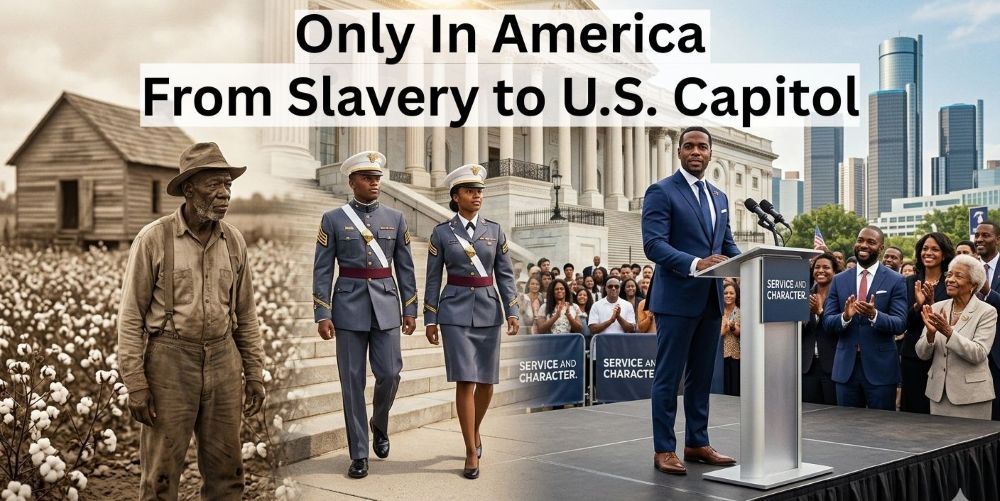
The recent words of Rep. Wesley Hunt have ignited a necessary fire in the national conversation. Hunt, an African American conservative, recently pointed out a glaring truth that many in the political establishment prefer to ignore: “It’s not 1860. It’s 2026.” His message is a powerful testament to the American Dream and a direct challenge to the narrative that the United States is a land of permanent, systemic oppression.
When Hunt speaks of his great-great-grandfather being born into slavery at Rosedown Plantation, he isn’t citing a dry history book—he is citing his own bloodline. Yet, in just a few generations, that same bloodline produced three West Point graduates and a United States Congressman. This trajectory isn’t an anomaly; it is the physical manifestation of what is possible in a nation built on merit rather than caste.
The Soft Bigotry of Low Expectations
The American Dream is often undermined by what many call the “soft bigotry of low expectations.” We see this most clearly in the debate over the Safeguard American Voter Eligibility (SAVE) Act.
Opponents of voter ID laws often argue that such requirements unfairly burden minority communities. This premise is inherently insulting. To suggest that Black Americans or other minorities are incapable of obtaining a government-issued ID is a form of racial superiority disguised as compassion.
As one African American woman recently stated:
“To say that a minority group is somehow not educated enough to get these documents is completely outrageous.”
This perspective aligns with the views of Ohio State Representative Josh Williams. It challenges the idea that minorities need “saviors” in the form of government bureaucrats. Instead, it asserts that the playing field is open to anyone with the will to compete.
Evidence of Success Across Every Sector
If structural racism were the impenetrable wall that some claim it to be, we would not see the heights of success reached by Black Americans today. The American Dream is visible in every industry, from the boardroom to the stars.
Consider these titans of industry and culture:
- Marvin Ellison: CEO of Lowe’s, leading one of the world’s largest retailers.
- Rosalind Brewer: A powerhouse executive who has led major global brands.
- Oprah Winfrey: Rose from extreme poverty to become a multi-billionaire media mogul.
- Jay-Z and Rihanna: Transformed music success into billion-dollar business empires.
- Victor Glover: An astronaut who recently journeyed around the moon, representing the pinnacle of human achievement.
NASA pilot Victor Glover CLAPS back after being asked what it means to be the first black man to visit the moon: “It’s the story of humanity, not black history, not women’s history, but that it becomes human history.”
These individuals didn’t succeed because of a “box they checked.” They succeeded because of their character, their talent, and their refusal to be defined by a victimhood narrative.
Why the “Systemic” Narrative Fails
The narrative that minorities need white progressives to rescue them is not just false; it is a political scheme. By maintaining a state of dependency, certain political factions ensure a loyal voting base in exchange for social goods.
- Individual Agency: Success is driven by the desire to achieve, not by government intervention.
- Universal Opportunity: There is nothing a white person can do that a Black person cannot do in today’s America.
- The Immigrant Perspective: As an immigrant from Colombia, I arrived with no money and no education. Through 25 years of hard work and self-education, I built businesses and retired comfortably.
Charlie Kirk on why White Privilege is a myth
Achieving the American Dream Today
The path to success in 2026 follows a predictable, albeit difficult, set of steps:
- Education: Taking personal responsibility for learning and skill acquisition.
- Service: Whether in the military or the community, service builds character.
- Persistence: Ignoring the voices that tell you the “system” is rigged against you.
The story of the Hunt family—from the chains of a plantation to the halls of Congress—is the ultimate proof. This story doesn’t exist everywhere. It exists here, in the United States. It is time we stop looking through the lens of 1860 and start embracing the power of what this country actually is.
Summary
The American Dream is alive and well for those willing to seize it. The transition from slavery to the highest levels of military and political leadership in a few generations proves that America is not systemically broken. By rejecting the “soft bigotry of low expectations” and embracing meritocracy, every citizen—regardless of race—has the power to define their own future.
FAQ
What is the SAVE Act? The Safeguard American Voter Eligibility (SAVE) Act aims to ensure that only U.S. citizens vote in federal elections by requiring proof of citizenship.
Is structural racism a barrier to the American Dream? While historical challenges exist, the success of Black CEOs, billionaires, and political leaders suggests that individual merit and desire are the primary drivers of success in modern America.
Who is Wesley Hunt? Wesley Hunt is an African American combat veteran, West Point graduate, and U.S. Congressman who advocates for conservative values and individual responsibility.
Other Personal Development Posts