QQQ Holdings
April 17th, 2026
I bought QQQ at 584.44 on April 7. Today, April 17th, it closed at 648.85. That’s a 11.02% return in 10 days.

April 10th, 2026
Off to a good start, I bought QQQ at 584.44 on April 7. Today, April 10th, it closed at 611.07. That’s a 4.7% return in justa few days.

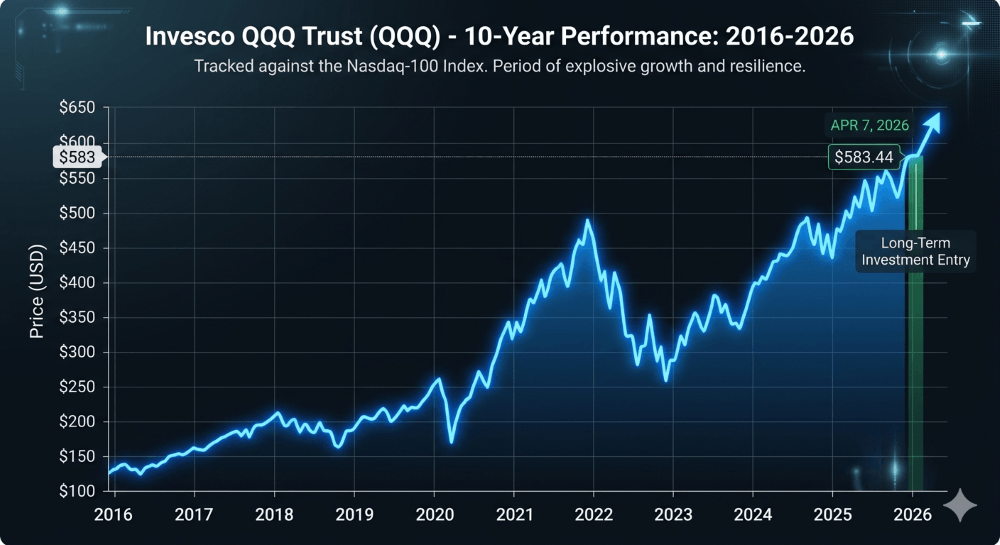
Yesterday, April 7th, 2026, I made a strategic move in my portfolio by purchasing shares of the Invesco QQQ Trust at $583.44. This isn’t a short-term trade or a speculative bet on next week’s headlines. Instead, I am viewing this as a core QQQ long term investment that I plan to hold for at least the next five years. For those who follow my journey on AlainGuillot.com, you know I prioritize efficiency and growth, and QQQ fits that mold perfectly.

What is QQQ?
The Invesco QQQ ETF is one of the most established and widely traded exchange-traded funds in the world. It is designed to track the Nasdaq-100 Index, which includes 100 of the largest non-financial companies listed on the Nasdaq Stock Market.
When you buy QQQ, you aren’t just buying “tech.” You are buying a basket of innovative companies that lead their respective industries. Because the fund excludes financial companies (like banks), it naturally leans toward sectors that drive modern economic growth: technology, consumer services, and healthcare.
What’s Inside QQQ? (2026 Holdings)
A major reason for my QQQ long term investment is the sheer quality of the companies within the fund. As of April 2026, the fund is anchored by the world’s most dominant “innovators.”
Top 10 Holdings Breakdown
The fund is market-cap weighted, meaning the largest companies have the most significant impact on performance. Here is a look at the current heavy hitters:
- NVIDIA (NVDA): ~8.7%
- Apple (AAPL): ~7.6%
- Microsoft (MSFT): ~5.6%
- Amazon (AMZN): ~4.6%
- Tesla (TSLA): ~3.6%
- Alphabet Class A (GOOGL): ~3.5%
- Walmart (WMT): ~3.4%
- Meta Platforms (META): ~3.4%
- Alphabet Class C (GOOG): ~3.2%
- Broadcom (AVGO): ~3.0%
Sector Exposure
While technology accounts for roughly 60% of the fund, you also get significant exposure to:
- Consumer Discretionary: Companies like Amazon and Tesla.
- Healthcare: Innovators in biotechnology and medical devices.
- Telecommunications: Leaders in digital connectivity.
Retelling the Purchase: Why April 7th?
I executed my buy order on April 7th, 2026, at a price of $583.44. The market has seen some volatility recently due to shifting international policies and fluctuating interest rates. However, as an advocate for the “4% rule” and index fund investing, I don’t wait for the “perfect” bottom.
I bought because:
- Innovation is Non-Negotiable: The companies in QQQ spend significantly more on R&D than the average S&P 500 company.
- Historical Outperformance: Over the last 10 years, QQQ has consistently outperformed broader market benchmarks.
- Long-Term Horizon: By committing to a 5-year+ timeline, I can ignore the “noise” of daily price swings.
Strategy for a QQQ Long Term Investment
Investing is as much about psychology as it is about math. Here is how I am managing this position:
- No Market Timing: I bought at $583.44 because the capital was available and the long-term thesis remained intact.
- Automatic Reinvestment: Any dividends produced by the ETF will be rolled back into more shares to leverage compound growth.
- The 5-Year Rule: I will not evaluate the “success” of this trade until 2031.
Investing in QQQ allows me to own a piece of the future without the headache of picking individual stocks. It is the ultimate “set it and forget it” tool for the modern investor.
Summary and FAQ
In summary, my purchase of QQQ at $583.44 is a bet on the continued dominance of large-cap innovators. With a diversified base in tech, healthcare, and retail, this ETF remains a premier choice for growth-oriented investors.
Frequently Asked Questions
1. Is QQQ a good long term investment? Historically, yes. QQQ has provided high double-digit returns over 5 and 10-year periods, though it does carry more volatility than a total market fund like VTI or VOO.
2. What are the fees for QQQ? The expense ratio for QQQ is 0.20%, meaning you pay $2 per year for every $1,000 invested. This is very competitive for an actively managed index.
3. Does QQQ pay dividends? Yes, QQQ pays a small quarterly dividend, though its primary focus is capital appreciation rather than income.
4. What is the difference between QQQ and QQQM? QQQM (Invesco Nasdaq 100 ETF) tracks the same index but has a lower expense ratio (0.15%), making it slightly better for long-term buy-and-hold investors.
Previous stock market posts