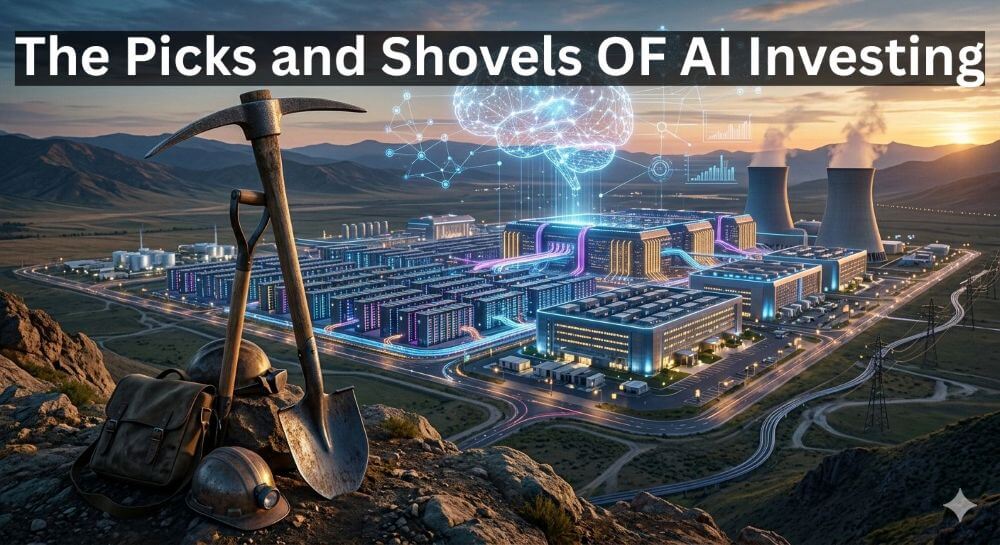
During the 1849 California Gold Rush, most miners went home broke. The people who got rich were the ones selling the picks, shovels, and sturdy denim jeans.
Today, we are seeing a digital gold rush. While everyone is focused on which Large Language Model (LLM) will “win,” savvy investors are looking at the foundational infrastructure. AI investing in the “picks and shovels” layer offers a way to profit from the revolution regardless of which chatbot comes out on top.
The “Picks and Shovels” Rational vs. LLM Stocks
The “picks and shovels” strategy focuses on the hardware, energy, and connectivity required to make AI possible.
If you invest in a specific LLM stock, you are betting on a single horse in a very expensive race. If that company’s model becomes obsolete or fails to monetize, your investment suffers.
By contrast, AI investing in infrastructure means you are betting on the entire race track. Whether OpenAI, Google, or an open-source newcomer wins, they all need chips, cooling systems, and massive amounts of electricity.
1. Data Center Infrastructure & Components
AI requires a physical home. Modern data centers are evolving from simple server rooms into high-performance “AI factories.”
- Vertiv Holdings (VRT): As chips get hotter, cooling becomes critical. Vertiv is a leader in thermal and power management.
- Super Micro Computer (SMCI): They provide the high-performance server racks that house AI chips.
- Arista Networks (ANET): AI models require massive data transfers; Arista provides the high-speed networking gear.
- Astera Labs (ALAB): Often called the “nervous system” of AI, they provide essential connectivity solutions.
- Jabil (JBL): A key manufacturer that benefits as tech giants ramp up infrastructure spending.
2. The Semiconductor Supply Chain
You can’t have AI investing without talking about silicon. Without these chips, the algorithms have no “brain.”
- Taiwan Semiconductor Manufacturing (TSM): The world’s foundry. Almost every advanced AI chip is physically made by TSM.
- Broadcom (AVGO): They specialize in custom chips (ASICs) that help companies like Google build their own hardware.
- Micron Technology (MU): AI requires massive memory (HBM), and Micron is a top-tier supplier.
- ASML Holding (ASML): They make the lithography machines required to print the world’s most advanced circuits.
- Nova (NVMI): They provide the metrology (measuring) tools to ensure chips are perfect during production.
3. Power, Energy, and Utility Infrastructure
As of 2026, the biggest bottleneck for AI isn’t software—it’s electricity. A single AI prompt can consume ten times the energy of a Google search.
- Nuclear Power: Cameco Corp (CCO) is a primary miner of uranium. Nuclear is becoming the go-to for carbon-free, 24/7 data center power.
- Grid Equipment: Eaton Corp (ETN) makes the circuit breakers and power distribution units needed to upgrade the aging electrical grid.
- Generation: GE Vernova (GEV) and Cummins (CMI) lead in turbines and backup power systems.
- The Providers: Vistra Corp (VST) is a major utility meeting the surging demand from hyperscalers.
4. Specialized AI Services & Software
Beyond hardware, specialized software tools are the “blueprints” for the AI era.
- Synopsys (SNPS): They provide the software used to design the very chips that run AI.
- Nebius Group (NBIS): A focused AI infrastructure firm providing specialized GPU computing.
- CoreWeave: While currently private, it represents the shift toward specialized clouds designed specifically for AI workloads.
The Risks and Opportunities of AI Investing
The opportunity is clear: massive capital expenditure (CapEx) from “Hyperscalers” like Microsoft and Meta is flowing directly into these companies. This provides a tangible revenue stream that is often more predictable than software subscriptions.
However, the risks are real. Many “picks and shovels” stocks are trading at high valuations. If Big Tech decides to slow down its infrastructure build-out, these stocks could see significant pullbacks.
Summary
Investing in the infrastructure of AI—from VRT to TSM—allows you to participate in the growth of the entire sector. By focusing on the “must-have” components like energy and semiconductors, you hedge your bets against the volatility of individual AI applications.
Frequently Asked Questions (FAQ)
What are “Picks and Shovels” in AI?
It refers to the companies providing the hardware (chips, servers), energy (utilities, uranium), and software tools (chip design) that enable AI to function.
Is AI investing risky in 2026?
The main risk is “valuation risk.” While the companies are profitable and growing, their stock prices may already reflect several years of future growth.
Why is energy a big part of AI investing?
AI models require an immense amount of electricity to train and run. Companies providing nuclear power and grid infrastructure are essential to the industry’s expansion.
Previous stock market posts