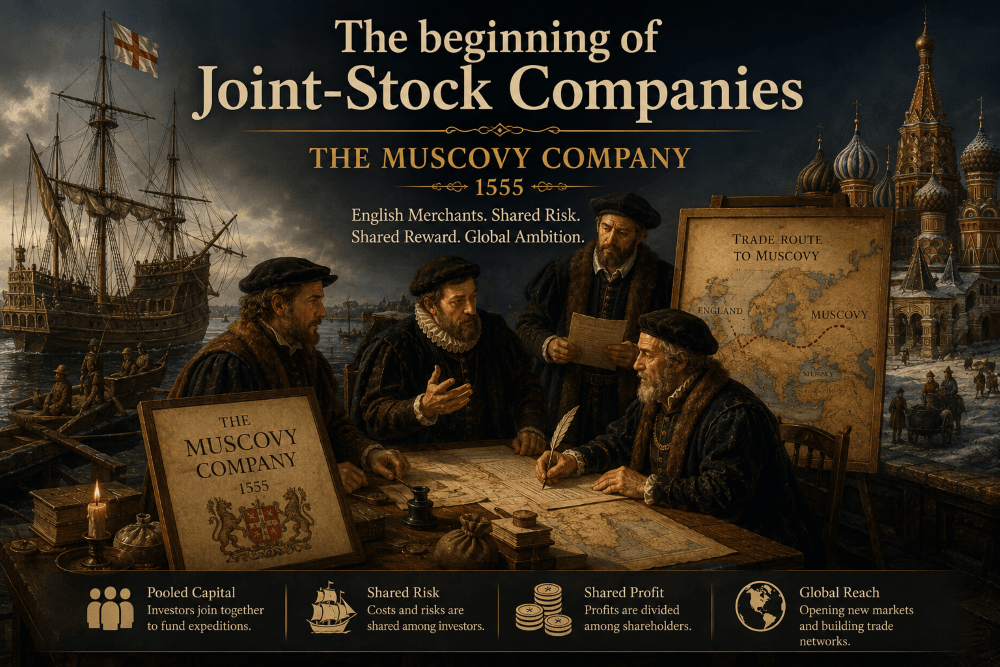
Before joint-stock companies existed, ambitious business ventures faced a hard ceiling: no single merchant, family, or even wealthy investor could realistically fund a project as large as a transoceanic trading fleet alone. This simple but powerful legal structure, pooling capital from many investors while spreading out risk, solved that problem and quietly became one of the most important innovations in business history. It made possible the massive trading companies, colonial enterprises, and eventually modern corporations that followed.
What Is a Joint-Stock Company?
A joint-stock company is a business structure in which ownership is divided into shares, allowing multiple investors to contribute capital and share in profits, losses, and (eventually) legal liability.
- Investors could buy a portion of a company without needing to personally manage its operations.
- Profits and losses were distributed proportionally based on how much of the company an investor owned.
- Unlike earlier partnership models, ownership could often be transferred or sold to other investors.
This structure allowed ventures to raise far larger amounts of capital than any single merchant or small partnership could realistically provide.
Why Joint-Stock Companies Emerged
The Problem With Earlier Funding Models
Before this structure became common, large commercial ventures relied on funding methods that worked reasonably well on a small scale but struggled as ambitions grew.
- Individual merchants often funded voyages entirely out of personal wealth, exposing themselves to catastrophic losses if a venture failed.
- Temporary partnerships were frequently formed for a single voyage or project, then dissolved once it concluded.
- This meant investors had to constantly renegotiate new arrangements for each individual venture, adding friction and uncertainty.
As trade expanded further from Europe, particularly toward Asia and the Americas, the capital and risk involved simply outgrew these older models.
Spreading Risk Across Many Investors
Joint-stock companies solved the risk problem by distributing exposure across a larger pool of participants.
- A single failed voyage no longer meant financial ruin for one merchant family.
- Investors could spread their capital across multiple companies or ventures, further reducing individual risk.
- This distributed risk model made people far more willing to invest in genuinely risky, long-distance ventures.
By spreading potential losses across many participants, this structure unlocked a level of ambition earlier funding models simply couldn’t support.
Early Examples of Joint-Stock Companies
The Muscovy Company and Early Experiments
Some of the earliest formal joint-stock companies emerged in England during the mid-16th century, aimed at establishing trade with Russia and other distant markets.
- These early ventures tested the basic mechanics of pooling investor capital for long-distance trade.
- They demonstrated that outside investors, not just merchants directly involved in a voyage, could meaningfully participate in funding trade.
- Lessons from these early experiments influenced the far larger companies that followed.
Scaling Up With the VOC and British East India Company
The joint-stock structure reached its most influential and consequential form with the founding of the Dutch East India Company (VOC) in 1602 and the British East India Company shortly before it.
- These companies issued permanent, tradable shares rather than temporary voyage-based investments.
- Their massive capital pools allowed them to fund fleets, build fortifications, and eventually maintain private armies.
- Their success demonstrated just how much scale the joint-stock structure could support when combined with strong legal charters and monopoly privileges.
The Evolution Toward Limited Liability
Protecting Investors From Total Loss
One of the most important refinements to the joint-stock model was the eventual introduction of limited liability, which protected investors from losing more than their initial investment.
- Early joint-stock companies sometimes still exposed investors to broader financial liability beyond their original stake.
- Limited liability made investing dramatically less risky on a personal level, encouraging even wider participation.
- This protection became a standard feature of modern corporations, directly tracing back to lessons learned from earlier joint-stock ventures.
Building the Foundation for Modern Corporations
The core principles pioneered by joint-stock companies remain foundational to how businesses raise capital today.
- Publicly traded shares, corporate boards, and shareholder voting rights all trace their origins to this structure.
- The separation of ownership from day-to-day management became a defining feature of large modern businesses.
- Stock exchanges, like the one established in Amsterdam, developed specifically to facilitate trading these company shares.
Lessons from Joint-Stock Companies
- Shared risk enables bigger ambition. Spreading potential losses across many investors made previously unthinkable ventures financially viable.
- Structure shapes scale. The shift from temporary partnerships to permanent, tradable shares allowed businesses to grow far larger and more durable.
- Protection encourages participation. Limited liability broadened who was willing to invest, fueling further capital availability.
Frequently Asked Questions
What is the difference between a partnership and a joint-stock company? A partnership typically involves a small number of individuals directly managing a business, while a joint-stock company allows many investors to hold tradable shares without direct involvement in daily operations.
Which was the first joint-stock company? Early English ventures like the Muscovy Company in the mid-16th century are often cited among the first, though the Dutch East India Company (VOC) became the most influential large-scale example.
Why were joint-stock companies important for trade? They allowed merchants to pool far larger amounts of capital while spreading financial risk across many investors, making large, long-distance ventures financially feasible.
How did joint-stock companies lead to modern corporations? Their innovations, including tradable shares, permanent capital structures, and eventually limited liability, became foundational features of how modern corporations are structured today.