| 📊 Alain’s Holdings — September 1, 2026 | ||||
|---|---|---|---|---|
| Symbol | Name | Price | Change | Change % |
| VOO | Vanguard S&P 500 ETF | 700.28 | -4.61 | -0.65% |
| QQQ | Invesco QQQ Trust | 707.64 | -9.12 | -1.27% |
| XIU.TO | iShares S&P/TSX 60 ETF | 53.13 | -0.52 | -0.97% |
September didn’t exactly receive a warm welcome from Wall Street.
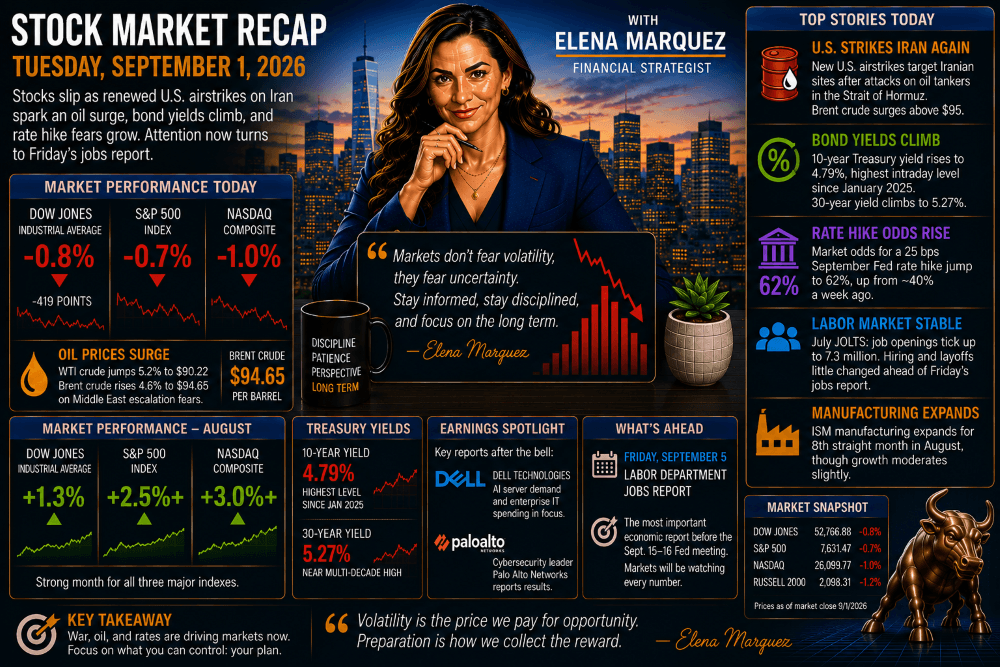
U.S. stocks fell Tuesday as renewed U.S. airstrikes against Iran pushed oil prices sharply higher, Treasury yields climbed, and investors became increasingly concerned that the Federal Reserve could raise interest rates again this month.
The selling was broad, but technology stocks were hit hardest.
Market Performance
- 📉 Dow Jones Industrial Average: -0.8%
- 📉 S&P 500: -0.7%
- 📉 Nasdaq Composite: -1.0%
- 📉 Russell 2000: -1.2%
The S&P 500 closed at 7,631.47, while the Dow lost 419 points to finish at 52,766.88. The Nasdaq dropped 271 points to 26,099.77.
The decline comes immediately after a strong August and illustrates how quickly Wall Street’s attention has shifted from corporate earnings to oil, inflation and interest rates.
The Iran War Escalates Again
The biggest market-moving story Tuesday came from the Middle East.
U.S. forces launched a new round of strikes against Iranian Revolutionary Guard targets after reported attempts to attack commercial shipping and American forces near the Strait of Hormuz.
The strikes followed reports that two tankers were hit Monday while leaving the Strait.
Iran has responded defiantly, threatening to prevent oil exports from moving through the Gulf if pressure continues.
For investors, the biggest immediate concern is obvious:
Oil.
Oil Surges More Than 5%
Oil prices jumped dramatically as traders priced in the possibility of further supply disruptions.
Brent crude rose 4.6% to $94.65 per barrel, while U.S. WTI crude climbed 5.2% to $90.22—its first close above $90 in more than a month.
That’s important far beyond the energy sector.
Oil feeds directly and indirectly into transportation, manufacturing, agriculture and consumer prices.
Which means the market’s geopolitical problem is quickly becoming an inflation problem.
And the inflation problem is becoming an interest-rate problem.
The 10-Year Treasury Hits 4.79%
While oil grabbed the headlines, the bond market may have been even more important for stocks.
The 10-year Treasury yield climbed to 4.79%, its highest level since January 2025.
The 30-year yield traded around 5.27%, remaining near multi-decade highs.
That’s particularly uncomfortable for technology stocks.
Higher Treasury yields increase borrowing costs throughout the economy while simultaneously making bonds more attractive relative to expensive growth stocks.
This helps explain why the Nasdaq suffered the largest decline among the three major indexes Tuesday.
The Fed Suddenly Has an Oil Problem
Just a few weeks ago, investors were debating when the Federal Reserve might eventually lower interest rates.
Now Wall Street is debating whether the Fed needs to raise them again.
Fed Chair Kevin Warsh made clear at Jackson Hole last week that inflation remains too high and that the central bank isn’t prepared to declare victory.
Then oil surged.
Markets are consequently assigning a substantially higher probability to a September rate hike, with estimates approaching roughly two-thirds during Tuesday’s session.
That represents a remarkable change in expectations.
And it creates a potentially difficult environment for stocks:
Higher oil + higher inflation + higher interest rates + higher bond yields.
The Labor Market Looks Surprisingly Stable
There was some reassuring economic news Tuesday.
The July JOLTS report showed 7.3 million job openings, little changed from June.
Hiring and total separations were also little changed at 5.1 million each.
In other words, the labor market isn’t booming—but it doesn’t appear to be collapsing either.
Normally, that would be encouraging.
But there’s an interesting twist.
A resilient labor market gives the Federal Reserve more freedom to fight inflation.
If employment remains strong while oil pushes prices higher, the Fed has less reason to worry that another rate hike will immediately damage the economy.
That’s why Friday’s employment report has suddenly become even more important.
Manufacturing Keeps Expanding, But Slows
U.S. manufacturing also remained in expansion territory in August, although growth moderated from July.
The Institute for Supply Management reported slower new orders, while manufacturers continued reporting concerns about higher input prices tied to tariffs, Middle East tensions and the enormous AI infrastructure buildout.
That’s another uncomfortable combination for the Fed:
The economy continues growing while price pressures remain elevated.
Earnings Season Isn’t Completely Finished
The flood of second-quarter earnings reports has slowed considerably, but there are still several companies worth watching.
Dell Technologies and Palo Alto Networks report after Tuesday’s close.
Dell provides another window into the AI infrastructure boom, particularly demand for servers used to run artificial-intelligence models.
Palo Alto Networks gives investors insight into another rapidly expanding area of corporate technology spending: cybersecurity.
These reports matter because Wall Street increasingly wants evidence that the AI boom is spreading beyond Nvidia.
Nvidia demonstrated last week that demand for AI chips remains extraordinary.
Now investors want to see whether that spending continues flowing throughout the technology ecosystem.
September’s First Warning
There’s an interesting psychological element to today’s decline.
September has historically been a difficult month for stocks.
But history doesn’t cause markets to fall.
Economic conditions do.
And this September begins with a particularly complicated combination:
Oil approaching $95.
The 10-year Treasury at 4.79%.
The possibility of another Fed rate hike.
Renewed fighting with Iran.
And stock valuations that already reflect considerable optimism about AI and corporate earnings.
None of those factors guarantees a correction.
But they reduce the market’s margin for error.
Friday Could Be the Next Big Test
The most important scheduled event this week comes Friday with the August employment report.
It will be the final monthly jobs report before the Fed’s September 15–16 meeting.
And strangely enough, an extremely strong report might not necessarily be good news for stocks.
Strong employment would demonstrate that the economy remains resilient.
But combined with expensive oil and persistent inflation, it could strengthen the Fed’s case for another rate hike.
A weak report would create the opposite problem: evidence that economic growth may be deteriorating while inflation remains elevated.
Neither scenario is particularly comfortable.
The Bottom Line
Tuesday’s market decline wasn’t really about one thing.
It was about a chain reaction.
War pushes oil higher.
Higher oil threatens inflation.
Higher inflation increases expectations for Fed tightening.
Higher interest rates push Treasury yields higher.
And higher Treasury yields put pressure on stock valuations—particularly expensive technology stocks.
That’s why the Nasdaq fell 1% even though the fundamental AI growth story remains intact.
The bull market entered September with impressive year-to-date gains: the Nasdaq is still up about 12.3%, the S&P 500 11.5%, and the Dow 9.8%.
But September begins with a reminder that investors can’t watch earnings alone.
The biggest question now may be whether strong corporate growth can overcome increasingly expensive energy and increasingly expensive money.
Other Stock Market blog posts
Comments
One response to “Stock Market Recap — September 1, 2026”
[…] The selling followed a fresh escalation between the United States and Iran that pushed oil prices sharply higher and sent government bond yields climbing, according to a market recap from Alain Guillot. […]