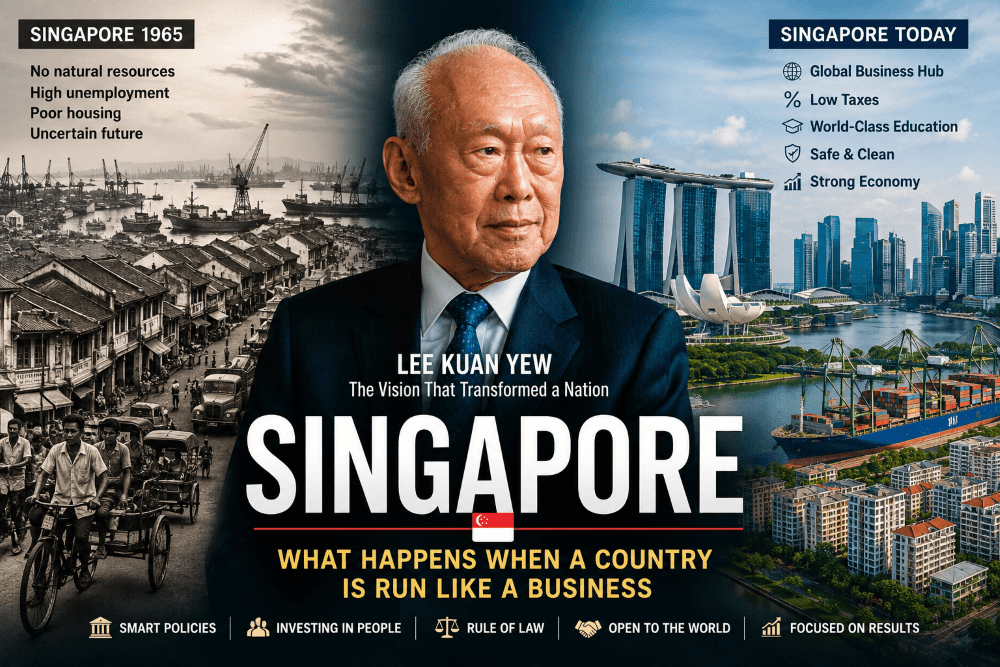
The story of Singapore success is one of my favorite examples of what can happen when leadership, incentives, capitalism, discipline and long-term thinking come together.
When Singapore became independent in 1965, few people would have predicted that this tiny country would eventually become one of the richest societies in the world.
Singapore had almost no natural resources. It had little land, a small domestic market, unemployment, inadequate housing and considerable uncertainty about its future.
Its much larger neighbor, Malaysia, had land, oil, gas, timber, agriculture and other natural resources.
Yet today, Singapore is dramatically richer per person.
According to World Bank data, Singapore’s GDP per capita was approximately US$98,800 in 2025, compared with about US$13,100 for Malaysia.
How did that happen?
A large part of the answer can be found in the vision of Singapore’s first prime minister, Lee Kuan Yew.
I don’t think Lee Kuan Yew should be viewed simply as a politician. I see him almost as an entrepreneur whose startup happened to be a country.
He had a product to sell to the world.
That product was Singapore.
Singapore Success Started With a Terrible Business Plan
Imagine somebody pitching this investment opportunity to you in 1965:
“I have a tiny island in Southeast Asia. We have virtually no natural resources. Our domestic market is tiny. We have high unemployment and housing problems. We have just separated from the country surrounding us. Would you like to invest?”
You probably wouldn’t be rushing to write a cheque.
But that was essentially the situation Lee Kuan Yew inherited.
Singapore couldn’t depend on oil or minerals. It couldn’t depend on a huge domestic consumer market. It couldn’t assume other countries would take care of it.
It had to become useful to the rest of the world.
That constraint may have become one of Singapore’s greatest advantages.
Lee and his government had to ask the same question every entrepreneur eventually has to answer:
What can we offer that people are willing to pay for?
Lee Kuan Yew Ran Singapore Like an Entrepreneur
One reason I find Lee Kuan Yew fascinating is that he was remarkably pragmatic.
He didn’t appear obsessed with whether a particular solution could be labeled capitalist or socialist.
He cared about whether it worked.
Singapore welcomed multinational corporations and international capital.
That’s capitalism.
The government built enormous quantities of public housing.
That’s state intervention.
Singapore embraced free trade.
That’s capitalism.
The government required workers to save through the Central Provident Fund.
That’s government intervention.
Singapore encouraged private enterprise while maintaining a powerful and competent state.
Instead of asking, “Is this left-wing or right-wing?” the Singaporean approach was closer to:
Does it work?
That pragmatism became one of the foundations of Singapore success.
1. Singapore Made Itself Attractive to Capital
A poor country needs capital.
Factories require capital. Businesses require capital. Infrastructure requires capital. New technologies require capital.
Singapore didn’t have enough of it.
So instead of treating foreign corporations as enemies, Singapore actively invited them in.
The government courted multinational companies and encouraged them to build factories, employ Singaporeans, bring technology and use Singapore as an export base.
Companies such as Texas Instruments, Hewlett-Packard and National Semiconductor established manufacturing operations in Singapore.
Those companies weren’t charities.
They came because Singapore created an environment where they could make money.
And Singapore benefited because those companies brought jobs, technology, management expertise and connections to international markets.
It was a mutually beneficial exchange.
2. Singapore Chose Global Competition Over Protectionism
Many developing countries attempted to protect domestic industries from foreign competition.
Singapore couldn’t afford that strategy.
Its domestic market was simply too small.
Singapore therefore had to produce goods and services that foreigners wanted to buy.
That meant competing internationally.
The strategy evolved over time.
Singapore moved from relatively inexpensive manufacturing into electronics, semiconductors, petrochemicals, logistics, finance, pharmaceuticals and advanced manufacturing.
Think about how similar that is to a successful entrepreneur.
You start with whatever skill you can sell.
You earn money.
You improve your skills.
You reinvest.
Then you move into higher-value activities.
Singapore did essentially the same thing at the national level.
3. Singapore Kept Taxes Competitive
Taxation is another fascinating part of the Singapore model.
Singapore isn’t a country without taxes. It has income taxes, corporate taxes, property taxes, stamp duties and a Goods and Services Tax.
But its government explicitly describes its personal income-tax system as designed to be both competitive and progressive.
Singapore’s highest resident personal income-tax rate is currently 24%.
For entrepreneurs, investors and wealthy individuals, another feature can be even more attractive: Singapore generally doesn’t tax personal investment gains as capital gains, although gains arising from business or trading activities may be taxable depending on the circumstances.
Singapore also abolished estate duty for deaths occurring after February 15, 2008.
This helps explain why Singapore has become attractive to entrepreneurs, investors, family offices and wealthy internationally mobile individuals.
Capital can move.
Talented people can move.
Companies can move.
Singapore understood that instead of asking:
“How much can we extract from successful people?”
a more productive question can sometimes be:
“How do we persuade successful people to come here, invest here and build businesses here?”
That doesn’t mean Singapore doesn’t tax wealth or consumption. Property taxation, stamp duties and the GST are important parts of the system.
The larger principle is that taxation should raise the money government needs without unnecessarily discouraging enterprise, investment and economic growth.
4. Singapore Made Corruption Dangerous
Low taxation wouldn’t mean much if businesses had to bribe officials to get anything accomplished.
Lee Kuan Yew understood this.
A government permit shouldn’t depend on knowing the right politician. A business shouldn’t have to pay a customs official to release its merchandise. An entrepreneur shouldn’t have to wonder whether a competitor can simply bribe a government official.
Singapore developed an international reputation for a highly professional bureaucracy and strong anti-corruption enforcement.
That created something enormously valuable:
trust.
Imagine you are deciding where to build a $100 million factory.
Country A has lower wages, but you don’t know whether your permits will be approved, whether officials will demand money or whether the rules will suddenly change.
Country B might be more expensive, but the electricity works, contracts are enforced, infrastructure is excellent and government officials generally follow established procedures.
For a long-term investor, Country B can easily be the better investment.
Singapore deliberately tried to become Country B.
5. Public Order Became an Economic Asset
This is one of the more controversial aspects of Singapore success.
Singapore has very little tolerance for certain forms of crime and public disorder.
Drug laws are an extreme example.
Singapore’s Misuse of Drugs Act imposes severe penalties for possession, consumption, trafficking, manufacturing, importation and exportation of controlled drugs.
Drug consumption can result in imprisonment, and trafficking large quantities of certain drugs can result in life imprisonment or even the death penalty.
Those policies are controversial, particularly from a Western perspective.
Critics legitimately raise questions about civil liberties, proportional punishment, corporal punishment and capital punishment.
But Singapore has made a clear policy choice:
Public safety and social order are priorities.
And public order has economic value.
If people feel safe walking home at night, that’s valuable.
If businesses don’t regularly deal with theft and vandalism, that’s valuable.
If public transportation feels safe, that’s valuable.
If tourists feel comfortable visiting, that’s valuable.
If international executives feel comfortable relocating their families, that’s valuable.
Singapore essentially treats safety, cleanliness and public order as part of the country’s infrastructure.
6. Singapore Didn’t Eliminate Homelessness — It Built Housing
I sometimes hear people say there are no homeless people in Singapore.
That’s not quite true.
Singapore’s Ministry of Social and Family Development counted 496 people sleeping rough during its July 2025 street count, down from 530 in 2022.
What is interesting isn’t that Singapore completely eliminated homelessness.
It didn’t.
What is remarkable is the combination of public order with an enormous housing program.
The Housing & Development Board built housing on a scale that transformed the physical and social landscape of Singapore.
But the goal wasn’t simply to create permanent government tenants.
Singapore strongly encouraged homeownership.
That distinction is important.
A family that owns its home has an asset.
It has something to preserve.
It has a stake in the neighborhood.
And it has a financial interest in the long-term success of the country.
Housing therefore became more than social policy.
It became nation-building.
7. Singapore Encouraged People to Save
Singapore also developed a very different approach to retirement and social security through the Central Provident Fund.
Workers and employers contribute to compulsory savings accounts.
Those savings can serve various purposes under the CPF system, including retirement and housing.
There is a philosophical idea here that I find interesting.
Instead of building the entire system around:
“What will the government give me?”
Singapore incorporated another question:
“What assets will I accumulate during my working life?”
That connects closely with financial independence.
Wealth isn’t created merely by earning money.
It’s created by keeping part of what you earn and investing it in productive assets.
Singapore institutionalized that principle.
8. Singapore Invested in Human Capital
If you don’t have natural resources, people become your natural resource.
Singapore therefore invested heavily in education.
English became particularly important because it gave Singapore a common working language while connecting its population to international business.
Technical education, mathematics, science, engineering and vocational skills also became important.
This was economic policy disguised as education policy.
A multinational corporation deciding where to establish a factory or regional headquarters asks:
Can we find engineers?
Can we find accountants?
Can we find managers?
Can employees communicate internationally?
Can workers learn new technologies?
Singapore wanted the answer to be yes.
9. Singapore Built Infrastructure Before It Was Rich
Poor countries sometimes think world-class infrastructure is something they can build after becoming wealthy.
Singapore treated infrastructure as one of the things that would make it wealthy.
It invested in its port, roads, water, electricity, industrial areas, telecommunications and eventually one of the world’s best-known airports.
Infrastructure increases productivity.
If a shipment takes three days instead of three weeks, that’s an economic advantage.
If electricity is reliable, that’s an economic advantage.
If an executive can travel easily between Singapore and major cities around the world, that’s an economic advantage.
A country can compete just like a business.
Singapore competed on efficiency.
10. Singapore Success Was Built on Predictability
Businesses don’t necessarily require governments to give them everything they want.
They need to know the rules.
What will my taxes be?
Can I enforce a contract?
Can I obtain a business permit?
Will the electricity work?
Can my products get through the port?
Can an official demand a bribe?
Will the government suddenly confiscate my investment?
Predictability lowers risk.
And lower risk makes investment more attractive.
Singapore turned boring administrative competence into a competitive advantage.
Why Did Singapore Become Richer Than Malaysia?
The comparison with Malaysia makes this story especially fascinating.
Singapore and Malaysia were briefly part of the same country before Singapore separated from Malaysia in 1965.
Malaysia had many advantages.
It had vastly more land, a much larger population and abundant natural resources.
Singapore had almost none of those things.
Yet according to World Bank data for 2025, Singapore’s GDP per capita was roughly 7.5 times Malaysia’s.
But I wouldn’t describe Malaysia as a failure.
Malaysia itself has experienced substantial economic development and has become an important manufacturing and trading economy.
The more interesting question is why Singapore became exceptionally wealthy.
Part of the answer is that Singapore had no alternative but to become extremely competitive.
Natural resources can sometimes allow governments to postpone difficult reforms.
Singapore couldn’t depend on digging wealth out of the ground.
It had to create wealth.
The Price of the Singapore Model
It’s important not to romanticize Lee Kuan Yew.
Singapore’s success came with trade-offs.
The government exercised substantial authority over society. Political opposition faced a difficult environment, freedom of expression has historically been more constrained than in many Western democracies, and criminal punishments can be extraordinarily severe (I think this is a good thing, we want to discourage crime as much as possible).
Lee’s philosophy placed considerable emphasis on social order, collective stability and results.
Reasonable people can admire Singapore’s economic achievements while disagreeing strongly with some aspects of its political or criminal-justice system.
That’s an important distinction.
We don’t have to copy everything Singapore did to learn from what worked.
What Entrepreneurs Can Learn From Singapore Success
The reason I find Singapore so fascinating is that its story extends beyond government policy.
It contains lessons for individuals.
Singapore could have spent decades complaining about everything it didn’t have.
No natural resources.
No huge domestic market.
No large territory.
No oil.
No agricultural hinterland.
Instead, it asked:
What do we have, and what can we build?
That’s the entrepreneur’s question.
A person can similarly say:
I wasn’t born wealthy.
I don’t have connections.
I don’t have an inheritance.
I don’t have the right education.
Or that person can ask:
What skills can I develop?
What problems can I solve?
What can I sell?
How much can I save?
Where can I invest?
How can I make myself more valuable?
Singapore couldn’t change its geography.
But it could change its value.
That’s a powerful lesson for anyone pursuing entrepreneurship or financial independence.
A Country Can Have a Business Model
Lee Kuan Yew understood something that I think many politicians forget.
Countries compete.
They compete for entrepreneurs.
They compete for investment.
They compete for corporations.
They compete for talented immigrants.
They compete for tourists.
They compete for financial capital.
Singapore essentially asked:
Why should somebody choose us?
Then it spent decades improving the answer.
Low and competitive taxes.
Strong institutions.
Public safety.
Education.
Infrastructure.
Housing.
International trade.
Foreign investment.
Political and economic stability.
A highly functional bureaucracy.
Singapore wasn’t trying to become everything to everybody.
It was building a compelling product.
Singapore’s Greatest Natural Resource Was Its People
There’s a beautiful irony in Singapore’s history.
Its lack of natural resources looked like a terrible disadvantage.
Perhaps it ultimately became an advantage.
Singapore couldn’t depend on what was underneath its soil.
It had to depend on what was inside people’s heads.
Knowledge.
Skills.
Discipline.
Entrepreneurship.
Organization.
And human capital.
Lee Kuan Yew didn’t discover oil.
He helped create an environment where people could create wealth.
That’s a much more durable resource.
Final Thoughts
The greatest lesson from Singapore success isn’t that every country should copy Singapore.
Singapore is a tiny city-state with unique geography, history and political circumstances. Policies that work there won’t necessarily produce identical results in Canada, the United States, Europe or developing countries.
The lesson is more fundamental.
Incentives matter. Institutions matter. Competence matters. Capital matters. Education matters. Safety matters. And culture matters.
Lee Kuan Yew inherited a vulnerable country with few obvious advantages and approached its problems with unusual pragmatism.
Attract capital rather than frighten it away.
Educate people rather than depend on natural resources.
Reward productive activity.
Save and invest.
Build infrastructure.
Maintain public order.
Fight corruption.
Change policies when they don’t work.
And continually ask how Singapore could become more valuable to the rest of the world.
That’s remarkably similar to entrepreneurship.
Perhaps Lee Kuan Yew’s greatest achievement wasn’t simply building a wealthy country.
He created a country that thought like an entrepreneur.
Frequently Asked Questions About Singapore Success
Why is Singapore so successful?
Singapore success resulted from a combination of strong institutions, openness to international trade and foreign investment, competitive taxation, education, infrastructure, compulsory savings, public housing, anti-corruption enforcement and long-term economic planning. No single policy explains the transformation.
Did Lee Kuan Yew make Singapore successful?
Lee Kuan Yew was enormously influential, but Singapore’s success wasn’t the work of one man. Other leaders, civil servants, entrepreneurs, workers and institutions played important roles. Lee provided much of the political leadership and long-term vision during Singapore’s formative decades.
Why is Singapore richer than Malaysia?
Singapore pursued an unusually export-oriented and investment-friendly development strategy while building strong institutions, infrastructure and human capital. However, comparisons should account for the enormous differences between a compact city-state and a much larger, geographically and socially complex country such as Malaysia.
Is Singapore a low-tax country?
Singapore has a relatively competitive tax system. Its highest resident personal income-tax rate is currently 24%, and personal investment gains generally aren’t subject to a separate capital-gains tax. However, Singapore also raises revenue through GST, property taxes, stamp duties and other sources.