September arrived with plenty of drama.
The first trading week of the month brought renewed fighting with Iran, oil approaching $100, surging Treasury yields, another twist in the Federal Reserve debate, Nvidia’s expanding AI empire, and a changing of the guard at Apple.
Yet despite all that turbulence, the stock market barely moved.
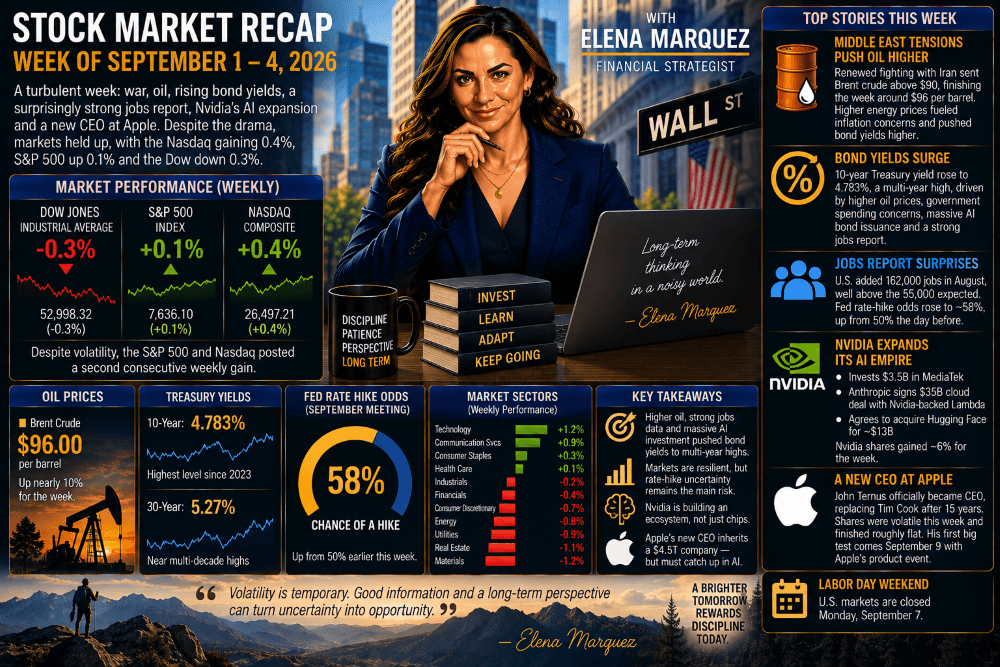
Weekly Market Performance
- 📈 Nasdaq Composite: +0.4%
- 📈 S&P 500: +0.1%
- 📉 Dow Jones Industrial Average: -0.3%
The S&P 500 and Nasdaq managed their second consecutive weekly gains, while the Dow slipped slightly.
That resilience is impressive considering what happened elsewhere.
Oil surged nearly 10% during the week. Treasury yields climbed toward multi-year highs. And Friday’s surprisingly strong employment report increased expectations that the Fed could raise rates again this month.
Why Did Bond Yields Surge?
One of the week’s biggest stories wasn’t in the stock market.
It was in the bond market.
The 10-year Treasury yield finished Friday around 4.78%, after reaching its highest intraday level since November 2023 earlier in the week.
There wasn’t one single reason.
Several powerful forces collided at once.
First came oil.
Renewed fighting between the United States and Iran sent Brent crude to roughly $96 per barrel by Friday, while WTI finished above $91.
Expensive energy increases the risk that inflation remains elevated.
Second came concerns about government borrowing.
The U.S. national debt recently crossed $40 trillion, and investors increasingly expect enormous Treasury issuance to finance federal deficits.
More bonds competing for buyers can mean investors demand higher yields.
Third came AI.
This one is particularly interesting.
The enormous AI infrastructure buildout isn’t being financed entirely with cash.
Technology companies, cloud providers, utilities and data-center operators are increasingly tapping capital markets to finance hundreds of billions of dollars of infrastructure.
That means the AI boom isn’t just influencing stocks.
It’s becoming a factor in the bond market.
And then Friday added one more ingredient.
The Jobs Report Changes the Fed Debate—Again
The U.S. economy added 162,000 jobs in August, nearly three times the roughly 55,000 economists expected.
The unemployment rate remained at 4.1%.
That strong number pushed the 10-year Treasury yield back toward 4.78%.
More importantly, traders increased the probability of a September Federal Reserve rate hike to approximately 58%–60%, compared with roughly 50/50 the previous day.
We’ve seen the same strange market dynamic repeatedly this year:
Good economic news can become bad news for stocks.
A strong labor market means the Fed has more room to fight inflation.
And with oil around $96, inflation remains a serious concern.
Nvidia Wants to Own More Than the AI Chip
If there was one company that seemed determined to dominate the headlines this week, it was Nvidia.
The company made three major moves spanning hardware, infrastructure and software.
1. Nvidia Invests $3.5 Billion in MediaTek
Nvidia invested $3.5 billion in Taiwanese chipmaker MediaTek.
The companies are expanding their collaboration around custom AI chips and Nvidia’s NVLink Fusion architecture, while also working together in areas including PCs and automobiles.
There’s an interesting strategy here.
Custom AI chips could theoretically threaten Nvidia.
Companies such as Google, Amazon and Microsoft increasingly want specialized processors rather than relying exclusively on Nvidia GPUs.
Jensen Huang’s response appears to be:
If customers are going to build custom chips, Nvidia wants those chips plugged into Nvidia’s ecosystem anyway.
That’s smart.
Nvidia doesn’t necessarily need to manufacture every processor if it controls the architecture connecting everything together.
2. Nvidia Moves Deeper Into AI Infrastructure
Anthropic also committed approximately $35 billion to rent computing capacity from Nvidia-backed cloud provider Lambda.
Nvidia itself is reportedly involved in the data-center lease supporting the arrangement.
Again, Nvidia isn’t simply selling chips.
It’s helping create the infrastructure and financing arrangements that allow customers to buy enormous quantities of computing power.
That strategy can reinforce demand for Nvidia products.
But it also creates a risk investors shouldn’t ignore.
Increasingly, Nvidia is financially connected to companies that are also customers.
The stronger the AI boom becomes, the more powerful that ecosystem looks.
But if AI spending eventually slows, those financial connections could amplify the downside.
3. Nvidia Buys Hugging Face for $13 Billion
Then came the biggest deal.
Nvidia agreed to acquire Hugging Face for nearly $13 billion, one of the largest acquisitions in the company’s history.
Hugging Face has become one of the most important platforms for developers building and sharing open-source and open-weight AI models.
Nvidia says Hugging Face will remain an open platform.
The strategic logic is fascinating.
Nvidia already dominates AI hardware.
Now it is expanding into the software and developer ecosystem surrounding that hardware.
Put all three deals together and Jensen Huang’s ambition becomes clearer:
Nvidia doesn’t merely want to be the company that sells AI chips.
It wants to become the architecture underlying the AI economy.
Investors liked what they saw.
Nvidia finished the week up close to 6%.
Apple Enters the John Ternus Era
While Nvidia was expanding its AI empire, another technology giant began a new chapter.
On September 1, John Ternus officially became CEO of Apple, replacing Tim Cook after 15 years.
Cook remains at Apple as executive chairman.
Ternus inherits an extraordinary company.
Under Cook, Apple’s market value grew from roughly $350 billion to about $4.5 trillion, while annual revenue climbed from $108 billion to more than $400 billion.
But Ternus also inherits perhaps Apple’s biggest strategic challenge since the iPhone transformed the company:
Artificial intelligence.
Can Apple Catch Up in AI?
Apple remains one of the most profitable businesses ever created.
But unlike Nvidia, Microsoft, Google and several other technology giants, Apple hasn’t established itself as a leader in generative AI.
Ternus therefore faces a difficult challenge.
He must preserve the extraordinary ecosystem Tim Cook built while positioning Apple for a world in which AI increasingly becomes the interface through which people interact with technology.
His background may help.
Ternus spent 25 years at Apple and previously ran hardware engineering, overseeing major products and helping lead Apple’s successful transition from Intel processors to its own Apple silicon.
The market’s initial verdict?
Essentially:
We’ll wait and see.
Apple shares moved around during Ternus’s first week but finished approximately flat.
His first major public test comes quickly, with Apple’s product event scheduled for September 9.
Three Stories, One Bigger Theme
At first glance, oil, Nvidia and Apple’s CEO transition have little in common.
But together they tell an interesting story about today’s market.
The economy is being pulled between two enormous forces.
One is the old economy:
Oil.
War.
Government borrowing.
Inflation.
Interest rates.
The other is the new economy:
AI chips.
Data centers.
Cloud computing.
AI models.
Trillions of dollars of technology investment.
The old economy is pushing the cost of capital higher.
The new economy is demanding extraordinary amounts of that capital.
That tension may become one of the defining investment stories of the next several years.
The Bottom Line
Considering everything Wall Street absorbed this week, the market held up remarkably well.
The Nasdaq gained 0.4%.
The S&P 500 edged 0.1% higher.
The Dow lost approximately 0.3%.
But those small movements hide an extraordinarily eventful week.
Oil surged toward $96.
Treasury yields approached 4.8%.
A surprisingly strong jobs report revived expectations for another Fed rate hike.
Nvidia spent billions expanding its influence across the entire AI ecosystem.
And Apple entered its first week under a new CEO in 15 years.
Perhaps the most interesting story is Nvidia.
Jensen Huang appears to understand something important:
The biggest prize in AI may not be selling the best chip.
It may be controlling the ecosystem through which AI computing happens.
Hardware.
Networking.
Data centers.
Cloud infrastructure.
Software.
Models.
Nvidia increasingly wants a piece of all of them.
And if this week’s deals are any indication, the world’s most valuable company has no intention of surrendering its position at the center of the AI boom.
Other Stock Market blog posts