| 📊 Alain’s Holdings — September 4, 2026 | ||||
|---|---|---|---|---|
| Symbol | Name | Price | Change | Change % |
| VOO | Vanguard S&P 500 ETF | 708.05 | -2.67 | -0.38% |
| QQQ | Invesco QQQ Trust | 718.96 | +1.29 | +0.18% |
| XIU.TO | iShares S&P/TSX 60 ETF | 54.11 | -0.20 | -0.37% |
Wall Street received the strong jobs report it normally wants.
This time, investors weren’t celebrating.
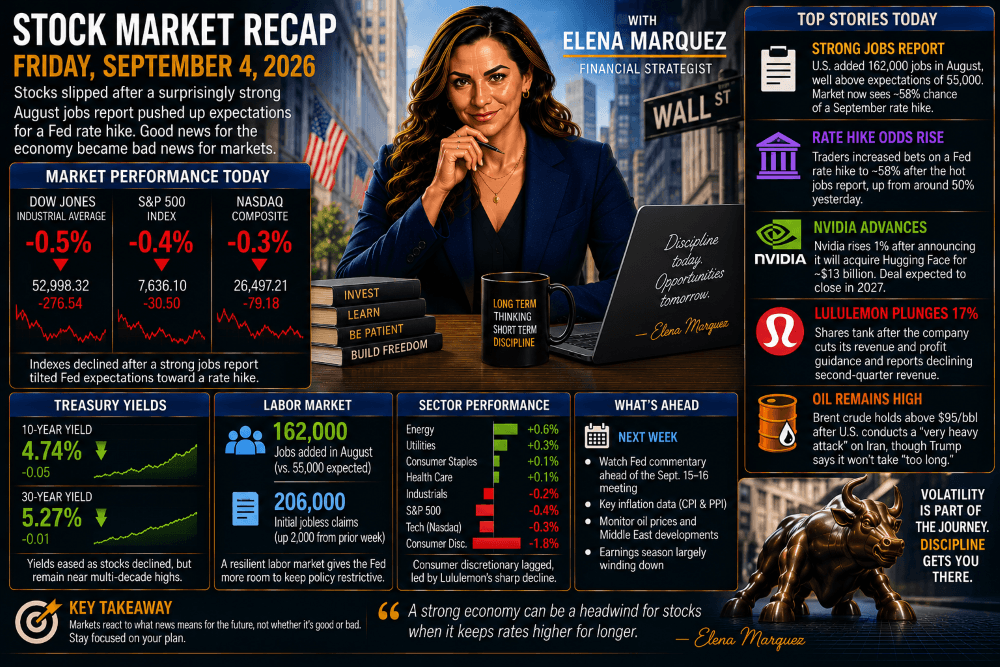
U.S. stocks slipped Friday after the August employment report showed the economy added 162,000 jobs, nearly three times what economists expected. The unexpectedly strong labor market revived concerns that the Federal Reserve could raise interest rates at its September meeting.
Market Performance
- 📉 Dow Jones Industrial Average: -0.5%
- 📉 S&P 500: -0.4%
- 📉 Nasdaq Composite: -0.3%
The decline came just one day after the Dow and S&P 500 posted their strongest sessions in nearly a month.
Once again, Wall Street is confronting one of investing’s strange paradoxes:
Good economic news can sometimes be bad news for stocks.
162,000 Jobs Change the Conversation
Friday’s employment report was unquestionably strong.
The U.S. economy added 162,000 jobs in August, blowing past expectations for approximately 55,000.
That’s significant because much of this week’s labor-market data had pointed in the opposite direction.
Wednesday’s ADP report showed private employers adding only 38,000 jobs.
Thursday’s unemployment claims increased slightly to 206,000.
The picture seemed to be one of a “low hire, low fire” economy: companies weren’t laying off workers aggressively, but they weren’t particularly enthusiastic about hiring either.
Then Friday’s report arrived.
Suddenly, the labor market looks considerably stronger.
Why Good Jobs Numbers Hurt Stocks
Normally, investors should welcome strong employment.
More jobs mean more income.
More income supports consumer spending.
Consumer spending supports corporate revenues.
And stronger corporate revenues should ultimately support stock prices.
But there’s another side to the equation.
A strong labor market gives the Federal Reserve more freedom to keep monetary policy restrictive.
The Fed doesn’t have to worry as much about damaging employment if companies continue hiring.
And that’s particularly important right now because inflation remains the Fed’s biggest problem.
September Rate-Hike Odds Jump to 58%
Following the jobs report, traders increased the probability of a September Fed rate hike to roughly 58%, according to CME Group’s FedWatch Tool.
That’s another dramatic reversal.
On Wednesday, markets were increasingly worried that another hike was coming.
Then Thursday, Fed Governor Christopher Waller talked about encouraging signs of disinflation and suggested the Fed might be able to leave rates unchanged.
Rate-hike expectations dropped toward 50%.
Twenty-four hours later, the jobs report moved the pendulum back again.
That’s how sensitive this market has become to every new piece of economic information.
The Fed Has a Difficult Decision
Fed officials now have conflicting signals to consider.
On one side, there are reasons to wait.
Some labor-market indicators have weakened.
Hiring outside Friday’s report has looked relatively sluggish.
And Fed Governor Waller believes there are encouraging signs that inflation may be improving.
On the other side:
The economy just created 162,000 jobs.
Oil remains extremely expensive because of the war with Iran.
And Fed Chair Kevin Warsh has already warned that inflation remains too high.
That combination makes another rate increase considerably easier to justify.
The Fed’s Problem Isn’t Growth—It’s Inflation
One of the most important themes emerging from the past few weeks is that the U.S. economy continues to surprise investors with its resilience.
Consumers are still spending.
Companies are still hiring.
Corporate earnings have generally been strong.
AI capital expenditures remain enormous.
Manufacturing continues expanding.
Ordinarily, investors would love that combination.
But when inflation is already running above the Fed’s target, economic strength creates a complication.
The Federal Reserve isn’t trying to stimulate growth.
It’s trying to prevent strong demand from keeping inflation elevated.
That means the market may actually need the economy to slow slightly before interest-rate pressure disappears.
Oil Makes Everything More Complicated
The other major wildcard remains energy.
Brent crude has been trading around $95 per barrel following renewed U.S.-Iran hostilities.
That’s important because higher oil prices can push inflation higher even if underlying price pressures elsewhere in the economy are improving.
This creates an uncomfortable situation for policymakers.
Imagine inflation gradually falling because housing, services and goods prices are moderating.
Then oil jumps because of a geopolitical shock.
Consumers suddenly pay more for gasoline.
Businesses pay more for transportation.
Airlines pay more for fuel.
Manufacturers face higher input costs.
The Fed can’t produce more oil.
But it still has to worry about the inflationary consequences.
Lululemon Plunges 17%
The day’s biggest corporate story came from Lululemon.
Shares plunged approximately 17% after the athletic-apparel company cut its revenue and profit outlook following declining second-quarter revenue.
It’s another warning from the consumer economy.
Earlier this week, DICK’S Sporting Goods raised concerns about excessive sneaker inventories and aggressive discounting.
Nike, Under Armour and On Running all came under pressure.
Now Lululemon is providing another signal that parts of the premium athletic-apparel market are struggling.
That’s worth watching.
For years, companies such as Lululemon benefited from extraordinary pricing power.
Consumers weren’t simply buying workout clothes.
They were buying lifestyle brands.
If that pricing power is weakening, investors may have to rethink some of the premium valuations traditionally assigned to these businesses.
From Nvidia to Lululemon: A Tale of Two Economies
The contrast between Nvidia and Lululemon is particularly interesting.
Last week, Nvidia told investors demand was so strong that its biggest problem was finding enough chips to satisfy customers.
This week, Lululemon lowered its outlook as consumer demand weakened.
That’s essentially the economy Wall Street is trying to understand.
Corporate AI spending is booming.
Parts of consumer spending are weakening.
The question is which force ultimately matters more.
Right now, AI investment is powerful enough to keep the broader corporate earnings picture relatively strong.
But consumer spending remains the backbone of the U.S. economy.
Weakness there can’t be ignored indefinitely.
The September Fed Meeting Is Now the Main Event
With Friday’s jobs report behind us, Wall Street’s attention increasingly turns toward the Federal Reserve.
The September meeting is scheduled for September 15–16.
Between now and then, inflation data will be critical.
If inflation continues cooling despite expensive oil, Waller’s argument for holding rates steady becomes stronger.
If inflation surprises to the upside, Friday’s strong employment report gives the Fed much more justification to raise rates.
The September decision is still uncertain.
But after today’s report, the case for another hike became stronger.
The Bottom Line
Friday provided another example of why markets don’t simply trade on whether economic news is “good” or “bad.”
They trade on what that news means for the future.
162,000 new jobs is good news for workers and the economy.
But for investors, it means the Federal Reserve has more room to fight inflation.
That’s why stocks fell.
The Dow declined more than 0.5%, the S&P 500 lost 0.4%, and the Nasdaq slipped 0.3%.
Meanwhile, rate-hike expectations climbed back toward 58%.
The bull market’s underlying strengths haven’t disappeared.
Corporate profits remain healthy.
AI investment remains extraordinary.
The economy remains resilient.
But Wall Street is learning that economic resilience has a price.
The stronger the economy remains, the less urgency the Federal Reserve has to make money cheaper.
For now, that may be the single most important equation driving the stock market.
Other Stock Market blog posts