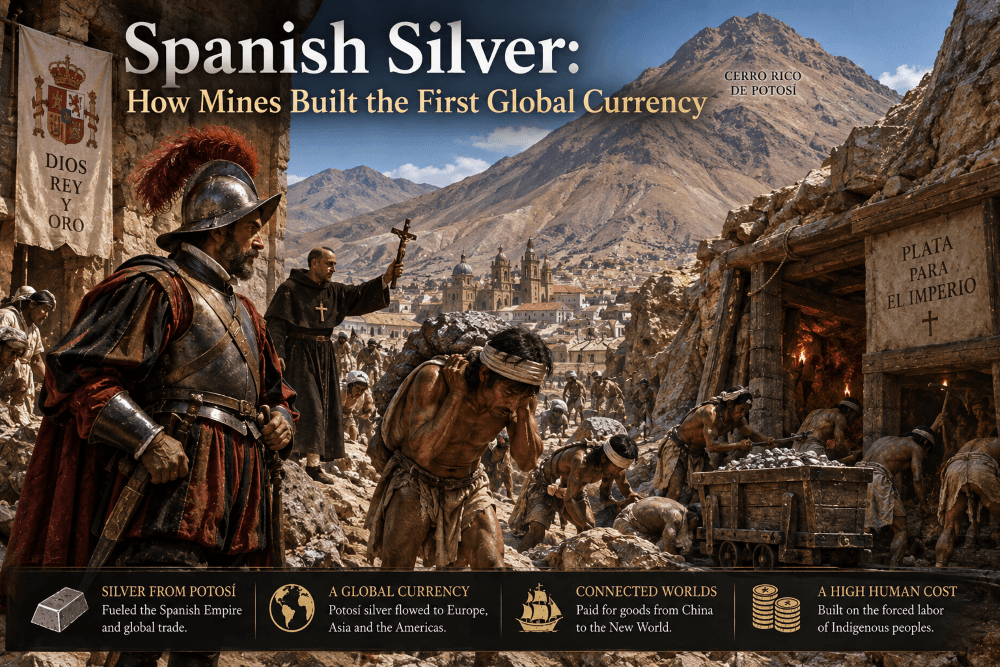
Spanish silver did something no previous currency had ever achieved: it circulated as accepted money across Europe, Asia, Africa, and the Americas simultaneously. Extracted in staggering quantities from mines in the Spanish colonies, particularly the legendary mountain of Potosí, this silver flowed into global trade networks and effectively became the world’s first universally recognized currency. Its story reveals both the extraordinary reach of early global commerce and the brutal human cost required to fuel it.
The Discovery That Changed Global Trade
Spain’s American colonies contained silver deposits on a scale that reshaped the global economy almost overnight.
- The mountain of Potosí, located in present-day Bolivia, was discovered in 1545 and quickly became the largest silver-producing site in the world.
- Additional major silver deposits were found in Mexico, further expanding Spain’s mining output.
- Within decades, Spanish America was producing the majority of the world’s silver supply.
This sudden, massive influx of precious metal gave Spain access to wealth on a scale no European power had previously possessed.
How Spanish Silver Became a Global Currency
The Silver Peso’s Reach
Spanish silver coins, particularly the widely circulated silver peso, became accepted currency far beyond Spain’s own colonial territories.
- Merchants across Europe accepted Spanish silver coins due to their reliable weight and purity standards.
- Trade networks in Asia, particularly in China, actively sought Spanish silver as payment for goods like silk and porcelain.
- Spanish coins circulated in West Africa, the Middle East, and across the Americas, making them genuinely global currency.
This widespread acceptance meant Spanish silver functioned as a practical, trusted medium of exchange across dramatically different economies and cultures.
Connecting Distant Markets
Spanish silver effectively linked previously separate global trade systems into a single interconnected economy.
- Silver mined in the Americas often traveled directly across the Pacific to Asia via the Manila Galleon trade route.
- This silver paid for Chinese goods that were then shipped back across the Pacific or onward to Europe.
- The resulting trade loop connected American mines, European markets, and Asian manufacturing into one continuous economic system.
The Economic Impact of Spanish Silver
Fueling European Commerce and Inflation
The massive influx of Spanish silver had significant and sometimes destabilizing effects on European economies.
- Increased silver supply contributed to substantial price inflation across much of Europe during the 16th and 17th centuries, a period historians often call the Price Revolution.
- Spain itself struggled with economic mismanagement despite controlling enormous silver wealth, partly due to heavy spending on wars and imports rather than domestic industry.
- Other European powers benefited significantly from silver flowing through trade with Spain, even without directly controlling the mines themselves.
Powering Global Trade Networks
Beyond Europe, Spanish silver became essential to functioning global trade relationships.
- Chinese demand for silver, partly driven by tax policies requiring payment in silver, made it an especially valuable trade commodity.
- Silver helped balance persistent trade imbalances between Europe and Asia, where European goods were often less desired than Asian silk, spices, and porcelain.
- This currency flow effectively created one of history’s first truly integrated global economic systems.
The Brutal Human Cost Behind the Silver
Forced Labor at Potosí
The staggering output of Spanish silver mines depended heavily on forced and coerced indigenous labor systems.
- The Spanish colonial mita system compelled indigenous communities to provide labor quotas for mining operations, often under brutal and dangerous conditions.
- Mercury used in silver processing caused severe health consequences for workers exposed to it over time.
- Mortality rates among laborers at sites like Potosí were extremely high, representing enormous human suffering behind the wealth being extracted.
A Pattern Repeated Across the Colonies
This exploitative labor system reflected a broader pattern seen throughout Spanish colonial economic activity.
- Indigenous populations across Spanish territories faced forced labor demands tied directly to resource extraction.
- Enslaved African labor was also introduced into mining and colonial economies as indigenous populations declined due to disease and mistreatment.
- The wealth generated through Spanish silver cannot be separated from the human cost required to produce it.
Lessons from Spanish Silver and the Global Economy
- Resource wealth doesn’t guarantee prosperity. Despite controlling enormous silver reserves, Spain’s broader economy struggled due to poor management and overreliance on extracted wealth.
- Currency can unify disparate markets. Spanish silver’s universal acceptance helped connect previously separate trade systems across multiple continents.
- Extraction-based wealth carries lasting costs. The human suffering behind Spanish silver production remains an inseparable part of understanding this economic story.
Frequently Asked Questions
Why was Spanish silver so widely accepted around the world? Its reliable weight and purity standards made it trustworthy for merchants across Europe, Asia, Africa, and the Americas, allowing it to function as an early form of global currency.
What was Potosí, and why was it significant? Potosí was a mountain in present-day Bolivia containing enormous silver deposits, discovered in 1545, that became the largest silver-producing site in the world during Spanish colonial rule.
How did Spanish silver affect the Chinese economy? Chinese demand for silver, partly driven by tax policies requiring silver payments, made it a highly sought-after trade commodity, connecting American mines directly to Asian markets via Pacific trade routes.
What was the human cost of Spanish silver production? Silver mining relied heavily on forced indigenous labor through systems like the mita, alongside enslaved African labor, resulting in extremely high mortality rates and widespread human suffering.
Related Articles
- The Atlantic Trade Triangle: Commerce’s Darkest Chapter
- Marine Insurance: How Lloyd’s Coffee House Priced Risk
- Joint-Stock Companies: The Structure That Scaled Business
- The British East India Company: Trade Turned Empire
- Tulipmania: What the Famous Bubble Really Teaches About Markets
- The Amsterdam Stock Exchange: Where Shares Were Born