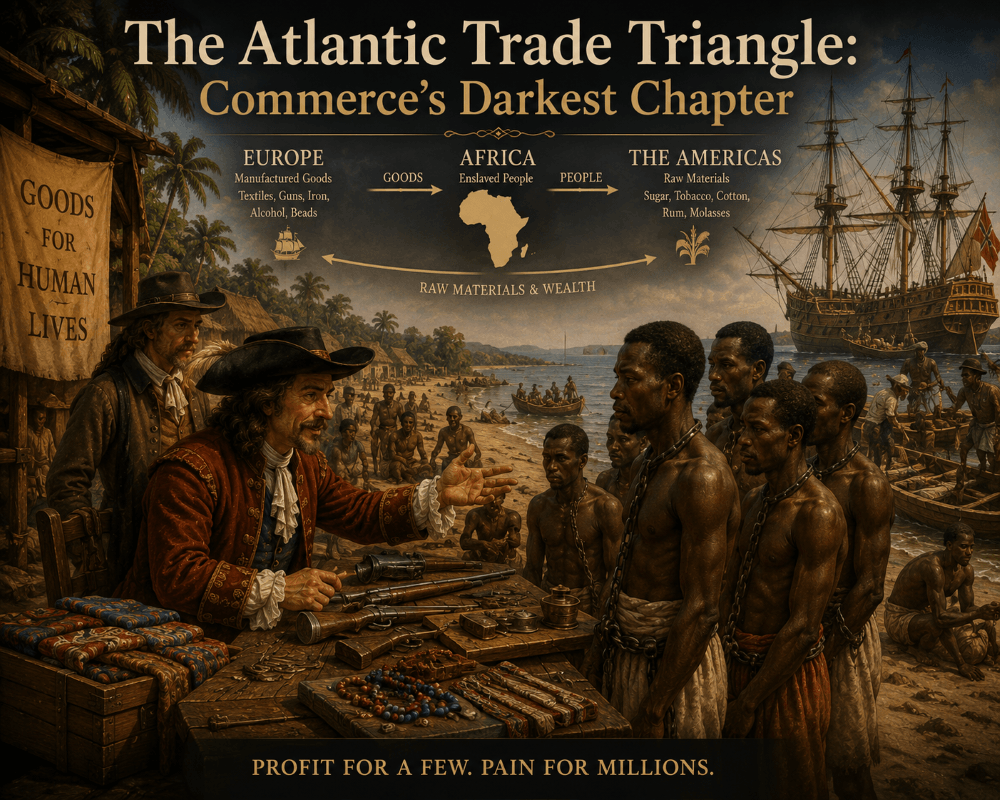
Any honest history of entrepreneurship has to include its worst chapter. The Atlantic Trade Triangle was a commercial system that generated enormous wealth for European and colonial economies between the 16th and 19th centuries, built directly on the forced enslavement and transport of millions of African people. Understanding this system isn’t about extracting business lessons from it. It’s about recognizing how thoroughly economic ambition, left without moral or legal restraint, can become an engine of atrocity.
What Was the Atlantic Trade Triangle?
The Atlantic Trade Triangle refers to a three-part trade route connecting Europe, West Africa, and the Americas, each leg carrying different goods, and one leg carrying human beings.
- Ships departed Europe carrying manufactured goods, including textiles, weapons, and metal tools.
- These goods were traded in West Africa, largely in exchange for enslaved people captured and slaved by other native African or purchased through violence and coercion.
- Enslaved Africans were then transported across the Atlantic to the Americas in what became known as the Middle Passage.
- Ships returned to Europe carrying raw materials produced through enslaved labor, including sugar, cotton, and tobacco.
This system connected three continents into a single, devastating economic engine that operated for centuries.
The Mechanics of the Triangular Trade
Manufactured Goods to Africa
The first leg of the Atlantic Trade Triangle involved European merchants sending manufactured goods to West African ports.
- Textiles, firearms, alcohol, and metal goods were commonly traded.
- European traders worked with some West African merchants and rulers who participated in supplying captives, often obtained through warfare, raiding, or existing regional systems of slavery. In short, blacks were already enslaving other blacks.
- This trade fueled ongoing demand for European manufactured goods, deepening the economic relationships tied to the system.
It’s important to state plainly that responsibility for this system rests overwhelmingly with the European powers, merchants, and colonial economies who created the demand, financed the trade, and profited most from it.
But before European traders established coastal footholds in West Africa in the mid-15th century (around the 1440s), various forms of forced labor and human trafficking had already existed across different regions of Africa for centuries—and in some regions, millennia.
Slavery is still common in Africa. While legal chattel slavery has been abolished worldwide, human rights organizations estimate that over 7 million people in Africa are currently living in conditions defined as modern slavery.
The Middle Passage
The transport of enslaved people across the Atlantic, known as the Middle Passage, represents one of history’s most horrific chapters.
- Enslaved people were forced into extremely overcrowded, unsanitary ship conditions for voyages that could last weeks or months.
- Death rates during these crossings were catastrophically high due to disease, malnutrition, and brutal treatment.
- Historians estimate that over 12 million Africans were forcibly transported through this system, with millions dying during capture, transport, or shortly after arrival.
No accurate account of this period can minimize the scale of suffering involved. This wasn’t an unfortunate side effect of trade. It was the trade.
Colonial Goods Back to Europe
The final leg of the Atlantic Trade Triangle carried goods produced through forced labor on plantations back to European markets.
- Sugar, cotton, tobacco, and other cash crops were harvested and processed by enslaved laborers under brutal conditions.
- These goods generated enormous profits for plantation owners, merchants, and European economies.
- This wealth helped fund further colonial expansion, industrial development, and continued investment in the system itself.
The Economic Scale of the Atlantic Trade Triangle
Building Colonial Wealth
The profits generated through this system were staggering, and they directly shaped the economic development of multiple nations.
- Caribbean and American plantation economies became enormously profitable for colonial powers and private investors.
- Port cities involved in this trade, including Liverpool, Bristol, and Nantes, grew wealthy through their direct participation.
- This wealth contributed meaningfully to capital available for later industrial and commercial development in Europe.
Institutions Built on This System
Some of the financial and commercial institutions explored elsewhere in this series were directly connected to or benefited from this trade.
- Insurance markets, including early Lloyd’s underwriters, insured slave ships and their human cargo as commercial property.
- Banking institutions provided financing for slave-trading voyages and plantation operations.
- Joint-stock companies and chartered trading firms were sometimes directly involved in organizing and profiting from this trade.
This connection is a necessary and uncomfortable part of understanding how deeply this system was embedded in the broader commercial history of the era.
Resistance and Abolition
Enslaved People Resisted Throughout
Enslaved people resisted this system continuously, through rebellion, escape, and countless forms of everyday resistance, despite facing brutal punishment for doing so.
- Uprisings occurred aboard slave ships and on plantations throughout the system’s history.
- The Haitian Revolution, beginning in 1791, became the most significant successful uprising, leading to Haiti’s independence.
- These acts of resistance directly challenged the system’s continuation and inspired abolitionist movements.
The Long Road to Abolition
Abolition of the Atlantic Trade Triangle came gradually, through decades of activism, economic pressure, and political change.
- Britain formally abolished the slave trade in 1807, though slavery itself continued in British colonies until 1833.
- Other nations abolished the trade and slavery at varying points across the 19th century.
- Abolition did not undo the system’s damage, and its economic and social consequences continued for generations afterward.
Reckoning With This History
- Economic ambition requires moral limits. This system demonstrates what happens when profit motives operate without meaningful ethical or legal restraint.
- Wealth built on atrocity carries lasting consequences. The economic and social damage of this system extended far beyond its formal abolition.
- History requires honest accounting. Understanding entrepreneurship’s full history means acknowledging its darkest chapters, not just its innovations.
Frequently Asked Questions
What was the Atlantic Trade Triangle? It was a three-part trade route connecting Europe, West Africa, and the Americas, in which European goods were traded for enslaved Africans, who were then forcibly transported to the Americas to produce raw materials shipped back to Europe.
How many people were affected by this system? Historians estimate that over 12 million Africans were forcibly transported through the transatlantic slave trade, with millions more dying during capture, transport, or enslavement.
When did the Atlantic Trade Triangle end? Britain abolished the slave trade in 1807 and slavery in its colonies in 1833, with other nations abolishing the trade and slavery at various points throughout the 19th century.
Were financial institutions connected to this trade? Yes, some banks, insurance underwriters, and chartered trading companies of the era were directly involved in financing or insuring aspects of the slave trade and plantation economies.
Related Articles
- Marine Insurance: How Lloyd’s Coffee House Priced Risk
- Joint-Stock Companies: The Structure That Scaled Business
- The British East India Company: Trade Turned Empire
- Tulipmania: What the Famous Bubble Really Teaches About Markets
- The Amsterdam Stock Exchange: Where Shares Were Born
- The Dutch East India Company: How the VOC Helped Create the Modern Corporation