| 📊 Alain’s Holdings — September 10, 2026 | ||||
|---|---|---|---|---|
| Symbol | Name | Price | Change | Change % |
| VOO | Vanguard S&P 500 ETF | 696.65 | -4.22 | -0.60% |
| QQQ | Invesco QQQ Trust | 708.69 | -7.62 | -1.06% |
| XIU.TO | iShares S&P/TSX 60 ETF | 52.56 | -0.44 | -0.83% |
Wall Street’s September slump continued Thursday.
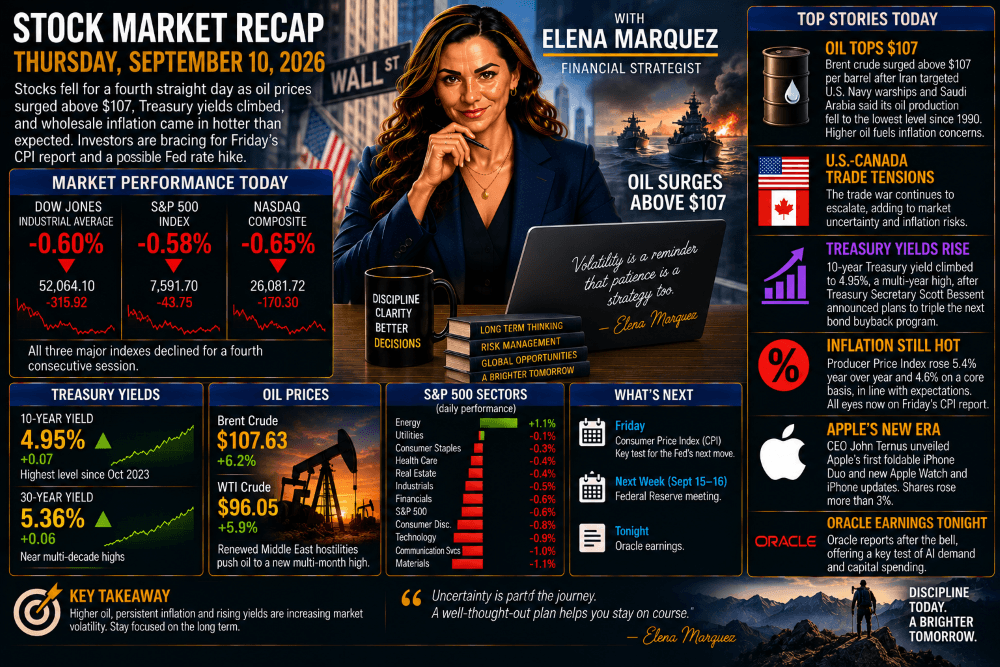
U.S. stocks fell for a fourth consecutive session as oil surged again, Treasury yields climbed toward 5%, and fresh wholesale inflation data strengthened expectations that the Federal Reserve could raise interest rates next week.
Market Performance
📉 Dow Jones Industrial Average: -0.60%
📉 S&P 500: -0.58%
📉 Nasdaq Composite: -0.65%
The Dow closed at 52,064.10, the S&P 500 at 7,591.70, and the Nasdaq at 26,081.72.
The S&P 500 has now lost roughly 2% in four trading sessions.
But today’s biggest story wasn’t stocks.
It was oil.
Oil Surges Above $107
Yesterday, $100 oil was the headline.
Today, that already looks outdated.
Brent crude surged more than 6% Thursday, briefly trading above $108 per barrel before settling around $107.63.
Oil has risen from less than $72 in early July.
The catalyst remains the escalating U.S.-Iran conflict and disruption to energy supplies moving through the Middle East.
Iran has targeted U.S. Navy vessels, while Saudi Arabian oil production has reportedly fallen to its lowest level in decades.
The market is increasingly confronting the possibility that disruptions through the Strait of Hormuz won’t disappear quickly.
And that creates a much bigger economic problem.
An Oil Shock Is Becoming an Inflation Shock
There’s an enormous difference between oil briefly touching $100 and remaining above $100.
If elevated prices persist, they eventually work their way through the economy.
Gasoline becomes more expensive.
Airlines pay more for fuel.
Truckers pay more for diesel.
Manufacturers face higher transportation and input costs.
Consumers have less disposable income.
Businesses eventually have to choose between absorbing those costs or raising prices.
That’s why Wall Street isn’t simply treating the oil rally as an energy-market story anymore.
It’s increasingly becoming an inflation story.
And inflation brings us directly back to the Federal Reserve.
Wholesale Inflation Hits 5.4%
Thursday brought another important piece of the inflation puzzle.
The Producer Price Index rose 0.4% in August and 5.4% from a year earlier.
Core producer inflation, excluding volatile categories, came in around 4.6% annually.
The monthly figure was roughly in line with expectations, but the headline annual rate was slightly hotter than economists anticipated.
That matters because producer prices measure costs faced by businesses.
Companies can absorb higher costs temporarily.
Eventually, however, some of those increases tend to reach consumers.
And now those businesses are simultaneously dealing with dramatically higher energy prices.
Fed Rate-Hike Odds Jump Again
Just a few weeks ago, investors were debating whether the Federal Reserve would simply leave interest rates unchanged.
That debate is changing rapidly.
Following Thursday’s PPI report and the latest oil surge, traders pushed the probability of a rate hike at next week’s Fed meeting to roughly 70%–75%.
Consider what the Fed is looking at:
A surprisingly strong August jobs report.
Oil above $107.
Producer inflation at 5.4%.
And an economy that, despite pockets of weakness, continues to show considerable resilience.
That’s hardly the environment policymakers want when trying to bring inflation back toward 2%.
The Fed increasingly faces an uncomfortable choice.
Raise rates and risk slowing the economy.
Or wait and risk allowing another inflation wave to become entrenched.
The 10-Year Treasury Approaches 5%
The bond market is already delivering its verdict.
The 10-year Treasury yield climbed to approximately 4.95%, its highest level in nearly three years.
The 30-year Treasury yield reached roughly 5.36%, around its highest level in more than two decades.
Those are significant numbers.
A 5% Treasury yield changes the investment equation.
Investors can earn close to 5% lending money to the U.S. government without assuming stock-market risk.
Stocks therefore have to offer a compelling reason to justify their valuations.
Higher yields also increase borrowing costs throughout the economy.
Mortgages.
Corporate debt.
Car loans.
Commercial real estate.
And increasingly important:
AI infrastructure.
AI’s $Trillion Question: Who Pays for Everything?
The artificial-intelligence boom has created extraordinary demand for chips, data centers, electricity and networking equipment.
But all that infrastructure costs money.
A lot of it.
Tech companies and AI infrastructure providers are increasingly using debt markets to finance enormous data-center projects.
That works beautifully when capital is cheap.
It becomes more complicated when long-term borrowing costs approach 5%.
Investors are beginning to ask a question that may become increasingly important:
Can the extraordinary returns promised by AI justify the extraordinary cost of building it?
That makes tonight’s Oracle earnings particularly interesting.
Oracle Faces an AI Reality Check
Oracle reports after Thursday’s closing bell.
Normally, one company’s earnings wouldn’t compete with $107 oil and a potential Fed hike for investors’ attention.
But Oracle has become an important test of the AI infrastructure boom.
The company has committed enormous amounts of capital toward expanding cloud capacity and data centers to satisfy AI demand.
Investors therefore won’t simply be looking at revenue and earnings.
They’ll be watching:
Cloud growth.
AI demand.
Capital expenditures.
Debt.
And most importantly:
Whether those enormous investments are generating adequate returns.
With Treasury yields near 5%, the hurdle just became higher.
Technology Takes the Hit
Higher yields put particular pressure on technology stocks Thursday.
Nvidia fell more than 2%, while Micron dropped nearly 5%.
That’s not necessarily a statement about AI demand.
It’s partly mathematics.
Growth stocks derive a significant portion of their valuations from profits expected years into the future.
When interest rates rise, those future profits become less valuable in today’s dollars.
That’s why technology companies can simultaneously report strong growth while their stocks decline when bond yields rise sharply.
Apple Provides a Bright Spot
Interestingly, Apple moved against the market.
Shares climbed more than 3% following this week’s unveiling of the company’s first foldable iPhone under new CEO John Ternus.
That’s an encouraging early market response to Apple’s new leadership era.
But the larger question remains unchanged:
Can Apple translate its enormous installed base and hardware ecosystem into a credible AI strategy?
The foldable iPhone gives consumers something visibly new.
The harder challenge will be convincing investors that Apple’s artificial-intelligence strategy can compete with Nvidia, Google, Microsoft, Meta and OpenAI.
Friday’s CPI Could Be the Biggest Test Yet
And now we arrive at tomorrow.
Friday’s Consumer Price Index may be the most important economic report before next week’s Federal Reserve meeting.
Thursday’s producer inflation report wasn’t disastrous.
But it wasn’t reassuring either.
And the bigger problem is that inflation data necessarily looks backward.
Oil’s latest surge won’t yet be fully reflected in August’s CPI.
That means even a relatively benign CPI report may not eliminate concerns about inflation in the months ahead.
That’s the dilemma confronting the Fed.
Today’s inflation numbers are being measured against tomorrow’s $107 oil.
Four Straight Days Down
It’s also worth keeping the market decline in perspective.
The S&P 500 has fallen for four consecutive sessions and is now roughly 3% below its August record.
That’s noticeable.
But it’s hardly a market collapse.
The S&P 500 remains up approximately 11% for 2026.
The Nasdaq is still up more than 12%.
Corporate earnings remain relatively strong.
AI spending continues.
And the economy hasn’t fallen into recession.
The problem isn’t that the fundamental bull-market story has disappeared.
The problem is that investors suddenly have to price in a considerably more difficult macroeconomic environment.
The Bottom Line
Wall Street’s equation keeps getting more complicated.
Yesterday it looked like this:
War → Oil → Inflation → Fed → Treasury yields → Stocks
Today we can add another link:
Higher Treasury yields → higher cost of financing the AI boom.
Oil above $107 changes the conversation.
A 10-year Treasury approaching 5% changes the conversation.
Producer inflation at 5.4% changes the conversation.
And a roughly 70%-plus probability of another Fed hike certainly changes the conversation.
The Dow fell 0.60%, the S&P 500 lost 0.58%, and the Nasdaq declined 0.65% Thursday.
Nothing about those numbers looks particularly dramatic.
But beneath them, something important is happening.
The market is beginning to confront the possibility that higher-for-longer interest rates may actually mean higher again.
Tomorrow’s CPI report gets the next vote.
Other Stock Market blog posts