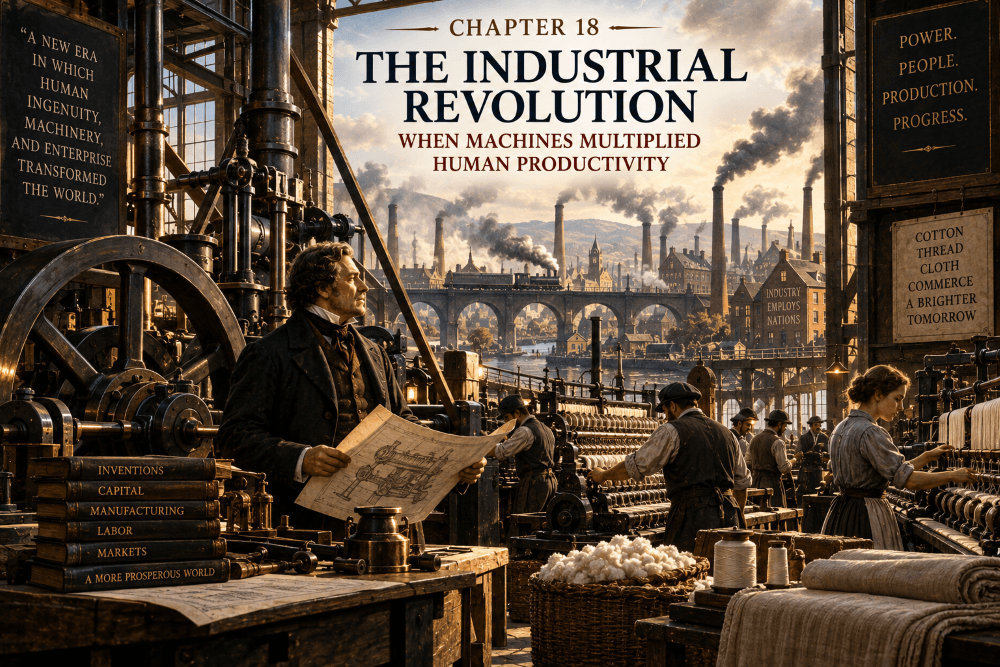
What transformed entrepreneurship more profoundly than better trade routes, better banking, or better financial markets?
Machines.
For thousands of years, economic production remained constrained by human muscle, animal power, wind, and water.
Then the Industrial Revolution changed the equation (approximately 1760 to 1840).
Entrepreneurs began combining machinery, coal, steam power, factories, capital, and organized labor to produce goods on a scale previously unimaginable.
The breakthrough was not simply that people worked harder.
It was that machines allowed every hour of human effort to produce dramatically more.
The entrepreneurial contribution of the Industrial Revolution was:
Mechanization and productivity.
What Was the Industrial Revolution?
The Industrial Revolution was a long period of technological and economic transformation that began most dramatically in Britain during the eighteenth century.
Manufacturing shifted increasingly from small workshops and household production toward mechanized factories.
New technologies transformed:
- Textiles
- Mining
- Iron production
- Transportation
- Energy
- Manufacturing
Production became faster.
Factories became larger.
Cities expanded.
Capital requirements increased.
And entrepreneurs increasingly became industrialists.
Why Did the Industrial Revolution Begin in Britain?
There was no single cause.
Britain combined several advantages at the right moment.
These included:
- Large coal deposits
- Expanding trade
- Growing cities
- Commercial institutions
- Access to capital
- Skilled craftspeople
- Improving agriculture
- Patent protections
- Overseas markets and resources
- A culture of experimentation
No single factor created industrialization.
The transformation emerged because technology, capital, markets, institutions, and entrepreneurship reinforced one another.
Once again, innovation came from an ecosystem.
Textile Manufacturing Led the Transformation
The textile industry became one of the earliest industries to experience dramatic mechanization.
Traditional cloth production required several stages.
Fiber had to be prepared.
Spun into thread.
Woven into fabric.
Finished.
Each stage limited the next.
Improve weaving, and suddenly spinning becomes the bottleneck.
Improve spinning, and another constraint appears.
This created a powerful chain reaction of innovation.
Entrepreneurs constantly searched for the next bottleneck.
The Flying Shuttle Increased Weaving Productivity
In 1733, John Kay patented the flying shuttle.
The device allowed weaving to become faster and made wider looms easier for one person to operate.
That increased cloth production.
But it also created a new problem.
Weavers suddenly needed much more yarn.
Spinners could not keep up.
Innovation had moved the bottleneck.
This remains one of operations management’s most important lessons:
Improving one part of a system often reveals the next constraint.
The Spinning Jenny Multiplied Output
During the 1760s, James Hargreaves developed the spinning jenny.
Instead of spinning one thread at a time, a worker could operate several spindles.
Productivity increased dramatically.
Other spinning technologies followed.
The water frame.
The spinning mule.
Each improved production in different ways.
The important shift was clear.
One worker could now produce far more than before.
Machines were multiplying human effort.
Richard Arkwright and the Factory System
One of the most important entrepreneurs of the early Industrial Revolution was Richard Arkwright.
His achievement went beyond machinery.
Arkwright helped organize production inside increasingly large factories.
Workers.
Machines.
Water power.
Capital.
Raw materials.
Management.
Scheduling.
Production became concentrated under one roof.
This was revolutionary.
The factory was not simply a big workshop.
It was a new business system.
Why the Factory Changed Entrepreneurship
Before factories, production was often scattered.
One family spun thread.
Another family wove cloth.
Merchants coordinated the finished goods.
Factories centralized the process.
They brought together:
- Machinery
- Labor
- Energy
- Supervision
- Inventory
- Management
- Quality control
Centralization created greater efficiency.
But it also created new management challenges.
Entrepreneurs increasingly needed to coordinate hundreds—or eventually thousands—of workers.
The entrepreneur’s role was changing.
James Watt and the Steam Engine
Few technologies symbolize the Industrial Revolution more than the steam engine.
Steam engines existed before James Watt, but Watt dramatically improved their efficiency.
His partnership with businessman Matthew Boulton was especially important.
Watt supplied engineering brilliance.
Boulton helped provide:
- Capital
- Manufacturing
- Sales
- Commercial strategy
- Customer relationships
- Distribution
Together, they demonstrate a key entrepreneurial lesson:
An invention becomes economically important only when someone builds a business around it.
Inventor vs. Entrepreneur
Inventors and entrepreneurs are not always the same person.
The inventor asks:
Can this work?
The entrepreneur asks:
Can customers use it, pay for it, and adopt it at scale?
A brilliant prototype can remain forgotten.
A successful business requires:
Manufacturing.
Pricing.
Sales.
Maintenance.
Training.
Capital.
Distribution.
Entrepreneurs transform technological possibility into economic reality.
Steam Power Removed Geographic Limits
Early factories often relied heavily on water power.
That meant factories had to be built near suitable rivers.
Steam engines reduced that constraint.
Factories could increasingly be located near:
Cities.
Workers.
Markets.
Transportation.
Coal.
Entrepreneurs gained greater freedom in deciding where production should occur.
Energy was becoming more portable.
And that expanded the geography of industry.
Coal Powered Industrial Growth
Coal was one of industrialization’s most important resources.
It contained concentrated energy.
Burning coal produced heat.
Steam engines converted that heat into mechanical power.
Industrial societies could now tap energy stored underground over millions of years.
That dramatically increased productive capacity.
Business history often focuses on money and technology.
But economic growth also depends on energy.
Every factory, mine, railroad, server farm, and transportation system ultimately requires power.
Productivity Changed the Economy
Suppose a worker produces 10 units per day.
A machine allows that same worker to produce 100.
The worker did not become ten times stronger.
The system became more productive.
That is productivity.
Productivity measures how much output can be produced from available resources.
Higher productivity can lead to:
- Lower costs
- Lower prices
- Higher wages over time
- Larger markets
- More investment
- Higher living standards
Few concepts matter more to long-term economic growth.
Lower Prices Created Larger Markets
Industrial machinery allowed manufacturers to produce more goods at lower cost.
As prices declined, more consumers could afford products.
That expanded demand.
More demand encouraged factories to grow.
Larger factories justified more machinery.
More machinery improved productivity further.
A feedback loop emerged:
Productivity → lower prices → larger markets → more investment → higher productivity.
Industrial entrepreneurship became self-reinforcing.
Mass Production Begins
Industrialization moved business toward another powerful idea:
Produce standardized goods in large quantities.
Traditional craftsmen often created unique products.
Factories focused increasingly on consistency.
Can we make:
100 units?
1,000 units?
100,000 units?
And make them quickly, reliably, and cheaply?
This shift laid the foundation for later developments such as interchangeable parts and assembly-line production.
Standardization Returned in a New Form
Earlier in our history, the Indus Valley introduced the entrepreneurial importance of standardization.
Industrial factories needed the same principle.
Machine parts required predictable dimensions.
Processes needed repeatability.
Products needed consistent quality.
Workers needed clear procedures.
Entrepreneurial ideas do not disappear as history advances.
They accumulate.
The Industrial Revolution combined standardization with mechanization.
Factories Required More Capital
Industrial factories were expensive.
Entrepreneurs needed money for:
- Buildings
- Machinery
- Steam engines
- Raw materials
- Wages
- Inventory
- Transportation
This meant industrialization depended heavily on financial tools developed in earlier centuries.
Banks.
Credit.
Insurance.
Joint-stock companies.
Capital markets.
The financial innovations of Amsterdam helped finance the mechanical innovations of industrial Britain.
Entrepreneurship builds upon earlier entrepreneurship.
Industrialists Became Capital Allocators
A factory owner faced constant investment decisions.
Should capital be spent on:
A new machine?
A second factory?
More inventory?
Transportation?
A better steam engine?
Hiring skilled workers?
Expanding into another market?
This made capital allocation increasingly important.
The entrepreneur no longer succeeded merely by selling products.
He succeeded by deciding where scarce capital would produce the highest return.
Modern CEOs still spend much of their time making exactly that decision.
Machines Wear Out
Industrialization created another accounting challenge.
Factories owned expensive machines.
Machines:
Wear out.
Break.
Require maintenance.
Become obsolete.
A machine purchased today may produce goods for years.
Businesses therefore needed to understand that the machine’s cost was spread across its useful life.
This helped make concepts such as depreciation increasingly important.
More complex businesses required more sophisticated accounting.
Adam Smith and the Division of Labor
Industrialization also intensified specialization.
Adam Smith famously described pin manufacturing in The Wealth of Nations.
If one worker tries to make the entire pin alone, output remains low.
Divide the work into specialized tasks and productivity rises dramatically.
One worker draws wire.
Another cuts it.
Another sharpens it.
Another attaches the head.
Specialization improves speed and efficiency.
But it creates a trade-off.
A worker who once created an entire product may now repeat one task all day.
Productivity rises.
Job satisfaction may not.
The Factory Changed People’s Relationship With Time
Industrial factories increasingly organized work according to clocks.
Start time.
Break time.
End time.
Production schedules.
Machine downtime.
Labor hours.
Time became an economic input.
An idle machine represented lost production.
A delayed shipment created costs.
Modern management’s obsession with schedules, productivity, and deadlines has deep roots in industrialization.
Industrialization Accelerated Urbanization
Factories needed workers.
Workers moved toward factories.
Cities expanded rapidly.
Places like Manchester grew into symbols of industrial change.
Urban growth created entire new markets.
Housing.
Transportation.
Food.
Retail.
Construction.
Banking.
Entertainment.
One successful industry creates opportunities for many others.
Entrepreneurship produces ecosystems.
Industrial Growth Had Serious Human Costs
The Industrial Revolution eventually increased productive capacity and contributed to enormous long-term improvements in living standards.
But the early transition could be brutal.
Many industrial cities suffered from:
- Overcrowding
- Pollution
- Poor sanitation
- Dangerous workplaces
- Long hours
- Industrial accidents
- Low wages
- Child labor
This distinction is essential.
Productivity creates the possibility of prosperity.
It does not guarantee fair distribution.
Institutions, laws, bargaining power, and social reform shape who benefits.
Child Labor and Industrialization
Children had worked throughout human history, particularly in agriculture and family businesses.
Industrialization concentrated child labor in factories and mines under conditions that could be extremely dangerous.
Families often depended on the income.
Factory owners benefited from inexpensive labor.
Political pressure and legislation eventually restricted child labor and improved working conditions.
This history reminds entrepreneurs of something important:
Labor is not simply another cost.
Workers are people.
Entrepreneurs and Workers Had Conflicting Interests
Industrialization intensified the relationship between capital and labor.
Business owners wanted:
Lower costs.
Higher productivity.
Longer machine utilization.
Workers wanted:
Higher wages.
Shorter hours.
Safety.
Greater security.
These interests sometimes aligned.
Profitable factories created employment.
But they also frequently conflicted.
Those conflicts helped produce:
Labor unions.
Worker organizations.
Political reform.
Employment regulation.
Industrial entrepreneurship reshaped society far beyond factory walls.
Who Were the Luddites?
The Luddites are often described simply as people who hated technology.
That is misleading.
Many Luddites were skilled textile workers who resisted machinery they believed was being used to undermine wages, employment, and traditional working conditions.
Their concern was not necessarily:
Machines are evil.
It was closer to:
Who receives the benefits of these machines?
That question remains relevant today whenever new technologies threaten existing jobs.
Creative Destruction
Economist Joseph Schumpeter later used the phrase creative destruction to describe capitalism’s tendency to replace older technologies, businesses, and jobs with new ones.
The Industrial Revolution made this process obvious.
Factories replaced some traditional production methods.
Machines replaced some tasks.
New industries appeared.
Old occupations declined.
Innovation creates.
Innovation also destroys.
Entrepreneurs often experience the upside.
Displaced workers may experience the downside.
Both are part of the same economic transformation.
Steam Transformed Transportation Too
Factories could produce enormous quantities of goods.
But production is useless if products cannot reach customers.
Transportation became another bottleneck.
Canals expanded.
Roads improved.
Steam was eventually applied to:
Ships.
Railways.
Transportation became faster and more predictable.
Markets expanded again.
Industrialization began compressing distance.
Patents Made Ideas More Valuable
Industrial inventions could require years of experimentation.
If competitors could immediately copy every invention, entrepreneurs and inventors might have less incentive to invest.
Patent systems offered temporary legal protection.
That turned inventions into economic assets.
A patent could be:
Licensed.
Sold.
Used to attract investment.
Built into a business.
Knowledge itself increasingly became intellectual property.
That concept would eventually become enormously important in software, pharmaceuticals, technology, and media.
Boulton & Watt Sold Productivity
Matthew Boulton and James Watt developed an especially interesting business model.
Rather than simply selling steam engines as equipment, they sometimes structured charges partly around the fuel savings achieved compared with older engines.
They were effectively selling:
Economic results.
Not machinery.
Customers did not really want steam engines.
They wanted:
Lower costs.
More output.
Better productivity.
This is essentially value-based pricing.
Modern software and consulting companies use similar business models today.
Great Entrepreneurs Sell Outcomes
Customers rarely want technology simply because it exists.
They want what technology allows them to achieve.
A factory owner did not want steam.
He wanted:
More production.
Lower fuel costs.
More flexibility.
Higher profits.
The entrepreneurial task was therefore:
Turn technology into an economically valuable outcome.
That remains true today.
Customers do not buy artificial intelligence because they want algorithms.
They buy:
Faster work.
Lower costs.
Better decisions.
More revenue.
The Industrial Revolution Was Gradual
The term Industrial Revolution makes the change sound sudden.
It wasn’t.
Industrialization developed over many decades.
Machines improved.
Factories expanded.
Energy systems changed.
Management evolved.
Different industries transformed at different speeds.
Different countries industrialized at different times.
The consequences were revolutionary.
The process was evolutionary.
That is another recurring entrepreneurial pattern.
Small improvements compound until the world suddenly looks different.
Productivity and Living Standards
Over the long term, industrialization helped generate unprecedented increases in material living standards.
But the benefits did not arrive immediately or equally.
Higher productivity created the capacity for greater prosperity.
Other institutions helped determine how broadly that prosperity spread.
Education.
Sanitation.
Labor reforms.
Public infrastructure.
Political participation.
Better housing.
Higher wages.
Technology creates possibilities.
Institutions shape outcomes.
Industrialization Created Pollution
Factories produced more than goods.
They also produced external costs.
Coal smoke.
Dirty water.
Industrial waste.
Mining damage.
Later, industrial activity would contribute heavily to greenhouse gas emissions.
Businesses could earn private profits while society paid some of the costs.
Economists call these costs externalities.
This leads to an important question:
What happens when the company makes money but someone else pays part of the bill?
Entrepreneurial success should consider more than profit alone.
Economies of Scale Changed Competition
Factories also demonstrated the power of economies of scale.
Producing more units can lower the average cost of each unit.
Why?
Fixed costs are spread across more output.
Workers specialize.
Machines operate more efficiently.
Inputs can be purchased in bulk.
Management systems improve.
Large companies can sometimes produce more cheaply than small competitors.
This encourages businesses to grow.
Scale Can Become a Competitive Barrier
Economies of scale also create barriers to entry.
Suppose an efficient factory requires millions of dollars.
A small competitor cannot simply start producing at the same cost.
Capital itself becomes an advantage.
Industrialization therefore encouraged the growth of larger firms.
This would eventually lead to new debates over:
Monopoly.
Market power.
Antitrust.
Corporate regulation.
The entrepreneur was becoming more powerful.
Society would eventually ask how much power a private business should have.
The Entrepreneur’s Toolbox
Mechanization and Productivity
The Industrial Revolution adds one of entrepreneurship’s most powerful tools.
Mechanization.
Machines multiply human effort.
Higher productivity allows the same resources to generate more output.
That can lower costs.
Expand markets.
Increase investment.
And eventually improve living standards.
For thousands of years, entrepreneurs focused heavily on moving goods more efficiently.
Industrialization transformed the efficiency of making them.
Five Lessons Modern Entrepreneurs Can Learn From the Industrial Revolution
1. Improve the System Before Demanding More Effort
Better technology and processes usually create more productivity than simply asking people to work longer hours.
2. Bottlenecks Keep Moving
Solving one constraint often reveals the next.
Optimization is continuous.
3. Invention Is Only the Beginning
An invention creates economic impact only when entrepreneurs turn it into a scalable business.
4. Productivity Is the Foundation of Long-Term Prosperity
The ability to produce more value with fewer resources creates room for higher wages, lower prices, and larger markets.
5. Innovation Has Consequences
Technological progress creates winners and losers.
Responsible entrepreneurs should understand the human and environmental effects of disruption.
Frequently Asked Questions
What was the Industrial Revolution?
The Industrial Revolution was a period of major technological and economic transformation beginning most dramatically in eighteenth-century Britain, when manufacturing increasingly shifted toward machines, factories, steam power, and large-scale production.
Why did the Industrial Revolution begin in Britain?
There was no single cause. Britain combined coal, capital, skilled workers, trade, markets, agricultural productivity, institutions, and technological experimentation in ways that supported industrialization.
Why was the steam engine important?
Steam engines provided reliable mechanical power and reduced industry’s dependence on water-powered locations, allowing factories and transportation systems to expand.
Who was James Watt?
James Watt was a Scottish engineer who significantly improved steam-engine efficiency. His partnership with businessman Matthew Boulton helped commercialize steam power.
Why was Richard Arkwright important?
Richard Arkwright helped develop and organize mechanized textile production through factory systems that brought machinery, workers, energy, and management together under one roof.
What is productivity?
Productivity refers to how efficiently labor, capital, and other resources are converted into output. Higher productivity allows economies to produce more value using the same or fewer resources.
What entrepreneurial lesson does the Industrial Revolution teach?
The central lesson is that technology creates the greatest value when entrepreneurs use it to improve productivity, lower costs, and scale production.
The Entrepreneur’s Toolkit So Far
| Chapter | Entrepreneurial Contribution |
|---|---|
| Chapter 1 | Exchange |
| Chapter 2 | Surplus |
| Chapter 3 | Accounting |
| Chapter 4 | Professional Merchants |
| Chapter 5 | Money |
| Chapter 6 | Standardization |
| Chapter 7 | Continuous Improvement |
| Chapter 8 | Networks |
| Chapter 9 | Competition |
| Chapter 10 | Scale |
| Chapter 11 | Knowledge & Financial Innovation |
| Chapter 12 | Risk-Sharing & Commercial Institutions |
| Chapter 13 | Organizational Scale |
| Chapter 14 | Portable Trust |
| Chapter 15 | Pooled Capital |
| Chapter 16 | Tradable Ownership & Permanent Capital |
| Chapter 17 | Market Psychology & Price Discovery |
| Chapter 18 | Mechanization & Productivity |
The change is profound.
The early entrepreneur improved exchange.
The industrial entrepreneur improves output per unit of effort.
That becomes the foundation for modern economic growth.
Continue the Journey: The Railroad Revolution
Factories could suddenly produce far more goods.
But those goods still needed to reach customers.
Distance became the next constraint.
The answer was one of the nineteenth century’s most transformative technologies:
The railroad.
Railroads would connect factories with cities.
Farmers with markets.
Workers with jobs.
Ports with inland economies.
They would reduce travel time.
Standardize schedules.
Expand national markets.
And require enormous amounts of capital.
Stocks.
Bonds.
Banks.
Government support.
Speculation.
Railroad entrepreneurship would transform both transportation and finance.
In Chapter 19, we’ll explore:
The Railroad Revolution
When Entrepreneurs Conquered Distance
The next entrepreneurial contribution will be:
Speed, Connectivity, and Infrastructure Networks.
Related Articles
- Johannes Gutenberg: The Entrepreneur Who Printed a Revolution
- The Antwerp Exchange: Europe’s First Finance Hub
- Spanish Silver: How Mines Built the First Global Currency
- The Atlantic Trade Triangle: Commerce’s Darkest Chapter
- Marine Insurance: How Lloyd’s Coffee House Priced Risk
- Joint-Stock Companies: The Structure That Scaled Business
- The British East India Company: Trade Turned Empire
About The History of Entrepreneurship
This article is part of The History of Entrepreneurship, an ongoing series exploring how civilizations, technologies, entrepreneurs, investors, institutions, and markets gradually created the foundations of modern business.
Each chapter asks:
What entrepreneurial tool did this period add to the world?
For the Industrial Revolution, the answer is:
Mechanization and productivity.
Machines allowed entrepreneurs to multiply human effort and transform production itself.
North Star
The Industrial Revolution transformed entrepreneurship by giving machines the ability to multiply human productivity. Factories combined capital, technology, energy, workers, and organization into systems capable of producing goods at unprecedented scale. The industrial entrepreneur’s greatest contribution was not simply building machines—it was turning technology into productivity.