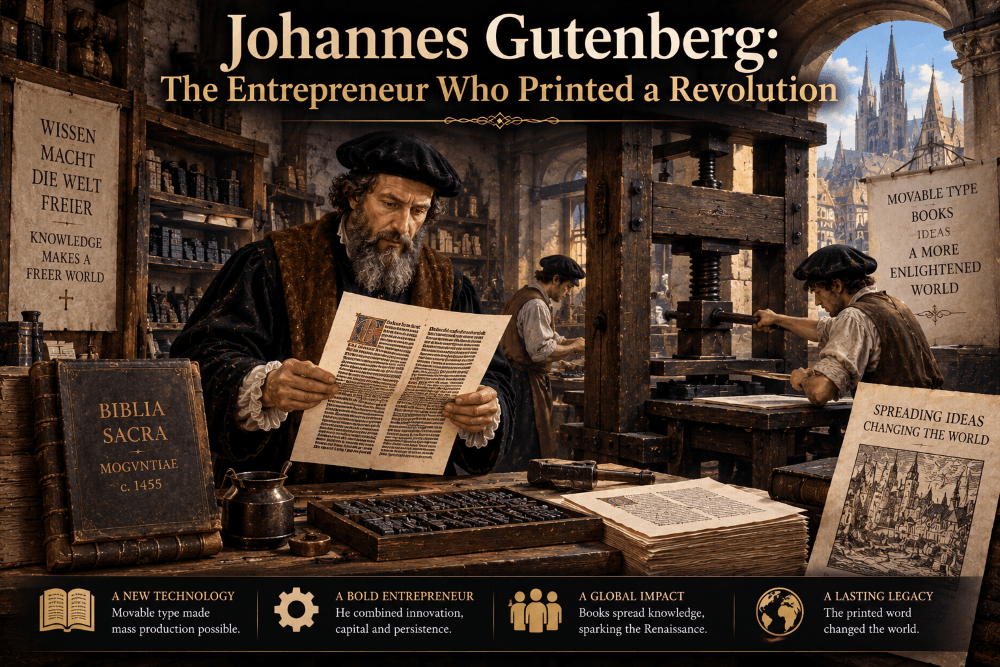
Johannes Gutenberg is remembered today as the inventor of the printing press, but his story is just as much about entrepreneurship as it is about technology. Financing his invention through risky loans, guarding his methods as trade secrets, and ultimately losing control of his own business through legal disputes, Gutenberg’s life reveals how even history’s most transformative innovations can come with brutal financial and personal costs.
Who Was Johannes Gutenberg?
Johannes Gutenberg was born around 1400 in Mainz, Germany, into a family involved in trade and, notably, metalworking.
- His background gave him practical skills in metallurgy, an unusual but crucial foundation for what he would eventually invent.
- He worked for years developing and refining his printing technology largely in secret, protecting what he clearly understood to be valuable intellectual property.
- By the early 1450s, he had developed a functional printing system combining movable metal type, oil-based ink, and a modified press design.
His technical background combined with genuine entrepreneurial instinct to protect and eventually commercialize his invention.
The Business Innovation Behind Gutenberg’s Printing Press
Solving a Real Market Problem
Before Gutenberg, books were painstakingly copied by hand, making them extremely expensive, slow to produce, and inaccessible to most people.
- Hand-copied manuscripts could take months or years to complete, drastically limiting the number of books in circulation.
- This scarcity meant books were largely restricted to wealthy individuals, churches, and universities.
- Gutenberg recognized that mechanizing this process could dramatically increase output while lowering costs.
His innovation wasn’t simply technical brilliance for its own sake. It directly addressed a significant, unmet market need.
Movable Type as a Scalable System
The core of Johannes Gutenberg’s innovation was a genuinely reusable, scalable system rather than a single clever device.
- Individual metal letters could be arranged, used, and then rearranged for entirely different texts.
- This modularity meant the same equipment could produce vastly different books without needing to be rebuilt each time.
- Combined with an efficient press mechanism, this system allowed for dramatically faster production than hand-copying ever could.
This scalability is what transformed Gutenberg’s invention from a clever novelty into something capable of genuinely reshaping an entire industry.
Financing and the Business Risks Gutenberg Faced
Borrowing to Build His Vision
Like many entrepreneurs pursuing capital-intensive innovations, Gutenberg needed significant funding to develop and scale his printing system.
- He borrowed substantial sums from a wealthy financier named Johann Fust to fund his printing operations.
- This financing allowed him to build the equipment and materials necessary to produce his most famous work, the Gutenberg Bible, around 1455.
- The loan came with real financial risk, structured in a way that placed Gutenberg’s equipment and business at stake if he couldn’t repay it.
This financing arrangement illustrates a pattern still familiar to entrepreneurs today: transformative innovation often requires outside capital, and that capital comes with real strings attached.
Losing Control of His Own Invention
Gutenberg’s financial arrangement ultimately backfired in a way that remains a cautionary tale in business history.
- Fust sued Gutenberg for repayment, and a court ruling ultimately awarded Fust control over Gutenberg’s printing equipment and workshop.
- Gutenberg was effectively pushed out of the very business he had built from years of technical development.
- Fust, along with Gutenberg’s former assistant Peter Schöffer, continued operating the printing business successfully without him.
Despite creating one of history’s most important technologies, Gutenberg himself saw limited financial reward from his own invention.
The Broader Economic Impact of the Printing Press
Rapid Spread Across Europe
Once Gutenberg’s printing methods became known, they spread across Europe with remarkable speed.
- Printing workshops using similar technology appeared in cities across Germany, Italy, France, and beyond within just a few decades.
- Book production increased dramatically, making written knowledge more accessible than at any previous point in history.
- This rapid diffusion shows how quickly a genuinely transformative business innovation could scale once proven viable.
Fueling Later Commercial and Intellectual Growth
The printing press’s economic impact extended well beyond the printing industry itself.
- It enabled the wider distribution of financial and business knowledge, including works like Luca Pacioli’s writings on double-entry bookkeeping.
- It supported the spread of new ideas during the Renaissance and later the Reformation, reshaping European intellectual and religious life.
- It created an entirely new commercial industry around publishing, bookselling, and distribution that continues in evolved forms today.
Lessons from Johannes Gutenberg
- Solve a real problem at scale. Gutenberg’s system succeeded because it addressed genuine, widespread demand for accessible books.
- Capital comes with risk. Borrowing to fund innovation can be necessary, but it can also cost founders control of what they built.
- Innovation can outlive its inventor’s fortune. Gutenberg lost his business, yet his invention transformed the world regardless.
Frequently Asked Questions
What did Johannes Gutenberg invent? Gutenberg developed a printing system using movable metal type, oil-based ink, and a modified press, allowing books to be produced far faster and more affordably than by hand-copying.
Did Johannes Gutenberg become wealthy from his invention? No, Gutenberg lost control of his printing business after a legal dispute with his financier, Johann Fust, and saw limited financial reward despite his invention’s massive impact.
What was the Gutenberg Bible? The Gutenberg Bible, produced around 1455, was one of the first major books printed using Gutenberg’s system and remains a landmark achievement in printing history.
How did the printing press impact the economy? It dramatically lowered the cost of producing books, increased access to knowledge, and created an entirely new publishing industry that supported the spread of ideas across Europe.
Related Articles
- The Antwerp Exchange: Europe’s First Finance Hub
- Spanish Silver: How Mines Built the First Global Currency
- The Atlantic Trade Triangle: Commerce’s Darkest Chapter
- Marine Insurance: How Lloyd’s Coffee House Priced Risk
- Joint-Stock Companies: The Structure That Scaled Business
- The British East India Company: Trade Turned Empire
- Tulipmania: What the Famous Bubble Really Teaches About Markets