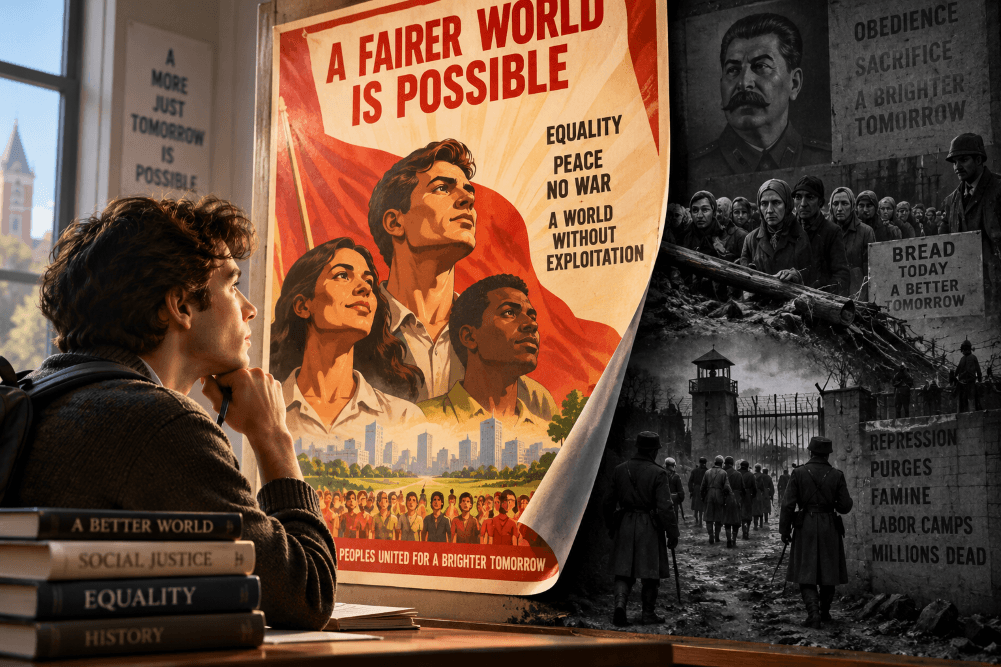
History has given us plenty of opportunities to observe Marxism-Leninism in practice. The results include dictatorship, political repression, forced collectivization, economic failures, imprisonment, famine, and millions of deaths.
Yet the ideology has repeatedly attracted young people, students, writers, professors, activists, and intellectuals.
That raises a question I find fascinating: Why?
Why would people support Marxism-Leninism while atrocities were taking place? More puzzling, why does the ideology retain intellectual appeal after we have had decades to study what happened?
I think part of the answer is that we focus too much on whether Marxism-Leninism works economically and not enough on why it is psychologically, morally, and politically attractive.
First, What Is Marxism-Leninism?
We should distinguish Marxism-Leninism from every political movement on the left.
Karl Marx’s writings encompass philosophy, economics, history, and a critique of capitalism. Social democracy, democratic socialism, modern progressivism, and Marxism-Leninism are not the same thing.
Marxism-Leninism developed into something more specific: revolutionary politics organized around a disciplined Communist Party claiming to represent the historical interests of the working class.
That distinction matters.
The problem I am interested in isn’t whether governments should provide universal healthcare, redistribute some income, regulate corporations, or maintain a social safety net. Capitalist democracies have been debating those questions for generations.
I am interested in the much more radical proposition that an enlightened political movement can acquire enormous power over society in order to remake it.
Marxism-Leninism Offers a Beautiful Destination
The first attraction is obvious.
Imagine telling a 20-year-old:
- We can eliminate exploitation.
- We can end extreme inequality.
- We can overcome racism and oppression.
- We can stop imperialist wars.
- Workers will no longer be exploited by wealthy capitalists.
- Everyone will have access to society’s resources.
- Human beings will finally become genuinely equal.
Those are powerful promises.
Young people are often impatient with injustice. I don’t mean that as an insult. In many ways, it is an admirable characteristic of youth.
When you see poverty beside enormous wealth, workers being exploited, racial discrimination, corruption, colonialism, or war, it is natural to ask:
Why should we tolerate this? Why don’t we change the whole system?
Marxism-Leninism doesn’t merely promise incremental improvement.
It promises transformation.
Marxism-Leninism Provides a Total Explanation
There is another attractive feature: simplicity.
The ideology gives you an intellectual framework through which an enormous range of events can be interpreted.
Why is there poverty? Class exploitation.
Why are there wars? Imperialism and economic interests.
Why are workers unhappy? Alienation.
Why do wealthy people have political influence? Control over capital.
Why don’t workers revolt against the system? They may not understand their true class interests.
Suddenly, an incredibly complicated world becomes comprehensible.
This is immensely satisfying.
Instead of hundreds of unrelated problems requiring different solutions, you have identified an underlying system responsible for many of them.
And once you identify the disease, the ideology offers the cure.
The Ideology Can Become Difficult to Falsify
This is where things become dangerous.
Suppose you believe capitalism inevitably produces exploitation and war.
Then someone points to atrocities committed by a Marxist-Leninist government.
You can acknowledge them while preserving the larger belief.
Yes, innocent people were imprisoned.
Yes, collectivization caused enormous suffering.
Yes, political opponents were killed.
Yes, the government became authoritarian.
But what is the alternative?
Are you defending exploitation?
Are you defending imperialism?
Are you defending landlords while peasants have nothing?
Are you defending billionaires while workers struggle?
The argument becomes extraordinarily powerful because criticism of the means can be transformed into apparent opposition to the ends.
If you criticize the revolution, perhaps you are helping the counterrevolution.
If you criticize the party, perhaps you are helping the capitalist class.
If you oppose confiscation, perhaps you are defending exploitation.
The ideology therefore has a built-in mechanism for neutralizing criticism.
The critic doesn’t merely become someone who disagrees with your methods. He risks becoming an accomplice of injustice.
Then Comes the “March of History”
Marxism-Leninism also offers something psychologically comforting: the belief that history has a direction.
Humanity is moving somewhere.
Capitalism is not simply one economic arrangement among many. It is a historical stage containing contradictions that will eventually lead to another social order.
This creates an extraordinary moral temptation.
If history is moving toward justice, equality, and liberation, then temporary suffering can be rationalized as the unfortunate cost of reaching the destination.
People will suffer.
Mistakes will be made.
Innocent people may even die.
But the revolution is building a better world.
The danger should be obvious: once the future becomes morally perfect, almost any sacrifice in the present can be justified in its name.
Marxism-Leninism and the Intellectual Class
There is another explanation that I find particularly interesting.
Marxism-Leninism gives intellectuals an extraordinarily important role in society.
Consider how a market economy normally works.
Millions of people independently make decisions.
A restaurant owner decides what food to sell.
An entrepreneur decides whether to open a factory.
A consumer decides which product to buy.
An investor decides where to put his savings.
A worker decides which employer to work for.
Most of these decisions don’t require permission from an intellectual, economist, professor, or central planner.
Of course, markets are far from perfect. People begin with different opportunities. Capital is distributed unequally. Some businesses have enormous advantages over others.
But economic power remains substantially decentralized.
That can be frustrating to people who believe they understand how society should operate.
The Intellectual Becomes the Planner
Marxism-Leninism reverses the relationship.
If markets produce unjust outcomes, someone must correct them.
If private investment produces the wrong industries, someone must direct investment.
If inequality is unacceptable, someone must determine the appropriate distribution of resources.
If private property produces exploitation, someone must decide how property should be allocated.
Who is that someone?
The state.
And who runs the state?
The political and administrative class.
Suddenly, theoretical knowledge becomes political power.
The intellectual is no longer merely writing articles explaining how society ought to function. He can become part of an institution with the authority to make society conform to the theory.
That is an enormous temptation.
“We Know Better”
Marxism-Leninism historically faced an uncomfortable problem.
What happens when the workers themselves don’t support the revolution?
One answer is that people can misunderstand their own interests.
They have been influenced by existing institutions, culture, religion, nationalism, consumerism, or capitalist ideology.
This creates a dangerous political proposition:
The people may not know what is best for the people.
But the revolutionary intellectual does.
Once you accept that premise, democracy itself can become an obstacle.
Why should the revolution be stopped merely because 51% of voters don’t understand historical forces?
Why allow supposedly reactionary newspapers to spread misinformation?
Why allow wealthy people to finance opposition?
Why allow property owners to obstruct redistribution?
Every institution capable of restraining revolutionary power can gradually be reinterpreted as an instrument of oppression.
Power Without the Usual Democratic Restraints
This helps explain another attraction of revolutionary ideology: it can provide moral justification for enormous political power.
In a liberal democracy, politicians face annoying constraints.
Elections.
Courts.
Opposition parties.
Private property.
Federalism.
Independent businesses.
A free press.
Civil society.
Constitutions.
All these institutions make radical social transformation frustratingly slow.
That is partly their purpose.
They prevent one group of people—even people convinced of their own virtue—from easily imposing their vision on everybody else.
For the revolutionary, however, these safeguards can look like obstacles protecting an unjust status quo.
Remove the obstacles, and suddenly society can be redesigned.
The Historical Record Should Make Us Cautious
The consequences of concentrating that much power are no longer theoretical.
Under Joseph Stalin, forced collectivization cost millions of lives, while millions of perceived “enemies of the people” were imprisoned, exiled, or executed during his consolidation of power and purges.
Cambodia provides another horrifying example. The Khmer Rouge attempted to construct a classless agrarian society through collectivization, abolition of private property and markets, forced labor, political persecution, and radical social transformation. Nearly two million people died between 1975 and 1979.
These regimes differed enormously in culture, circumstances, leadership, and policy. We should be careful about pretending that every disaster had one simple cause.
But there is a recurring political danger worth recognizing:
When a government claims both superior moral purpose and enormous centralized power, who is allowed to tell it that it is wrong?
Social Engineering Eventually Requires Coercion
Every government uses some coercion.
We pay taxes whether we enjoy paying them or not. Governments enforce contracts, regulate pollution, punish crime, and impose countless rules.
The relevant question is not whether government should ever use coercion.
The question is how much power we are willing to give people who believe they know what society should look like.
Large-scale social engineering inevitably collides with human beings who have different plans.
The farmer doesn’t want to surrender his farm.
The business owner doesn’t want to surrender his company.
The journalist doesn’t want to stop criticizing the government.
The religious believer doesn’t want to abandon his faith.
The voter doesn’t want the revolutionary party.
What happens then?
The planner eventually has only two choices: abandon the plan or force people to comply.
Why Young People Can Be Particularly Susceptible
Youth has one characteristic that revolutionary movements can exploit exceptionally well: impatience.
Why wait 30 years to reduce poverty?
Why tolerate another generation of discrimination?
Why accept another war?
Why compromise with people defending an unjust system?
The revolutionary answers:
We don’t have to.
Destroy the old institutions. Build new ones. Put the right people in charge.
That message can be intoxicating.
Incremental reform sounds boring beside revolution.
“Let’s improve the institutions” cannot compete emotionally with “Let’s build a new world.”
But Intellectuals Face Another Temptation
For intellectuals, there can be something else involved besides compassion for the disadvantaged.
Status.
Imagine spending years studying political theory, economics, sociology, philosophy, history, or public policy while watching entrepreneurs with little academic education accumulate enormous wealth and influence.
The market delivers an irritating message:
Nobody is obligated to value your knowledge as highly as you value it yourself.
A political system centered around planning delivers a very different message.
Your knowledge qualifies you to organize society.
You don’t merely deserve a voice.
You deserve authority.
That doesn’t mean every Marxist intellectual secretly desires power. Many Marxists have undoubtedly been motivated by sincere outrage over poverty, exploitation, racism, colonialism, and inequality.
But political systems should never be judged only by the purity of their supporters’ intentions.
We should also ask what incentives the system creates.
Good Intentions Don’t Eliminate the Problem of Power
Perhaps this is the central lesson.
The attraction of Marxism-Leninism doesn’t require people to be evil.
Quite the opposite.
It can appeal precisely because people want to eliminate genuine injustices.
That is what makes the ideology so powerful.
The revolutionary doesn’t wake up thinking:
How can I become a dictator?
He thinks:
How can I eliminate injustice?
But if eliminating injustice requires controlling property, investment, education, information, employment, and political opposition, enormous power gradually becomes morally defensible.
And the person exercising that power can continue believing that he is acting on behalf of humanity.
The Most Dangerous Political Question
The great political question is therefore not:
Who has the best intentions?
It is:
What prevents the people with the best intentions from abusing their power?
Capitalism has serious flaws.
Markets produce inequality.
Corporations can exploit political influence.
Democracies make terrible mistakes.
Governments can become corrupt.
People do not begin life with equal opportunities.
Those problems deserve criticism and reform.
But acknowledging the defects of capitalism does not require believing that a small group of enlightened people should acquire the authority to redesign society.
Perhaps the enduring lesson of Marxism-Leninism is not merely economic.
It is a lesson about human nature and political power.
The dream of creating a perfectly just society is extraordinarily attractive.
But the more perfect the destination appears, the easier it becomes to justify coercion along the road toward it.
And whenever someone tells us that history is inevitably marching toward justice—and that they should be given extraordinary power to lead us there—we should ask the simplest question of all:
Who gets to say no?
Frequently Asked Questions
Why is Marxism-Leninism attractive to young people?
Marxism-Leninism offers a powerful moral narrative: injustice has identifiable structural causes, society can be radically transformed, and exploitation and inequality can eventually be overcome. For young people frustrated by gradual political change, revolutionary transformation can be particularly appealing.
Why were intellectuals attracted to Marxism?
Marxism offered intellectuals a comprehensive framework for interpreting economics, history, politics, class, and social conflict. Marxist movements also gave intellectuals potentially important roles as theorists, organizers, administrators, and planners in constructing a new society.
Is Marxism the same as Marxism-Leninism?
No. Marxism refers broadly to ideas originating with Karl Marx and subsequent traditions inspired by his work. Marxism-Leninism developed into a specific revolutionary political doctrine emphasizing Communist Party leadership, centralized political authority, and transformation of society. Democratic socialism and social democracy should not automatically be classified as Marxism-Leninism.
Why did people continue supporting Marxism-Leninism after its failures became apparent?
Ideologies can survive contrary evidence when supporters distinguish between the ideal and its implementation. Failures may be attributed to particular leaders, hostile foreign powers, insufficient commitment to the revolution, historical circumstances, or deviations from the “true” ideology. The promised destination can therefore survive even when particular attempts to reach it end disastrously.