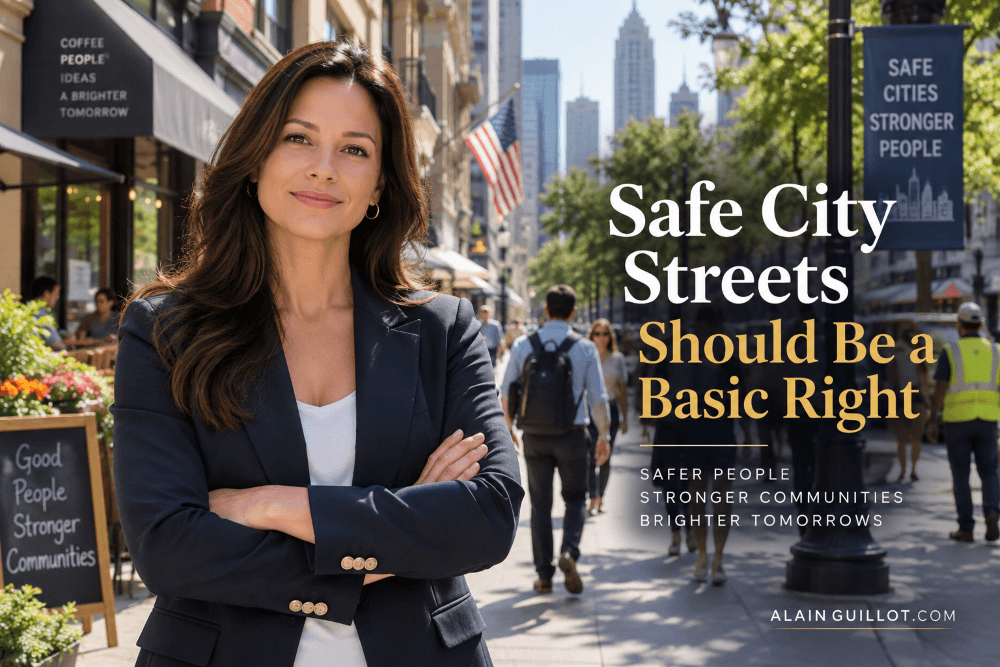
Safe city streets should be one of the most basic things citizens can expect from their government.
People should be able to go to work, operate a business, ride public transportation, walk home, raise their children and enjoy their neighborhoods without constantly worrying about theft, assault, drugs or violence.
In my view, this responsibility comes before many of the other things modern governments have decided to do.
Governments debate redistribution, subsidies, tax credits and hundreds of social programs. But before government tries to redistribute prosperity, it should fulfill one of the oldest and most fundamental responsibilities of the state: protect peaceful citizens from people who would harm them.
Safe City Streets Are Part of the Social Contract
Most ordinary people ask remarkably little from government.
They wake up, go to work, pay their bills, take care of their families and try to improve their lives. Business owners create products and services, employ people and pay taxes.
In return, they should reasonably expect something fundamental: peace and security.
If governments are going to collect a significant portion of people’s income through taxation, protecting citizens and their property should be near the top of the list of services provided in return.
A society in which ordinary people are afraid to use the subway, merchants have to lock inexpensive products behind glass, or residents avoid certain streets after dark has failed an important test of government.
Public safety isn’t a luxury.
It is part of the foundation upon which everything else is built.
Crime Is Also an Economic Issue
Crime isn’t merely a policing issue. It imposes an economic tax on everyone.
When theft becomes common, retailers spend more money on security. Insurance becomes more expensive. Businesses may close locations or leave troubled neighborhoods entirely.
When streets become dangerous, customers stay home. Property values can decline. Tourism suffers. Entrepreneurs become reluctant to invest.
Ultimately, law-abiding people pay twice: once through their taxes and again through the economic costs created by crime.
The people hurt most may be those with the fewest alternatives.
A wealthy person can move to a safer neighborhood, take a taxi instead of public transit or pay for private security. A working-class person often cannot.
That is one reason safe city streets should be considered a basic expectation for everyone, regardless of income.
What Can We Learn From Singapore?
Singapore offers an interesting example.
It is famous around the world for clean streets, public order and strict enforcement of its laws. That doesn’t mean every Singaporean policy should be copied by Western democracies.
But we should be willing to study what works.
Singapore still has crime. The Singapore Police Force reported 20,857 physical-crime cases in 2025, up 4.4% from 2024. Authorities combine enforcement with surveillance, crime-prevention programs, cooperation with businesses and public participation.
The broader lesson is more important than any particular Singaporean law:
Rules have to mean something.
Laws that are rarely enforced eventually become suggestions. When people believe theft, vandalism, open drug dealing or violence will produce few consequences, like in California, incentives begin to change.
A functioning society needs reasonable laws, predictable enforcement and consequences for people who repeatedly violate the rights of others.
El Salvador Shows Both the Power and Danger of Tough Enforcement
El Salvador provides an even more dramatic example.
For decades, criminal gangs terrorized communities through murder, extortion, kidnapping and intimidation. The country’s homicide rate reached an extraordinary 105 per 100,000 people in 2015.
Under President Nayib Bukele, the government launched an aggressive campaign against gangs. Homicides subsequently fell dramatically.
People who once lived under the control of criminal organizations regained the ability to move through neighborhoods that had previously been dangerous.
That accomplishment deserves serious attention.
But there is another lesson we shouldn’t ignore.
Human-rights organizations have documented mass arbitrary detention, due-process violations, torture allegations and deaths in custody under El Salvador’s continuing state of emergency. But what about the human rights of the inocent?
This creates an important distinction.
Being tough on crime does not require abandoning the rule of law.
The ideal isn’t to choose between streets controlled by criminals and a government with unlimited police power. A successful democratic society should insist on both public order and due process.
Police should have the resources and political support necessary to arrest dangerous criminals. Prosecutors should prosecute them. Courts should impose meaningful sentences when guilt is established.
But the government should still have to prove its case.
That’s the model worth pursuing: strong enforcement constrained by strong institutions.
Border Security Is Part of Public Safety
The same principle applies to national borders.
A country has every right—and, in my opinion, an obligation—to decide who enters its territory.
Immigration can bring enormous economic and cultural benefits. The United States itself demonstrates how immigrants can become entrepreneurs, scientists, workers, investors and productive citizens.
But legal immigration and uncontrolled immigration are not the same thing.
President Donald Trump’s administration has made border enforcement a major priority, and the decline in illegal crossings has been substantial. Border Patrol apprehensions along the southwest border fell sharply during 2025, although crossings had already begun declining after enforcement changes introduced by the Biden administration in 2024.
The principle should transcend political parties:
A sovereign country should control its borders.
People who want to immigrate should have understandable legal pathways. At the same time, immigration laws should actually be enforced.
It is also important to be precise about terminology. An illegal alient is someone who is in the country illegally, someone whose first action in the U.S. was to break the law. This person is already a criminal.
An then it spirals from there. They have to get a job to eat, so they get a job by commiting some kind of fraud by using fraudulent identities, or by working under the table with is als a form of breaking the law. Their whole life becomes a series of a crime or a fraud after another.
A sensible immigration system should therefore combine secure borders, enforcement of immigration and employment laws, and workable legal immigration channels.
Stopping Illegal Drugs Before They Reach Our Streets
Border security also intersects with another enormous public-safety problem: illegal drugs.
Fentanyl and other dangerous narcotics have devastated communities across North America.
The Trump administration has emphasized aggressive action against drug cartels and trafficking networks. In one major DEA operation between January 12 and February 10, 2026, authorities reported seizing more than 4.7 million fentanyl pills and nearly 2,400 pounds of fentanyl powder.
That kind of enforcement matters.
Every shipment intercepted before reaching consumers represents drugs that cannot be sold on American streets.
But border enforcement alone cannot solve America’s drug problem.
The United States also needs domestic policing, prosecution of trafficking organizations, addiction treatment and prevention. As long as enormous demand exists, criminal organizations will search for ways to satisfy it.
The strategy therefore needs to attack both supply and demand.
Government Should Protect Productive Citizens
There is a broader philosophical issue behind all of this.
I don’t believe government’s primary purpose should be taking money from the most productive members of society and continually searching for new ways to redistribute it.
People who work hard, create businesses, invest, save and take risks shouldn’t be treated primarily as sources of tax revenue.
Government has legitimate functions, and reasonable people can disagree about exactly how extensive those functions should be.
But surely we can establish priorities.
Before politicians promise another subsidy or create another government program, they should ask:
- Are our streets safe?
- Can people use public transportation without fear?
- Can merchants operate without constant theft?
- Are violent criminals being arrested and prosecuted?
- Does the country control who enters its borders?
- Are criminal organizations being prevented from trafficking dangerous drugs?
Those aren’t extravagant demands.
They are among the most basic services government can provide.
Being Tough on Crime Doesn’t Mean Being Cruel
There is sometimes a tendency to portray law enforcement as a choice between compassion and punishment.
I think that’s a false choice.
We can have compassion for people struggling with poverty, addiction, mental illness or difficult circumstances while still insisting that they respect the rights of other people.
Poverty doesn’t give someone the right to assault a stranger.
Addiction doesn’t create a right to steal from a store.
Disadvantage doesn’t give anyone permission to terrorize a neighborhood.
And compassion for an offender should never require indifference toward the victim.
The shopkeeper whose merchandise is stolen deserves compassion too. So does the elderly woman afraid to take the subway, the immigrant family opening its first business and the worker walking home late at night.
Their rights matter.
Safe Streets Create Freedom
We often think about freedom primarily in terms of protection from government.
That’s essential.
But there is another dimension of freedom: being able to live your daily life without being intimidated by criminals.
A person who is technically free to walk through a park but is afraid to do so isn’t enjoying much practical freedom.
A business owner who legally owns his store but must tolerate repeated theft isn’t enjoying secure property rights.
A family that cannot safely use its neighborhood after dark has lost something valuable.
That is why public order and individual liberty shouldn’t automatically be treated as enemies.
Properly designed, law enforcement protects liberty.
The Goal: Order, Freedom and the Rule of Law
America doesn’t need to become Singapore or El Salvador.
Every country has its own history, institutions and constitutional traditions.
But successful countries should be studied rather than dismissed simply because their methods make us uncomfortable.
From Singapore, we can learn the importance of predictable enforcement, public order and making laws credible.
From El Salvador, we can learn how dramatically determined government action can change a society overwhelmed by violent crime, it’s a net benefit to society to keep criminals in prison.
From America’s current border and anti-drug policies, we can evaluate whether stronger enforcement reduces illegal crossings and disrupts criminal trafficking.
The objective should be to keep criminals off the streets.
A free society in which law-abiding people can live their lives without fear.
Government cannot eliminate every crime but they should try, that’s what taxpayers want. Let crime, more value for their taxdollars.
Safe city streets should be one of government’s highest priorities.
People who work, pay taxes, raise families, create businesses and obey the law have every right to demand it.
Frequently Asked Questions
Why should safe city streets be a government priority?
Protecting people and property is one of the fundamental functions of government. Public safety also allows businesses, transportation systems, neighborhoods and local economies to function effectively.
Should the United States copy Singapore’s crime policies?
Not necessarily. Singapore operates under different laws and institutions, but the United States can study its emphasis on enforcement, crime prevention, public order and accountability while preserving American constitutional protections.
Has El Salvador’s crackdown reduced crime?
El Salvador has experienced a dramatic decline in gang violence and homicides according to official figures. President Bukele has prioritized the rights of the inocents over the rights of the criminals, in spite of criticism from the left-wing media.
What does border security have to do with public safety?
Border enforcement allows a country to control entry and combat certain forms of transnational crime. However, illegal immigration is only the beginning of a series of consecutive crimes commited in order to evade immigration authories and in order to earn money by illegal means.
Leave a Reply