Wall Street had a rough week as $100-plus oil, stubborn inflation and a bond-market selloff forced investors to reconsider one of the most important assumptions behind this year’s bull market: that interest rates were finished going higher.
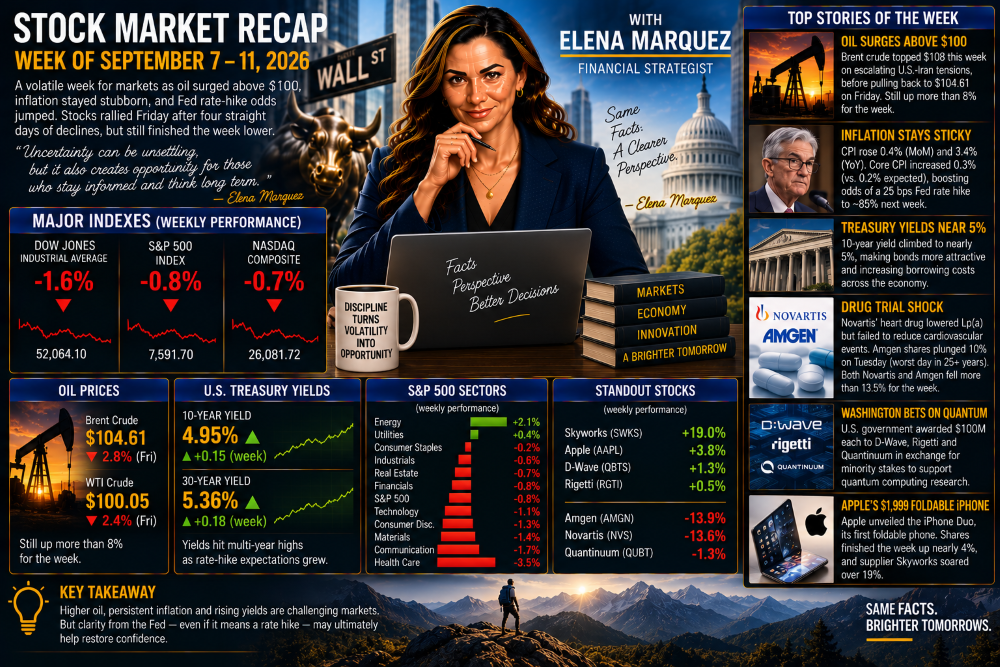
The major indexes fell for the week:
📉 Dow Jones: -1.6%
📉 S&P 500: -0.8%
📉 Nasdaq: -0.7%
Stocks declined for four consecutive sessions before staging a strong rebound Friday.
The biggest story, however, wasn’t really stocks.
It was the dramatic repricing taking place in oil, bonds and Federal Reserve expectations.
Oil Above $100 Changes the Inflation Story
The week began with oil already elevated.
Then the situation deteriorated.
Escalating conflict involving the United States and Iran disrupted energy markets and raised fears that shipping through the Strait of Hormuz could remain constrained.
Brent crude surged to nearly $110 per barrel before retreating Friday to around $104.
Even after Friday’s decline, Brent gained more than 8% for the week.
That matters far beyond energy stocks.
Higher oil increases transportation and manufacturing costs. Diesel prices feed directly into trucking, agriculture and logistics.
Eventually, some of those costs reach consumers.
The concern on Wall Street is increasingly straightforward:
An energy shock could become an inflation shock.
And an inflation shock could force the Federal Reserve to keep raising rates.
The 10-Year Treasury Nearly Hits 5%
The bond market delivered perhaps the week’s most important number:
4.99%.
That’s how high the 10-year Treasury yield briefly climbed Friday.
Higher Treasury yields put pressure on stocks in two ways.
First, they raise borrowing costs for businesses.
Everything from factories and commercial real estate to acquisitions and enormous AI data centers becomes more expensive to finance.
Second, Treasury bonds become more attractive competitors to stocks.
When investors can earn close to 5% lending money to the U.S. government, they have less incentive to pay extremely high valuations for risky assets.
That’s especially important for growth stocks whose valuations depend heavily on profits expected years into the future.
Inflation Makes a Fed Hike Increasingly Likely
Friday brought the week’s most anticipated economic report.
The Consumer Price Index rose 0.4% in August and 3.4% from a year earlier.
Headline inflation was roughly in line with expectations.
But core CPI rose 0.3% for the month, slightly hotter than expected.
That was enough to strengthen expectations for another Federal Reserve rate increase.
By Friday, traders were assigning roughly an 85% probability of a 25-basis-point hike at next week’s Fed meeting.
That’s an extraordinary change.
Only a week earlier, the odds were close to a coin toss.
The market went from asking:
Will the Fed raise rates?
To:
How many more hikes could there be?
Why Did Stocks Rally Friday?
Here’s where the week gets interesting.
If investors suddenly became convinced that interest rates were going higher, you might expect stocks to plunge.
Instead, the Dow, S&P 500 and Nasdaq all rallied roughly 1% Friday.
Why?
Clarity.
Investors had spent four days worrying about what the Federal Reserve might do.
Friday’s CPI report made the answer considerably clearer.
A rate hike now appears likely.
Markets don’t necessarily like higher rates.
But they dislike uncertainty even more.
Investors may also be concluding that decisive action from the Fed today could prevent inflation from becoming a much larger problem tomorrow.
So Friday produced an unusual combination:
Higher rate-hike expectations—and higher stock prices.
A Failed Drug Trial Hits Amgen
One of the week’s most fascinating stock stories involved a drug that wasn’t even developed by the company whose shares were punished most severely.
Swiss pharmaceutical giant Novartis reported disappointing results from a late-stage trial of pelacarsen, an experimental cardiovascular treatment designed to lower lipoprotein(a), or Lp(a).
The drug successfully lowered Lp(a).
But it failed to demonstrate the hoped-for reduction in major cardiovascular events.
That result raised an uncomfortable question:
Does lowering Lp(a) actually reduce heart attacks and strokes?
That’s potentially bad news for other companies developing drugs based on the same biological hypothesis.
Including Amgen.
Amgen is developing its own Lp(a)-lowering treatment, and investors immediately reassessed its potential.
Shares suffered their worst single-day decline in more than two decades and finished the week sharply lower.
The episode provides an important lesson about biotech investing.
Sometimes your competitor’s failed clinical trial can hurt your stock almost as much as your own.
Healthcare Takes the Hit
The fallout helped make healthcare one of the market’s weakest areas this week.
That’s particularly interesting because healthcare had recently been one of Wall Street’s strongest sectors.
The Novartis results remind investors just how quickly sentiment can change when a clinical trial challenges an entire therapeutic approach.
Drug development isn’t simply about whether one medicine works.
Sometimes a trial tests a much bigger scientific hypothesis.
When that hypothesis comes into question, billions of dollars of market value can disappear across multiple companies.
Washington Makes a $300 Million Quantum Bet
While healthcare struggled, another speculative corner of the market suddenly received an enormous vote of confidence:
Quantum computing.
The U.S. government finalized agreements providing $100 million each to:
D-Wave Quantum
Rigetti Computing
Quantinuum
In exchange, the government will receive minority equity stakes in the companies.
That’s $300 million backing technologies that remain far from mainstream commercial adoption.
Quantum computers use principles of quantum physics to tackle certain calculations that are extraordinarily difficult for conventional computers.
The potential applications are enormous—from drug discovery and materials science to cryptography and artificial intelligence.
But today’s machines remain limited, expensive and prone to errors.
In other words:
The technology is promising. The commercial business model remains uncertain.
Washington Is Becoming a Technology Investor
There’s a bigger story here.
The federal government isn’t merely offering research grants.
It’s increasingly using taxpayer capital to support technologies it considers strategically important—and sometimes receiving ownership stakes in return.
Semiconductors.
Artificial intelligence.
Quantum computing.
These industries are increasingly being treated not simply as businesses, but as strategic national assets.
That represents a significant shift in American industrial policy.
The quantum investments may eventually prove enormously profitable.
Or they may not.
But Washington is making something clear:
It doesn’t intend to leave leadership in strategic technologies entirely to the private market.
Apple’s $1,999 Experiment
And then there’s Apple.
The company unveiled the biggest redesign of the iPhone since its introduction in 2007:
The foldable iPhone Duo.
Price?
$1,999.
That’s more expensive than some Mac computers.
The question is whether consumers will pay laptop prices for a smartphone.
Foldable phones have existed for years without becoming mainstream.
Yet Apple has something competitors don’t:
An enormous installed base of loyal iPhone customers and one of the world’s most powerful consumer brands.
Analysts quickly became optimistic that Apple could transform foldables from a niche category into a mainstream premium product.
Apple shares initially slipped following the announcement—which isn’t unusual for an iPhone launch.
Then sentiment reversed.
Shares rallied Thursday and finished the week nearly 4% higher.
Apple supplier Skyworks Solutions did even better, surging roughly 19% for the week.
Can Apple Make Foldables Mainstream?
This might be the more interesting question than whether the iPhone Duo itself succeeds.
Apple has entered existing product categories late before.
It wasn’t the first company to make an MP3 player.
Or a smartphone.
Or a smartwatch.
Apple’s historical strength has been taking an existing concept and creating a product polished enough to make the category mainstream.
The iPhone Duo gives new CEO John Ternus an early opportunity to demonstrate that Apple can still do exactly that.
At $1,999, however, consumers will expect something extraordinary.
Three Big Stories From One Week
At first glance, the week’s biggest stories seem unrelated.
Oil above $100.
Washington investing in quantum computing.
Apple launching a $1,999 foldable phone.
But they actually tell us something important about today’s market.
Investors are simultaneously navigating three enormous forces.
1. Inflation and interest rates
Oil, inflation and Treasury yields are challenging stock valuations.
2. Government-directed technology investment
Washington increasingly views semiconductors, AI and quantum computing as strategic infrastructure.
3. The next generation of consumer technology
Companies such as Apple are still betting that innovation can persuade consumers to spend—even in an inflationary environment.
Those forces will shape markets well beyond this week.
What Comes Next: The Fed
Next week belongs to the Federal Reserve.
Markets now overwhelmingly expect policymakers to raise rates by 25 basis points.
A hike itself may therefore produce relatively little surprise.
What matters more will be Fed Chair Kevin Warsh’s message afterward.
Investors will want to know:
Is this an insurance hike designed to prevent inflation from accelerating?
Or does the Fed believe another sustained tightening cycle has become necessary?
That’s a much bigger question.
Because the difference between one additional rate hike and several could have enormous implications for bonds, housing, technology valuations, AI investment and the broader economy.
The Bottom Line
Wall Street endured a difficult week:
📉 Dow: -1.6%
📉 S&P 500: -0.8%
📉 Nasdaq: -0.7%
Oil surged above $100.
The 10-year Treasury nearly touched 5%.
Inflation remained stubborn.
And the probability of another Fed hike climbed to roughly 85%.
Yet stocks rallied sharply Friday.
That resilience shouldn’t be ignored.
Investors appear increasingly willing to accept another rate hike if they believe it will prevent inflation from becoming entrenched.
Meanwhile, beneath the macroeconomic turmoil, enormous technological bets continue.
Washington is investing directly in quantum computing.
Apple is betting consumers will pay $1,999 for the next evolution of the iPhone.
And companies continue pouring unprecedented amounts of money into AI.
The bull market hasn’t disappeared.
But the price of money is rising again.
And next week’s Federal Reserve decision will tell us whether 5% Treasury yields are the end of this adjustment—or only the beginning.
Other Stock Market blog posts