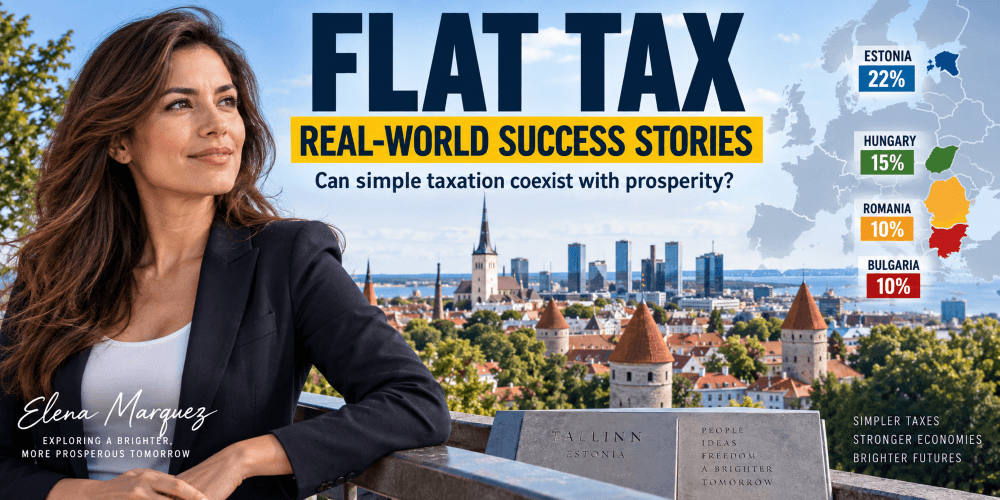
Could a flat tax finance a modern country where people enjoy good healthcare, education, infrastructure and a high standard of living?
For Canadians accustomed to multiple federal and provincial income-tax brackets, the idea may sound unrealistic. We tend to assume that as a society becomes wealthier and government services become more sophisticated, a highly progressive income-tax system is inevitable.
But look across the Atlantic and you find an intriguing counterexample: Estonia.
Estonia is a developed European Union country with universal healthcare, public education, modern infrastructure and one of the world’s most advanced digital governments. Yet in 2026, Estonia taxes personal income at a single rate of 22%, after a basic exemption.
Estonia isn’t alone. Hungary has a 15% flat personal income tax. Bulgaria taxes personal income at 10%, while Romania generally uses a 10% rate.
These countries don’t prove that a flat tax is superior to progressive taxation. But they demonstrate something important:
A flat tax is possible in a modern economy.
And that raises a more interesting question: If it can work elsewhere, why couldn’t a country such as Canada at least consider a simpler income-tax system?
What Is a Flat Tax?
A flat tax applies the same statutory tax rate to taxable income regardless of how much a person earns.
Imagine a hypothetical country with a 20% flat income tax and a $20,000 basic exemption.
Someone earning $40,000 would pay tax on $20,000.
Someone earning $100,000 would pay tax on $80,000.
Someone earning $1 million would pay tax on $980,000.
The millionaire still pays vastly more money in taxes. What doesn’t change is the marginal rate applied to additional taxable income.
This also illustrates an often-missed point: a flat tax can still be progressive in its effective burden when it includes a tax-free allowance.
A lower-income worker may pay little or no income tax, while a high-income worker pays close to the full flat rate.
A flat tax also doesn’t mean that every tax disappears. Countries with flat personal income taxes still collect VAT or sales taxes, corporate taxes, social-security contributions, property taxes and excise taxes.
The debate is specifically about whether personal income needs numerous escalating tax brackets.
The Eastern European Flat Tax Revolution
One of the most interesting economic experiments following the collapse of communism happened in taxation.
After the Soviet Union and communist governments of Eastern Europe fell, these countries had to transform centrally planned economies into market economies. That meant creating or rebuilding institutions for private property, corporations, banking, investment and taxation.
Estonia made a radical move in 1994, replacing its progressive personal income-tax system with a 26% flat tax.
Others followed.
The International Monetary Fund documented an extraordinary wave of flat-tax reforms:
- Estonia — 26% in 1994
- Lithuania — 33% in 1994
- Latvia — 25% in the 1990s
- Russia — 13% in 2001
- Serbia — 14% in 2003
- Slovakia — 19% in 2004
- Ukraine — 13% in 2004
- Georgia — 12% in 2005
- Romania — 16% in 2005
The movement became sufficiently widespread that economists began talking about a flat-tax revolution in Eastern Europe.
Why did so many former communist countries experiment with the idea?
One explanation is simply necessity.
Their governments needed tax systems that could function in countries with young market institutions, substantial informal economies and limited administrative capacity. A simpler system could be easier to understand, administer and enforce.
There was another possible advantage: attracting capital.
Countries emerging from communism desperately needed businesses, entrepreneurs and foreign investment. Low, predictable tax rates became part of their competitive strategy.
And there is a fascinating political-economy hypothesis.
Did Eastern Europe Have an Advantage Because It Could Start Over?
Consider Canada, France or the United States.
Their tax codes have developed over generations. Every decade brings new credits, deductions, incentives, exemptions and special provisions.
Once those provisions exist, someone benefits from them.
Homeowners want their benefits. Businesses defend theirs. Industries hire lobbyists. Charities, unions, investors, families, municipalities and professional associations all have legitimate reasons for wanting particular provisions preserved.
Removing complexity therefore creates political losers.
Post-communist countries faced a very different situation. They were reconstructing major parts of their economic systems almost from scratch.
They may have had an unusual historical opportunity to ask:
If we were designing an income-tax system today, what would it look like?
That doesn’t prove special interests caused Western tax complexity or explain the entire Eastern European flat-tax movement. Tax administration, tax evasion, investment competition and political ideology also mattered.
But the contrast raises an important question about institutional history: perhaps it is easier to create a simple tax system than to simplify one after decades of accumulated provisions.
Estonia: The Strongest Case for a Flat Tax
Estonia is especially interesting because its experiment didn’t disappear after a few years.
More than three decades after its original reform, Estonia still maintains a broadly flat personal income tax.
For 2026, Estonia’s Tax and Customs Board lists the personal income-tax rate at 22%. Individuals receive a basic exemption of €700 per month, or €8,400 annually.
That basic exemption is important.
A person earning a modest income doesn’t actually hand 22% of every euro to the government. The exemption reduces the effective tax rate, particularly for lower earners.
Yet once taxable income is calculated, Estonia doesn’t impose increasingly high personal income-tax brackets as income rises.
There is another fascinating component of the Estonian model: corporate taxation.
Estonia generally taxes corporate profits when they are distributed, rather than taxing retained profits in the conventional manner each year. The current standard corporate income-tax calculation on distributed profits is 22/78.
That structure gives companies an incentive to retain and reinvest earnings.
Estonia therefore offers something more interesting than merely a low tax rate. It represents a different philosophy of taxation: relatively simple rules, broad taxation and incentives that favor investment.
Can Estonians Really Have a High Standard of Living With a Flat Tax?
Yes—but we should be careful about what that means.
Estonia is not as wealthy as Canada.
OECD figures show that average wages measured using purchasing-power parity remain substantially higher in Canada. OECD data for 2025 put Canada’s average annual wage at roughly US$67,900 in purchasing-power-adjusted dollars, compared with about US$41,000 in Estonia.
So it would be misleading to claim that the average Estonian has the same material purchasing power as the average Canadian.
But that’s not the argument.
The important observation is that Estonia is a developed EU democracy whose citizens have access to modern infrastructure, education, healthcare and public services while living under a flat personal income-tax system.
In other words, adopting a flat tax has not required Estonia to become a society without a functioning public sector or modern European living standards.
A regular Canadian is, on average, materially richer than a regular Estonian. But the difference is nowhere near the difference between Canada and a poor developing country.
Estonia also demonstrates how quickly living standards can improve. OECD purchasing-power-adjusted wage data show a dramatic long-term increase in Estonian wages since the early 2000s.
That doesn’t mean the flat tax caused Estonia’s development. EU integration, education, foreign investment, technological development, institutional reforms and many other factors contributed.
But it does undermine a simpler claim sometimes made against flat taxation:
A country does not need steeply progressive personal income-tax rates merely to achieve a modern standard of living.
Other Countries That Still Use a Flat Tax
Estonia isn’t the only example.
Hungary: 15%
Hungary has a 15% personal income-tax rate and no additional local personal income-tax system.
Hungary’s average income remains below Canada’s, but it is a modern EU economy with developed infrastructure and public services.
Bulgaria: 10%
Bulgaria has one of Europe’s most striking examples: a 10% flat personal income tax.
The European Commission describes Bulgaria’s system as a 10% flat tax on taxable personal income, generally without a basic tax-free allowance.
Bulgaria, however, illustrates why we shouldn’t equate a low flat income tax with a low overall burden. Social contributions and consumption taxes still matter, and the European Commission has raised concerns about distribution, tax collection and the financing of public services.
Romania: 10%
Romania also generally applies a 10% flat personal income tax.
But here again the headline rate doesn’t tell the whole story. The OECD notes that substantial pension and health contributions can push the combined effective tax-and-contribution burden for an ordinary wage earner far above 10%.
This is an important lesson:
Never compare countries using income-tax rates alone.
Some Countries Tried Flat Taxes—and Abandoned Them
A fair assessment must also acknowledge that the flat-tax revolution didn’t conquer Europe.
Slovakia introduced its famous 19% flat tax in 2004 but replaced it with multiple brackets beginning in 2013.
Latvia also moved away from flat taxation. Today its personal income-tax system is explicitly progressive, with rates of 25.5% and 33%, plus an additional 3% rate on income above €200,000.
That matters.
If flat taxation were an obvious economic miracle, we might expect every country that adopted it to retain it forever.
They haven’t.
The Eastern European experience therefore provides evidence that flat taxation is feasible, but not that it is necessarily optimal.
The Arguments for a Flat Tax
Supporters generally emphasize several potential advantages.
Simplicity. Fewer brackets can make the tax system easier to understand.
Transparency. Citizens can more easily see the marginal tax rate they face.
Incentives. A lower marginal rate on additional income may make work, entrepreneurship and investment more attractive.
Compliance. Simpler taxation may reduce opportunities or incentives for tax avoidance and evasion.
Political discipline. A broad tax base may reduce pressure to constantly create new brackets and targeted tax privileges.
Competitiveness. Smaller countries may use relatively low and predictable taxation to attract investment and skilled workers.
The IMF’s examination of flat-tax reforms found some evidence of improved tax compliance, although evidence that flat taxes substantially increased work incentives was much weaker.
That distinction is important.
Economic policy rarely produces the miraculous results promised by its most enthusiastic advocates.
The Arguments Against a Flat Tax
The strongest objection is fairness.
Critics argue that someone earning $500,000 can afford to contribute a larger percentage of income than someone earning $50,000.
Progressive taxation reflects the economic concept of diminishing marginal utility: losing the next $1,000 matters more to someone struggling to pay rent than to a millionaire.
There is also the revenue question.
If Canada replaced high marginal rates with a relatively low flat tax without expanding the tax base or raising other taxes, government revenue could decline significantly.
That could mean larger deficits or reductions in healthcare, education, pensions and other services.
Distribution matters as well.
Bulgaria provides a warning. The European Commission has noted that interactions between its 10% flat income tax and social contributions can produce a tax burden that is less progressive than the headline income-tax rate suggests.
A badly designed flat tax can therefore shift the burden toward lower- and middle-income workers.
Flat Tax Doesn’t Mean Small Government
This may be the biggest misconception surrounding the debate.
A country can have a flat personal income tax while collecting substantial government revenue elsewhere.
Governments can collect money through:
- VAT or sales taxes
- payroll and social-security contributions
- corporate taxes
- property taxes
- capital-income taxes
- excise taxes
- environmental taxes
Therefore, Estonia’s 22% income tax should not be compared directly with Canada’s top marginal income-tax rate and interpreted as the total difference in taxation.
The better question is how each country structures the entire tax burden.
And that leads to perhaps the most interesting lesson from Estonia.
What Could Canada Learn From Estonia?
Canada doesn’t have to copy Estonia.
Canada is much larger, wealthier and more decentralized. Provinces levy their own income taxes, and Canadians have different expectations concerning healthcare, pensions, transfers and other public services.
But Estonia demonstrates that our current system isn’t the only imaginable one.
We could ask:
Could Canada have fewer income-tax brackets?
Could we eliminate dozens of deductions and credits in exchange for lower rates?
Could we establish a generous tax-free basic income threshold and then apply one rate above it?
Could we broaden the tax base while lowering marginal rates?
Could businesses receive stronger incentives to reinvest profits?
And perhaps most importantly:
Could Canadians spend less time and money navigating the tax code?
These questions don’t require believing that government is bad or that taxation should disappear.
They simply require recognizing that complexity isn’t necessarily a virtue.
The Real Lesson of the Flat Tax Experiment
The experience of Eastern Europe doesn’t prove that flat taxes create prosperity.
Estonia didn’t become successful simply because it adopted one tax rate. Good institutions, education, trade, entrepreneurship, technology, fiscal policy and integration with Europe all played important roles.
Likewise, countries with progressive taxation—including Switzerland, Denmark, Germany and Canada—have achieved extremely high standards of living.
The evidence doesn’t justify claiming:
Flat taxes make countries rich.
But it does justify a much more interesting conclusion:
Progressive income taxation is not a prerequisite for becoming a prosperous, developed society.
Estonia has spent more than three decades demonstrating that a modern European country can operate with a broadly flat personal income tax.
Hungary, Bulgaria and Romania provide additional variations on the experiment.
Some former flat-tax countries have gone back to progressive taxation. Others have kept their flat taxes.
That makes Eastern Europe one of the most fascinating real-world laboratories in modern tax policy.
Perhaps the question for Canadians shouldn’t be, “Would a flat tax work?”
We already know that a flat tax can work.
The harder questions are what rate would raise enough revenue, what basic exemption would protect lower-income households, which deductions would disappear, what other taxes would be required—and whether Canadians would consider the resulting system fair.
Those are questions worth debating.
Frequently Asked Questions About Flat Tax
What is a flat tax?
A flat tax applies the same statutory tax rate to taxable income regardless of how much a taxpayer earns. It can still include a tax-free basic allowance, meaning lower-income people can have lower effective tax rates.
Does Estonia have a flat tax?
Yes. Estonia applies a 22% personal income-tax rate in 2026 and provides a basic exemption of €8,400 per year. Estonia has used a broadly flat personal income-tax structure since 1994.
Which European countries still have flat income taxes?
Examples include Estonia at 22%, Hungary at 15%, Bulgaria at 10%, and Romania generally at 10%. However, social-security contributions and other taxes mean these percentages should not be interpreted as the total tax burden.
Could Canada introduce a flat tax?
Technically, yes. Nothing prevents Canada from replacing its progressive federal income-tax brackets with a flat rate. The difficult questions would be determining the rate, basic exemption, treatment of deductions and credits, interaction with provincial taxation, and how to maintain government revenue and distributional goals.