Is the claim of anti-Israel bias in The New York Times merely a opinion of critics, or can it be empirically measured?
A new academic study provides some remarkable evidence.
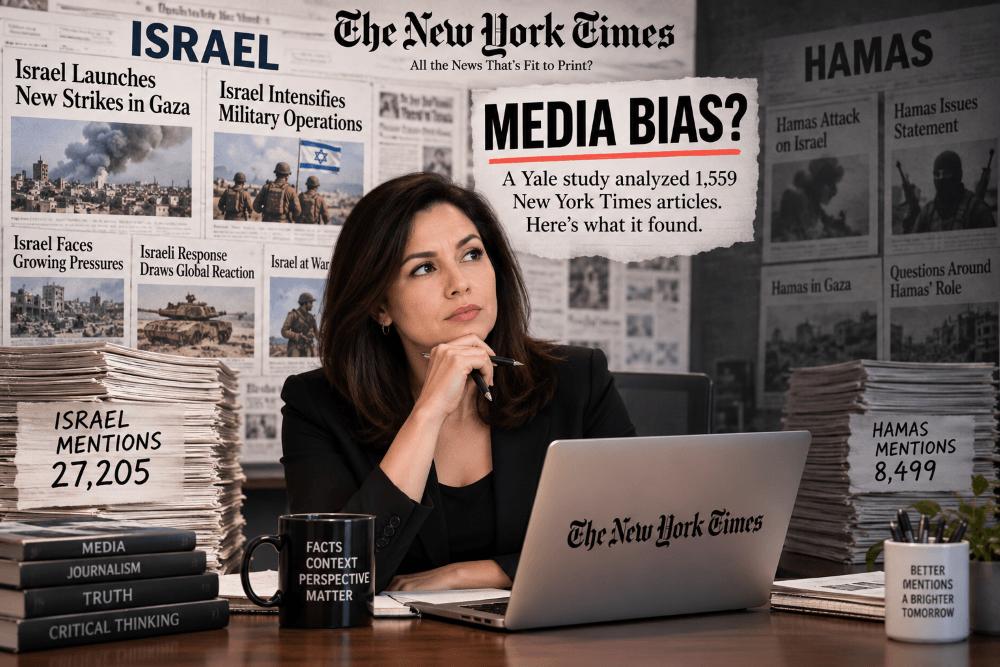
Edieal Pinker, a professor and deputy dean at the Yale School of Management, analyzed 1,559 New York Times news articles covering the war between Israel and Hamas from October 7, 2023, through June 7, 2024.
His conclusion was striking: the newspaper’s dominant narrative placed what Pinker described as near-exclusive agency and responsibility for the continuing war on Israel, while giving much less attention to Hamas’s continuing role in the conflict.
That does not mean the Times fabricated what happened in Gaza. Palestinian civilian suffering was—and remains—real and unquestionably newsworthy.
However, Israeli civilian suffering is also real but ignored by the NYT because the NYT doesn’t think that Israeli suffering is worthe mentioning.
An interesting question is what happens when a newspaper consistently emphasizes certain facts while other important facts largely disappear.
What the Yale Study Found About New York Times Anti-Israel Bias
Pinker’s paper, “How the New York Times Framed the War Between Israel and Hamas,” was published online in September 2026 in the peer-reviewed journal Studies in Conflict & Terrorism.
The final study examined 1,559 articles published during the first eight months following the October 7 Hamas attack.
Pinker found a recurring narrative.
The story presented to readers generally went like this: Hamas attacked Israel on October 7, killing approximately 1,200 people. Israel then responded militarily, while the Palestinian death toll continued rising.
The problem, according to Pinker, is what frequently disappeared from that narrative after October 7:
- Israeli military casualties
- Israeli civilian casualties after October 7
- Hamas fighters killed in combat
- Palestinian attacks against Israelis after October 7
- The continuing military role of Hamas
- The experiences of Israelis suffering because of the war
The result was not necessarily inaccurate individual stories. Instead, Pinker argues that the overall picture produced by hundreds of stories was unbalanced.
The Numbers Are Difficult to Ignore
Some of Pinker’s findings are particularly revealing.
Among articles that described the conflict, 895 articles—or about 70%—fit what the study identified as the dominant narrative.
Of those articles, only about half mentioned the Israeli hostages held in Gaza. Forty-one percent did not mention the Israeli casualties from October 7.
Across the broader dataset, 1,423 articles did not mention either post-October 7 Israeli casualties or Hamas combatants killed during the fighting.
Another revealing statistic concerns the basic language used to identify the actors in the war.
“Israel” appeared 27,205 times in the analyzed articles.
“Hamas” appeared only 8,499 times.
In other words, Israel was mentioned more than three times as often as Hamas.
That matters because wars require actors.
If one combatant is constantly identified while the other frequently disappears linguistically, readers may naturally begin assigning most of the agency—and therefore responsibility—to the actor they continually see.
Whose Suffering Gets a Human Face?
Statistics tell us how many people have died. Personal stories tell us whom to care about.
This is where the study becomes especially interesting.
Pinker found personal stories about Palestinian or Lebanese suffering appeared, on average, about two out of every three days.
Israeli suffering received considerably less attention.
The study identified nine stretches lasting a week or longer in which The New York Times did not mention Israeli casualties after October 7, even though Israeli soldiers were being killed during the fighting.
During the study period after October 7, Pinker cited data indicating that Israel lost 364 soldiers, while thousands were wounded. Another 34 Israeli civilians were killed in hundreds of attacks in Israel and the West Bank.
Yet those casualties rarely became part of the continuing narrative.
Hamas casualties were similarly easy to miss.
Only about 10% of articles directly related to the fighting mentioned Hamas deaths, according to the analysis. And only about 18% of articles focused on the war mentioned Palestinian violence after October 7.
The potential impression for readers is powerful: Israel attacks, Palestinians suffer, and Hamas gradually fades into the background.
Media Bias Doesn’t Require False Information
This is perhaps the most important lesson from the study.
Bias does not necessarily require publishing something false.
Imagine two newspapers covering exactly the same war.
One repeatedly publishes photographs and personal stories about civilian casualties on Side A while emphasizing military actions by Side B.
The other regularly reports civilian casualties on Side A but also reports soldiers killed on Side B, attacks launched by Side A’s military forces, hostages being held and combatants killed on both sides.
Both newspapers might publish factually accurate stories.
Yet a reader who followed the first newspaper for eight months could develop a very different understanding of the conflict.
That is the power of selection, repetition, omission and framing.
Hamas Didn’t Stop Being an Actor After October 7
There is no serious dispute that Palestinian civilians experienced enormous suffering during the Gaza war. Their deaths, injuries, displacement and destruction of their communities deserve extensive journalistic coverage.
But acknowledging Palestinian suffering does not require making Hamas disappear from the story.
Hamas continued fighting Israeli forces. It continued holding hostages. Palestinian armed groups continued launching attacks.
Yet Pinker’s research suggests those facts did not receive anything close to the same sustained emphasis as Israeli military actions.
The study summarized the resulting narrative as one in which Israel effectively becomes the principal active participant while Palestinians increasingly appear as passive recipients of Israeli violence.
That distinction matters enormously when readers are deciding who bears responsibility for continuing a war.
An Important Limitation of the Study
There is an important distinction worth making.
Pinker did not claim that his research could prove intentional political bias by New York Times journalists.
Determining bias is difficult because proving deliberate editorial intent is very different from demonstrating measurable imbalance.
There are also practical explanations that could contribute to some differences in coverage. Access to information varies dramatically between Israel and Hamas-controlled Gaza, for example.
Pinker’s research therefore provides strong evidence of systematic imbalance in the resulting coverage, rather than proof of the motivations of individual reporters or editors.
That distinction makes the argument stronger, not weaker.
We don’t need to speculate about journalists’ intentions. We can examine what readers actually received.
What The New York Times Says
The New York Times disputes the criticism.
Responding to Pinker’s research, a Times spokesperson said the newspaper had covered the conflict extensively and from multiple perspectives.
The newspaper said its editors make deliberate decisions about language, framing, prominence and tone in pursuit of independent journalism, and argued that its coverage included both Hamas’s October 7 atrocities and Israel’s subsequent military campaign.
That response deserves to be included.
Criticism of Israel-Gaza reporting also comes from the opposite direction. Pro-Palestinian critics have accused The New York Times and other American media organizations of framing coverage in ways favorable to Israel.
This is precisely why Pinker’s quantitative approach is useful.
Instead of selecting several headlines and declaring them biased, he examined more than 1,500 articles and searched for recurring patterns.
My View of The New York Times
Personally, I have long viewed The New York Times as a left-leaning newspaper, and I approach its reporting with considerable skepticism.
This study reinforces some of my concerns about its credibility.
But my opinion about the Times is ultimately less important than the data.
Readers should examine Pinker’s research and reach their own conclusions.
And the lesson extends well beyond Israel and Gaza.
Every newspaper makes choices. Editors decide which stories deserve attention, which photographs appear prominently, which victims receive profiles, which statistics are repeated and which events disappear after a few paragraphs.
Those decisions gradually create narratives.
The disturbing question raised by this research is therefore bigger than The New York Times:
If systematic framing can substantially change how we understand a war unfolding before our eyes, how many other events do we think we understand simply because one narrative has been repeated more often than the alternatives?
FAQ About New York Times Israel Bias
Did a Yale study find that The New York Times was biased against Israel?
Edieal Pinker’s study documented systematic imbalances in New York Times coverage that he argues created a narrative assigning near-exclusive agency and responsibility to Israel while diminishing Hamas’s continuing role. The study did not attempt to prove intentional political bias by individual journalists.
How many New York Times articles did the study analyze?
The final peer-reviewed paper analyzed 1,559 news articles covering Israel and Gaza between October 7, 2023, and June 7, 2024. An earlier working-paper version reported 1,561 articles, which explains why both numbers appear in coverage of the research.
Did The New York Times ignore Hamas completely?
No. The Times extensively reported the October 7 Hamas attack and published reporting about Hamas. Pinker’s argument is that Hamas’s continuing agency became disproportionately less visible afterward. Across the dataset, Israel was mentioned more than three times as often as Hamas.
How did The New York Times respond to the study?
The newspaper defended its reporting, saying it covered the conflict rigorously and from multiple angles. The Times said its editorial decisions regarding language, framing and prominence were made in pursuit of independent journalism.
Previous Politics posts
Leave a Reply