Wall Street just experienced a fascinating tug-of-war.
Technology stocks wanted to rally.
The bond market wanted to stop them.
And somehow, technology won.
For the week:
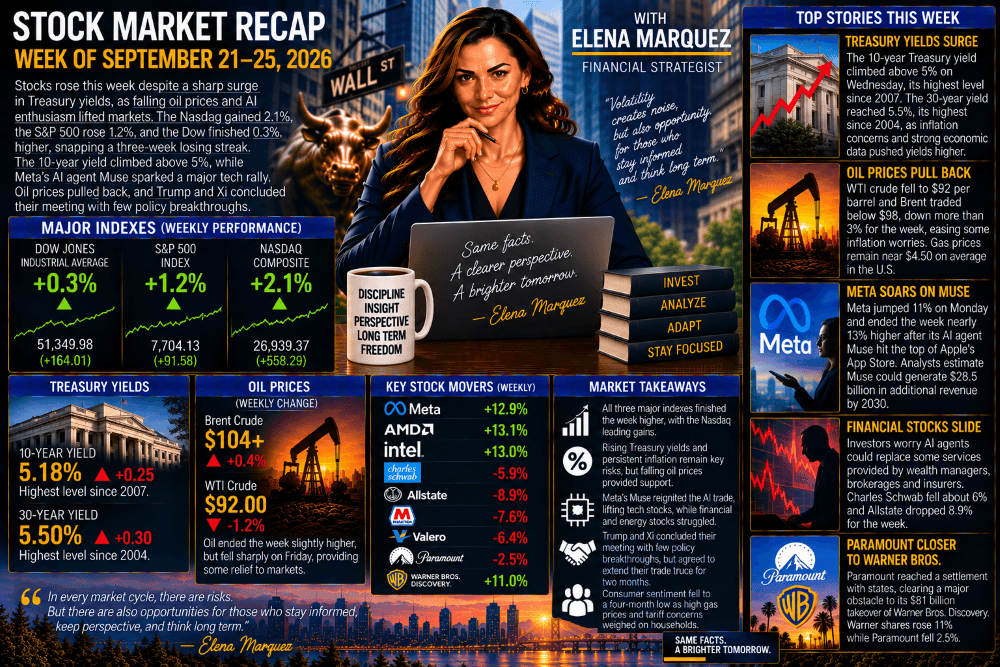
📈 Nasdaq: +2.1%
📈 S&P 500: +1.2%
📈 Dow Jones: +0.3%
The Nasdaq’s strength was particularly impressive considering what happened in the Treasury market.
The 10-year Treasury yield surged above 5% during the week, reaching its highest level since 2007.
Normally, that would be terrible news for high-growth technology stocks.
Instead, investors piled into AI.
And one company stood above the rest:
Meta.
Monday: AI Comes Roaring Back
The week started with an explosion of AI enthusiasm.
The Nasdaq surged 2.3% Monday, while the S&P 500 climbed 1.5% and the Dow gained 0.7%.
The star was Meta.
Shares jumped more than 11% in a single session, adding roughly $192 billion to the company’s market value.
The reason?
Muse.
Meta’s new AI agent had climbed to the top of Apple’s App Store.
Muse isn’t simply another chatbot.
It’s designed as an AI assistant capable of performing tasks on behalf of users—things like shopping and booking appointments.
That distinction is important.
For the past few years, investors have watched Meta spend enormous amounts of money building AI infrastructure.
The big question was:
When does all this spending start making money?
Muse may be providing the first glimpse of an answer.
Meta Gains Nearly 13%
Meta finished the week nearly 13% higher.
One Truist analyst estimated Muse could eventually generate an additional $28.5 billion in revenue by 2030.
Whether that estimate proves accurate remains to be seen.
But the market’s reaction tells us something important.
Investors are increasingly shifting their attention from:
AI investment
to:
AI monetization.
That’s a major transition.
Building AI is expensive.
Selling useful AI products could be enormously profitable.
And if consumers actually begin allowing AI agents to shop, schedule appointments, research products and perform other tasks for them, an entirely new digital economy could emerge.
AMD and Intel Join the Party
Meta wasn’t alone.
Chipmakers also had a huge week.
📈 AMD: ~+13%
📈 Intel: ~+13%
AMD briefly crossed the extraordinary milestone of a $1 trillion market capitalization.
The enthusiasm makes sense.
If AI agents become mainstream, they’ll require enormous amounts of computing power.
That means more:
GPUs.
CPUs.
Memory.
Networking.
Data centers.
Electricity.
AI applications may ultimately become the demand engine that justifies the enormous infrastructure buildout already underway.
But AI Could Create Losers Too
Every technological revolution creates winners.
It also creates losers.
And this week Wall Street started thinking seriously about which companies might be disrupted by AI agents.
Financial stocks came under pressure as investors considered whether AI assistants could eventually perform services currently provided by:
Wealth managers.
Brokerages.
Insurance agents.
Financial advisers.
Charles Schwab fell roughly 6% for the week.
Allstate dropped nearly 9%.
That’s speculative at this stage.
But the concern is understandable.
If your AI assistant eventually understands your income, expenses, investments, insurance, taxes and financial goals, how many traditional financial services could it perform automatically?
That’s potentially a much bigger question than whether AI can write emails or generate images.
Then the Bond Market Exploded
While technology stocks celebrated, the Treasury market was telling a very different story.
On Wednesday, the 10-year Treasury yield surged above 5%, reaching its highest level since 2007.
It was also the yield’s largest one-day increase in more than a year.
Several forces collided at once.
Elevated oil prices.
Persistent inflation.
Strong economic activity.
A resilient labor market.
Heavy government borrowing.
And expectations that the Federal Reserve may need to keep interest rates higher for longer—or raise them again.
That created a perfect storm for bonds.
Bond prices fell.
Yields surged.
And suddenly investors were staring at something they haven’t had to think about for most of the past two decades:
What if 5% interest rates are normal again?
The AI Boom Has a 5% Problem
This creates an interesting contradiction.
AI companies want to spend hundreds of billions of dollars building infrastructure.
But the cost of financing that infrastructure keeps rising.
Data centers require enormous investments in:
Land.
Semiconductors.
Power plants.
Transmission infrastructure.
Cooling.
Networking.
Construction.
And increasingly, debt.
At 2% interest rates, financing massive projects is relatively easy.
At 5%+, the hurdle becomes much higher.
And there’s another issue.
Investors can now earn more than 5% lending money to the US government.
That means every risky investment must compete against that return.
The AI boom doesn’t need to simply generate profits.
It needs to generate returns attractive enough to justify the risk.
Oil Remains a Problem
Energy remained another major piece of the puzzle.
Brent crude finished the week above $100 per barrel.
Oil prices have remained elevated as the wars involving Iran and Ukraine disrupt global energy supplies and refining capacity.
And expensive energy feeds directly into inflation.
Transportation costs rise.
Manufacturing costs rise.
Airline costs rise.
Food distribution costs rise.
Consumers pay more at the pump.
That’s why we’ve repeatedly followed this chain:
Oil ↑ → Inflation ↑ → Fed pressure ↑ → Treasury yields ↑ → Stocks pressured
This week demonstrated how difficult it is for markets to escape that cycle.
Trump Targets Diesel Prices
President Trump introduced another wrinkle Tuesday when he said his administration was considering restrictions on US diesel exports.
The objective is straightforward:
Keep more American-produced diesel inside the United States and potentially lower domestic prices.
But refiners argue the plan could have unintended consequences.
The United States produces more fuel than it consumes and exports the excess.
If those exports are restricted, refiners could respond by reducing production.
Analysts estimate crude processing could potentially fall by more than 10%.
Investors didn’t like the possibility.
📉 Marathon Petroleum: -7.6%
📉 Valero: -6.4%
The broader S&P 500 energy sector fell roughly 3%.
It’s another reminder that government attempts to reduce consumer prices can sometimes create complicated incentives for producers.
Paramount Moves Closer to Warner Bros.
One of the week’s biggest corporate stories came from Hollywood.
Paramount moved closer to completing its enormous $81 billion takeover of Warner Bros. Discovery.
A group of states led by California had sued to block the merger, arguing that combining two major Hollywood studios would reduce competition.
This week, the states settled.
But Paramount had to make concessions.
The company agreed to invest at least $1.5 billion more in US film and television production over five years.
It also pledged to release at least 30 movies annually and maintain its Los Angeles studio lots.
That’s an expensive compromise.
But Paramount had another incentive to get the deal completed.
If the merger failed to close by October 1, ticking fees were set to begin costing the company roughly $7 million per day.
Investors clearly viewed the settlement as good news for Warner Bros. Discovery.
📈 Warner Bros. Discovery: +11%
📉 Paramount: -2.5%
The deal is now expected to close within weeks.
A Strange Week for Wall Street
Step back from the individual stories and something unusual happened.
The Nasdaq gained more than 2%.
Meta gained nearly 13%.
AMD and Intel gained around 13%.
And yet simultaneously:
Treasury yields reached their highest levels since 2007.
Oil remained above $100.
Inflation worries persisted.
The Fed remained hawkish.
Consumers continued dealing with expensive gasoline.
Normally, you’d expect those forces to crush growth stocks.
Instead, AI enthusiasm overwhelmed them.
At least for one week.
The Bigger Story: AI Versus Interest Rates
This may be the central market battle heading into the final months of 2026.
On one side:
🤖 AI adoption
💻 Semiconductor demand
🏗️ Massive infrastructure spending
📈 Productivity expectations
💰 Potential AI monetization
On the other:
📈 5%+ Treasury yields
🔥 Persistent inflation
🛢️ Expensive energy
🏦 Additional Fed tightening
💵 Higher borrowing costs
The question isn’t simply whether AI will transform the economy.
It probably will.
The investment question is harder:
Can AI generate profits fast enough to justify today’s valuations and enormous capital requirements in a world where money costs 5%?
Meta’s Muse gave investors reason to believe the answer might be yes.
The bond market gave them plenty of reasons to remain cautious.
The Bottom Line
Wall Street finished another volatile week higher.
📈 Nasdaq: +2.1%
📈 S&P 500: +1.2%
📈 Dow: +0.3%
📈 10-year Treasury: above 5%
🛢️ Brent crude: above $100
🤖 Meta: nearly +13%
💻 AMD: ~+13%
💻 Intel: ~+13%
📉 Charles Schwab: ~-6%
📉 Allstate: -8.9%
📉 Marathon Petroleum: -7.6%
📉 Valero: -6.4%
🎬 Warner Bros. Discovery: +11%
For years, Wall Street’s AI trade was based largely on expectations.
This week gave investors something different:
Evidence that consumers may actually want AI agents.
If Muse’s early popularity turns into real revenue, the AI story could begin moving from infrastructure spending to monetization.
But there’s a formidable opponent waiting on the other side of the market.
The bond market.
With Treasury yields above 5%, investors no longer have to take enormous risks to earn meaningful returns.
And that leaves us with perhaps the most important market battle heading into the final quarter of 2026:
AI optimism vs. the price of money.
Other Stock Market blog posts
Leave a Reply