| 📊 Alain’s Holdings — September 23, 2026 | ||||
|---|---|---|---|---|
| Symbol | Name | Price | Change | Change % |
| VOO | Vanguard S&P 500 ETF | 707.60 | -5.18 | -0.73% |
| QQQ | Invesco QQQ Trust | 741.21 | -6.25 | -0.84% |
| XIU.TO | iShares S&P/TSX 60 ETF | 52.95 | -0.83 | -1.54% |
Wall Street’s record-setting run hit a wall Wednesday.
After two strong sessions pushed the Nasdaq to back-to-back records, investors suddenly confronted a familiar problem:
Interest rates.
The 10-year Treasury yield surged above 5.1%, oil prices rebounded sharply, and new economic data suggested the US economy—and inflation—may be running hotter than investors hoped.
Technology stocks took the biggest hit.
Market Performance
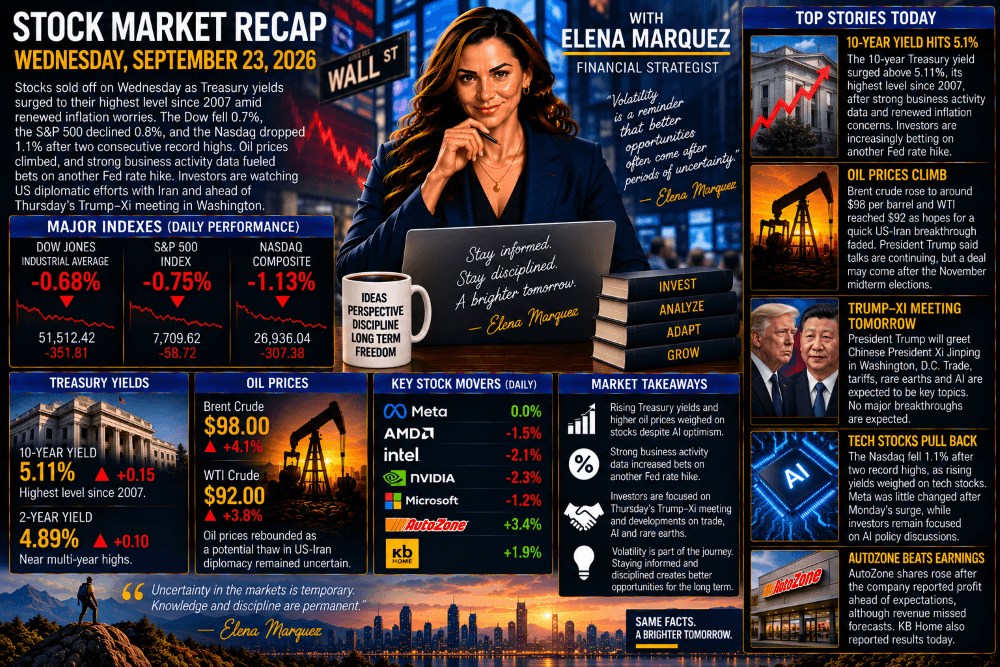
📉 Dow Jones: -0.68% to 51,512.42
📉 S&P 500: -0.75% to 7,709.62
📉 Nasdaq Composite: -1.13% to 26,936.04
The reversal was particularly notable for the Nasdaq.
Just one day earlier, technology enthusiasm had helped push the index to another record.
Wednesday reminded investors that even the AI boom has to compete with the price of money.
The 10-Year Treasury Surges Above 5.1%
The day’s most important number wasn’t the Nasdaq.
It was:
5.10%.
The 10-year Treasury yield jumped roughly 15 basis points to around 5.10%, reaching its highest level since July 2007.
The two-year Treasury climbed toward 4.89%, while the five-year briefly crossed 5% for the first time since 2007.
Those are enormous moves for the bond market.
And they matter tremendously for stocks.
When investors can earn more than 5% from US government debt, expensive stocks have to compete with a much more attractive alternative.
Higher yields also raise borrowing costs for corporations, consumers and the federal government.
Most importantly for today’s market, higher yields reduce the present value of profits expected many years in the future.
That’s why technology stocks are particularly sensitive to rising rates.
A Strong Economy Is Suddenly Bad News Again
What sent Treasury yields soaring?
Ironically:
Good economic news.
S&P Global’s September survey showed US business activity expanding at its fastest pace in more than five years.
Normally, strong economic growth would be good news for stocks.
But today’s market is different.
The economy isn’t the Fed’s biggest problem.
Inflation is.
S&P Global also reported that businesses faced sharply higher input costs, with fuel and transportation costs contributing significantly to the increase.
So investors saw two things simultaneously:
A strong economy.
And persistent inflation.
That’s exactly the combination that gives the Federal Reserve room to keep raising interest rates.
Michael Barr Sends a Hawkish Message
Federal Reserve Governor Michael Barr reinforced those concerns Wednesday.
Barr said economic growth remains strong and the labor market solid, but inflation is still above the Fed’s 2% target and isn’t clearly returning to target quickly enough.
He supported last week’s 25-basis-point rate increase and said that, in his base case, further policy adjustments are likely to be needed to bring inflation down.
That matters because last week’s hike may not have been a one-and-done move.
Markets are increasingly preparing for another increase.
The question Wall Street spent years asking was:
When will the Fed cut?
Then it became:
Will the Fed hike again?
Now the question may be:
How many more hikes will it take?
Oil Comes Roaring Back
Oil provided another unwelcome surprise.
After falling for five consecutive sessions, Brent crude reversed sharply Wednesday and jumped more than 4%, trading around $103–$104 per barrel.
The move came as hopes for rapid progress between the United States and Iran weakened.
Earlier optimism had helped push Brent briefly below $98.
That optimism faded Wednesday as Iranian President Masoud Pezeshkian said Iran remained willing to negotiate but would not submit to US pressure.
US Secretary of State Marco Rubio also described this week’s talks as meaningful but stopped short of calling them a major breakthrough.
And suddenly oil was back above $100.
The Oil-Fed Connection Returns
This matters because oil doesn’t simply affect energy companies.
It affects almost everything.
Transportation.
Airlines.
Food.
Manufacturing.
Shipping.
Plastics.
Consumer goods.
Higher energy costs eventually work their way through the economy.
That brings us back to the equation investors should keep watching:
Oil ↑ → Inflation ↑ → Fed expectations ↑ → Treasury yields ↑ → Stocks ↓
Wednesday was almost a textbook example.
Oil rose.
Inflation concerns increased.
Rate-hike expectations increased.
Treasury yields surged.
And stocks fell.
Technology Takes the Hit
The Nasdaq suffered the largest decline among the major indexes, falling 1.13%.
Semiconductors also weakened after their recent strong run.
Nvidia and AMD fell, while the Philadelphia Semiconductor Index lost more than 1%.
That’s particularly interesting because AI enthusiasm hasn’t disappeared.
Demand for computing remains enormous.
Meta’s Muse AI agent continues generating excitement.
Companies continue investing billions in AI infrastructure.
But the financial environment is becoming more difficult.
A company building a data center when the 10-year Treasury yields 3% faces one economic calculation.
At 5.1%, the calculation is very different.
AI Has to Beat the Risk-Free Rate
This may become one of the biggest investment themes of the next several years.
AI isn’t just competing against other technologies.
AI investments are competing against the cost of capital.
Hundreds of billions of dollars are being spent on:
GPUs.
Data centers.
Power generation.
Networking equipment.
Memory.
Cooling infrastructure.
AI models.
And software.
Investors ultimately need those investments to generate returns.
When government bonds yield more than 5%, the hurdle becomes considerably higher.
The AI boom can continue.
But increasingly, Wall Street may demand something beyond technological breakthroughs:
Profits.
Meta Bucks the Trend
One notable exception Wednesday was Meta.
Shares managed to rise even as much of the technology sector declined.
The company’s Muse AI agent has generated significant investor enthusiasm since its September 8 launch.
That makes Meta an interesting test case.
Investors aren’t merely rewarding the company for spending money on AI.
They’re beginning to imagine how AI agents could become actual products used by millions of consumers.
That distinction may become increasingly important.
The next phase of the AI trade may be less about:
Who spends the most?
And more about:
Who actually makes money?
Trump and Xi Take Center Stage
Now Wall Street turns toward another major event.
Chinese President Xi Jinping is beginning a state visit to Washington, his first in more than a decade.
President Donald Trump and Xi are expected to discuss several major issues, including trade, tariffs, rare-earth exports and artificial intelligence.
The existing tariff truce between the two countries is also approaching its November expiration.
No major breakthrough is guaranteed.
But even incremental agreements could matter to financial markets.
Technology investors will be watching particularly closely.
AI Becomes a Diplomatic Issue
One of the most interesting aspects of the Trump-Xi discussions is the growing role of artificial intelligence.
AI is no longer merely something discussed in Silicon Valley boardrooms.
It’s increasingly part of international diplomacy.
The United States and China are competing for leadership in:
Advanced semiconductors.
AI models.
Data centers.
Robotics.
Quantum computing.
And other strategic technologies.
Treasury Secretary Scott Bessent has already discussed an AI safety notification system with Chinese officials.
The possibility of even limited cooperation would be significant.
But the two countries are simultaneously competitors.
That makes AI one of the most complicated subjects on the agenda.
Silicon Valley Goes to Washington
Some of the biggest names in technology are expected to participate in events surrounding Xi’s visit.
That puts corporate leaders at the center of a geopolitical discussion with potentially enormous implications for technology markets.
For investors, the important question isn’t whether Thursday produces a dramatic agreement.
It’s whether the talks reduce—or increase—uncertainty around trade and technology.
Markets don’t necessarily require perfect outcomes.
Sometimes they simply need greater clarity.
From Record Highs to Rate Anxiety
The speed of this week’s reversal is remarkable.
Monday:
AI stocks exploded higher.
Tuesday:
The Nasdaq reached another record.
Wednesday:
Treasury yields surged and the Nasdaq dropped more than 1%.
That’s today’s market.
Investors remain enthusiastic about AI.
But they’re also extremely sensitive to interest rates.
And that creates a tug-of-war:
AI optimism pushes stocks higher.
Higher bond yields pull valuations lower.
Whichever force dominates may determine where technology stocks go next.
The Bottom Line
Wednesday belonged to the bond market.
📉 Dow: -0.68%
📉 S&P 500: -0.75%
📉 Nasdaq: -1.13%
📈 10-year Treasury: ~5.10%
📈 2-year Treasury: ~4.89%
🛢️ Brent: ~$103–$104
The economy remains strong.
That’s good news.
But strong growth combined with persistent inflation can also mean higher interest rates.
And that’s the paradox investors now face.
Wall Street wants economic growth.
It wants AI investment.
It wants strong consumer spending.
But it doesn’t want those things to keep inflation so high that the Fed is forced to keep tightening.
For months, we’ve watched the same chain drive markets:
Oil → Inflation → Fed → Treasury yields → Stocks.
Wednesday demonstrated that chain almost perfectly.
And with the 10-year Treasury now above 5.1%, the message from the bond market is becoming increasingly difficult for stock investors to ignore:
Money is expensive again.
Other Stock Market blog posts
Leave a Reply