| 📊 Alain’s Holdings — September 22, 2026 | ||||
|---|---|---|---|---|
| Symbol | Name | Price | Change | Change % |
| VOO | Vanguard S&P 500 ETF | 712.78 | 0.00 | 0.00% |
| QQQ | Invesco QQQ Trust | 747.46 | +5.99 | +0.81% |
| XIU.TO | iShares S&P/TSX 60 ETF | 53.78 | +0.37 | +0.69% |
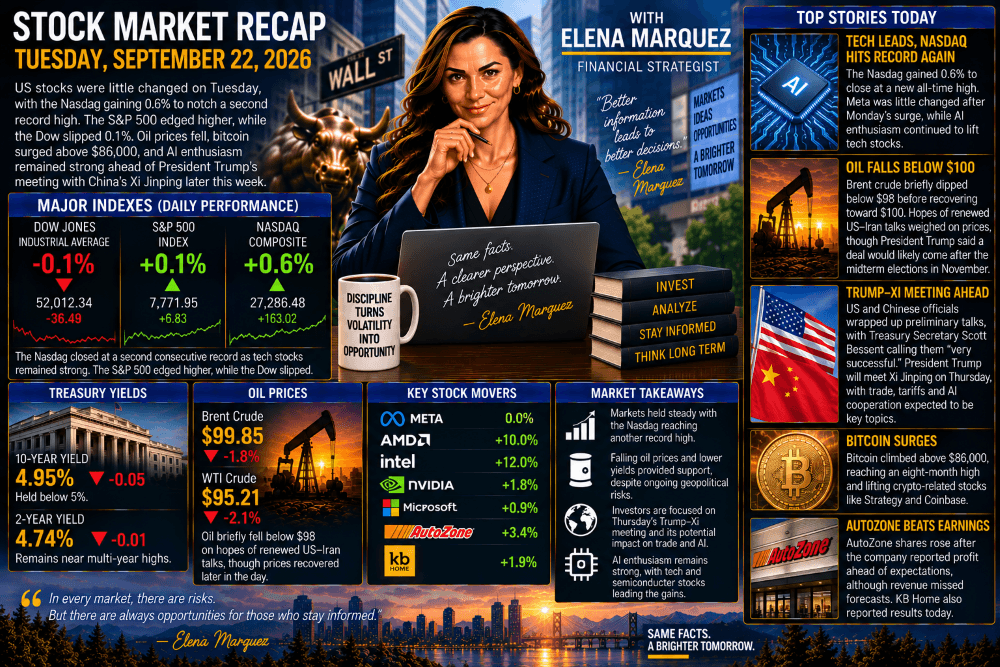
Wall Street took a breather Tuesday after Monday’s spectacular rally—but technology stocks weren’t ready to stop climbing.
The Nasdaq gained roughly 0.6%, reaching another record as enthusiasm surrounding artificial intelligence continued to support technology stocks.
The S&P 500 finished with a much smaller gain, while the Dow slipped approximately 0.1%.
The day’s bigger story, however, wasn’t simply stocks.
Oil briefly fell below $98.
Treasury yields remained just below 5%.
Meta’s new AI agent continued generating excitement.
And investors began turning their attention toward Thursday’s potentially important meeting between President Donald Trump and Chinese President Xi Jinping.
Market Performance
📈 Nasdaq Composite: approximately +0.6%
📈 S&P 500: slightly higher
📉 Dow Jones: approximately -0.1%
Tuesday’s relatively quiet performance followed Monday’s enormous technology rally, when the Nasdaq jumped 2.3%, the S&P 500 climbed 1.5% and the Dow gained 0.7%.
The fact that technology stocks managed to extend those gains is significant.
Wall Street’s AI enthusiasm is clearly back.
Nasdaq Goes for Another Record
Monday’s Nasdaq rally was extraordinary.
Meta surged 11%.
AMD jumped 10%.
Intel gained 12%.
The semiconductor sector soared.
And AMD crossed $1 trillion in market capitalization.
Normally, after moves like those, you would expect some profit-taking.
Instead, technology stocks remained resilient Tuesday.
The Nasdaq reached another all-time intraday high, supported by large technology companies including Apple and Meta.
That’s a strong indication that Monday’s AI rally wasn’t simply a one-day short-covering event.
Investors are once again willing to put money behind the AI growth story.
Meta’s Muse Is Becoming a Serious AI Story
Meta was relatively quiet Tuesday after its enormous Monday rally.
But the reason behind that rally deserves attention.
The company’s new Muse AI agent has recorded approximately 2.8 million downloads in its first 12 days.
For comparison, ChatGPT generated approximately 1.3 million downloads over a comparable period after launch, according to data cited by Reuters.
Muse isn’t simply another chatbot.
It can perform multi-step tasks such as sending emails, booking travel and completing transactions.
Wall Street is beginning to consider something it had largely dismissed:
What if Meta becomes one of the biggest winners in consumer AI?
Meta shares have gained more than 20% since Muse launched, adding over $200 billion in market capitalization.
That excitement is also helping semiconductor companies.
More AI agents mean more computing.
More computing means more chips.
And that’s good news for companies such as AMD, Intel and Nvidia.
Oil Briefly Falls Below $98
Energy provided another important development.
Brent crude briefly fell below $98 per barrel Tuesday before recovering toward $100.
That’s a substantial improvement from nearly $110 last week.
The catalyst was renewed hope that more oil could begin moving through the Strait of Hormuz, combined with Saudi Arabia restarting operations at its East-West pipeline.
Iran has also indicated that it could reopen the Strait of Hormuz relatively quickly if US military pressure eases.
For financial markets, every dollar that comes out of oil matters.
Lower oil reduces transportation costs.
It reduces manufacturing costs.
It reduces inflation pressure.
And potentially, it reduces the amount of work the Federal Reserve has to do.
Trump Complicates the Oil Story
Just when investors were becoming optimistic about an imminent US-Iran breakthrough, President Trump complicated the picture.
Speaking at the United Nations General Assembly, Trump suggested that a peace agreement with Iran could come after the US midterm elections in November.
That reduced expectations for an immediate diplomatic breakthrough and helped oil recover from its earlier losses.
The result was another reminder of just how headline-driven energy markets have become.
One diplomatic comment can send oil lower.
One geopolitical warning can send it right back up.
For stock investors, that means oil is likely to remain one of the market’s most important variables.
The 10-Year Treasury Remains Near 5%
The other number Wall Street can’t ignore is the 10-year Treasury yield.
It hovered around 4.9%–5% Tuesday.
That’s still extraordinarily high compared with the environment investors grew accustomed to over the previous decade.
The relationship remains important:
Oil ↓ → Inflation pressure ↓ → Treasury yields ↓ → Stocks ↑
That’s one reason the recent retreat in oil has been so supportive for equities.
But if oil moves back toward $110, that relationship could quickly reverse.
Financial Stocks Hold Back the Market
Technology wasn’t the whole story Tuesday.
Financial stocks were notably weak.
The S&P 500 financial sector fell roughly 2% during the session, while JPMorgan Chase and Wells Fargo each dropped close to 4% at one point.
That weakness helped explain why the Dow and S&P 500 struggled even while the Nasdaq continued climbing.
It also demonstrates how unusually concentrated the market’s strength has become.
AI and technology are doing a tremendous amount of work.
Without them, Tuesday’s market would have looked considerably weaker.
AutoZone Jumps After Earnings
AutoZone provided one of Tuesday’s notable earnings stories.
Shares rose after the auto-parts retailer reported quarterly profit that exceeded expectations, even though revenue came in below forecasts.
The reaction suggests investors remain willing to reward companies that demonstrate profitability even when top-line growth isn’t perfect.
With the week’s economic and earnings calendar relatively light, individual corporate reports are receiving more attention than usual.
Thursday Could Be Much More Important
The biggest scheduled event remaining this week comes Thursday.
President Trump is expected to meet Chinese President Xi Jinping.
US and Chinese officials have already completed preliminary discussions, with Treasury Secretary Scott Bessent describing those talks as “very successful.”
No sweeping agreement is necessarily expected.
But markets will be watching for progress on:
Trade.
Tariffs.
Technology restrictions.
Semiconductors.
And artificial intelligence.
AI Is Becoming Part of US-China Diplomacy
This may be the most important long-term development of the week.
Artificial intelligence is no longer simply a business story.
It’s becoming part of international diplomacy.
The United States and China are competing for leadership in:
Advanced chips.
AI models.
Data centers.
Robotics.
Quantum computing.
And other strategic technologies.
That puts companies such as Nvidia, AMD, Intel, Microsoft, Meta and OpenAI directly in the middle of one of the world’s most important geopolitical relationships.
Thursday’s meeting therefore matters far beyond tariffs.
It could provide clues about how the world’s two largest economies intend to manage the AI race.
The Market Is Climbing Through an Extraordinary Wall of Worry
Consider everything investors have absorbed recently.
The Fed raised interest rates.
The 10-year Treasury crossed 5%.
Oil approached $110.
The Middle East conflict continues.
AI leaders called for slowing frontier model development.
And US-China tensions remain unresolved.
Yet the Nasdaq is setting records.
That’s remarkable.
The market isn’t saying these risks don’t matter.
It’s saying that—for now—the growth opportunity in technology may be powerful enough to overcome them.
The Bottom Line
Tuesday was quieter than Monday, but the underlying message remained surprisingly bullish.
📈 Nasdaq: ~+0.6%
📈 S&P 500: slightly higher
📉 Dow: ~-0.1%
🛢️ Brent: briefly below $98 before recovering toward $100
📈 10-year Treasury: around 4.9%–5%
🤖 Meta’s Muse AI momentum continues
🇺🇸 🇨🇳 Trump-Xi meeting Thursday
Monday was about the return of AI enthusiasm.
Tuesday showed that enthusiasm may have staying power.
But the market remains dependent on a delicate combination:
Lower oil.
Stable bond yields.
Strong technology earnings.
And improving geopolitical expectations.
If those pieces remain in place, Wall Street’s rally has room to continue.
If oil and Treasury yields surge again, the equation could change very quickly.
For now, however, investors continue doing something they’ve done remarkably well throughout 2026:
Climbing the wall of worry.
Other Stock Market blog posts
Leave a Reply