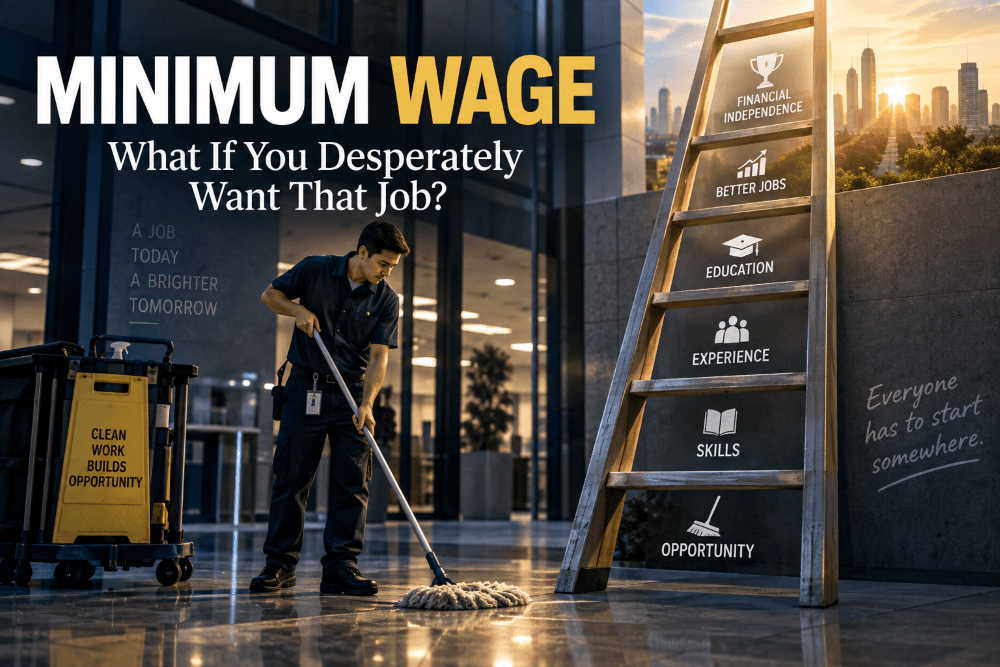
What if the minimum wage is protecting you from the very job you desperately want?
That question isn’t theoretical to me. I lived it.
When I first came to Montreal, I desperately needed work. I had very little money, I needed to pay my living expenses and tuition, I didn’t speak the language, and I had virtually no job experience.
I was ready to work. The problem was finding somebody willing to hire me.
Eventually, I found an employer who offered me a job as a janitor cleaning buildings. The wage was below the legally mandated minimum wage.
I took it.
For approximately two years, I worked as a janitor. And here is the part of my story that doesn’t fit comfortably into the conventional narrative about low-wage workers:
I never felt exploited. I felt grateful for the opportunity.
Minimum Wage and the First Rung of the Ladder
My employer wasn’t preventing me from taking a better job. Nobody else was offering me one.
I didn’t have the language skills, experience or credentials that would make other employers willing to hire me at the legal minimum wage.
So my real choice wasn’t:
- Work for less than minimum wage.
- Work for minimum wage.
My actual choices were closer to:
- Work for less than minimum wage.
- Don’t work.
Given those alternatives, the decision was easy.
I wanted the job.
My employer had something I desperately needed: an opportunity. I had something he needed: my willingness to work at a lower rate.
We had found a price at which we were both willing to make an exchange.
The law said that exchange should not happen.
I Didn’t Consider Myself a Victim
Today, someone might describe the person I was then as a “vulnerable worker.”
Many media outlets call people who take jobs paying less than the minimum wage “vulnerable workers.” I think that label is an exaggeration.
A lot of people willingly accept those jobs because that lower pay reflects the real market value of the work. The minimum wage is not a natural price—it’s a rate set by politicians. When the market value of certain labor is below that legal floor, some workers still choose to take the job rather than remain unemployed.
I wasn’t forced to work for my employer. He didn’t deceive me about my wage. He didn’t prevent me from looking for something better.
I accepted the best employment opportunity available to me at that moment.
There is something uncomfortable about someone who wasn’t there subsequently telling me that I was a victim when I didn’t experience myself that way.
I felt exactly the opposite.
Work gave me dignity.
I could earn money. I could buy food. I could pay my living expenses. I could contribute toward my education.
Most importantly, I had entered the labor market.
Everyone Has to Start Somewhere
Think of employment as a ladder.
Some people are fortunate enough to enter the labor market several rungs up. They have education, language skills, connections, credentials or previous experience.
Others start at the bottom.
I started lower than the legal buttom.
But the important thing wasn’t where I started. It was that someone allowed me to get onto the ladder.
As my circumstances improved, so did my economic value.
I learned. I gained experience. My language skills improved. I became more employable.
Eventually, I earned wages consistent with the minimum wage. A few years later, I became a high-earning individual.
The janitorial job wasn’t my destination.
It was my first rung.
In the United States and Canada, people who remain in low-paying jobs for many years usually do so because of a lack of ambition or effort—not because good opportunities are missing.
Both countries have relatively open job markets. Entry-level work is widely available, and it is possible to move up through hard work, learning new skills, taking on more responsibility, and sticking with a company or industry over time. Many people begin at the bottom and later reach senior or even top leadership roles.
One clear example is Mary Barra, the CEO of General Motors. She started at GM in 1980 at age 18 as a co-op student. Her first job was on the factory floor at a Pontiac plant, inspecting hoods and fenders. The company helped pay for her college education while she worked. After earning an engineering degree and later an MBA, she steadily moved up through manufacturing, engineering, human resources, and product development roles. In 2014 she became CEO—the first woman to lead a major global automaker. She spent more than three decades rising from entry-level plant work to the top job.
Another example is Doug McMillon, CEO of Walmart. As a teenager in 1984 he took a job unloading trucks at a Walmart distribution center for $6.50 an hour so he could help pay for college. He stayed with the company, advanced through store management, merchandising, and international roles, and became CEO in 2014.
These stories are not rare. Plenty of people start in basic or minimum-wage roles—stocking shelves, serving customers, loading trucks, or working on assembly lines—and later become managers, executives, or company leaders. The path usually requires consistent effort, willingness to learn, and the drive to take on harder challenges. When someone stays in a low-paying job for a long time despite those openings, the main reason is often a lack of ambition rather than a lack of opportunity.
Had someone “protected” me by eliminating that rung, I would not automatically have appeared on the second or third rung.
I might simply have remained on the ground.
The Economic Argument Behind the Minimum Wage
A wage is also a price.
It’s the price at which someone sells labor and an employer buys it.
Minimum wage legislation establishes a price below which that transaction is prohibited.
Suppose an inexperienced worker can find an employer willing to offer $6 an hour, but the government says employment below $10 an hour is illegal.
It is tempting to imagine that the law transforms the $6 job into a $10 job.
Sometimes something resembling that can happen. The employer might absorb the additional cost, become more productive, accept a smaller profit or raise prices.
But there are other possibilities.
The employer can hire fewer people, reduce hours, require more experience, automate the job, raise prices, close the business—or move the work somewhere else.
Most importantly, the employer can simply decide:
“At this wage, I’m not going to hire this person.”
The worker hasn’t received a raise.
The worker has lost an opportunity.
What the Evidence Actually Says About Minimum Wage
This is where I think advocates on both sides should be careful.
The simple economic model predicts that when a minimum wage is set above the market-clearing wage, employers demand less labor.
But the real world is more complicated.
The better question is:
Which jobs disappear, which workers don’t get hired, and which opportunities never come into existence because the legally mandated wage is higher than an employer is willing to pay?
Those invisible opportunities matter.
Minimum Wage Laws May Hurt the People at the Bottom
This is my biggest concern.
Imagine two job applicants.
One speaks the language fluently, has three years of experience and excellent references.
The other recently arrived in the country, speaks little of the language and has no local employment history.
If an employer must pay either person exactly the same minimum hourly wage, which applicant represents the greater risk?
Probably the inexperienced worker.
That was me.
Allow the second applicant to compete partly on price, however, and suddenly the calculation changes.
“I don’t have his experience yet, but give me an opportunity. I’ll work hard and prove myself.”
That’s an extraordinarily powerful tool for someone who doesn’t have anything else to offer yet.
A wage floor can remove that bargaining tool.
The people most likely to lose out are those with the least experience or the lowest skills—teenagers looking for their first job, people with limited education, recent immigrants, or anyone whose productivity does not yet match the higher legal wage. These are the workers who most need that first job to gain skills and climb the ladder. By pricing them out of the market, the minimum wage removes the bottom rung.
Many people willingly accept lower pay for certain jobs because that is what the work is currently worth in the open market. The minimum wage overrides that choice. It tells both the worker and the employer that a mutually beneficial deal is illegal. The worker who would rather earn something than nothing ends up with nothing.
History and evidence show the pattern repeatedly. When the minimum wage is raised sharply, employment among low-skill groups often falls or grows more slowly. Businesses respond by hiring fewer people, cutting hours, raising prices for customers, or investing in machines that replace workers. The higher wage helps those who keep their jobs, but it leaves others unemployed or stuck outside the labor market altogether.
There are better ways to help people earn more. Stronger economic growth creates more jobs and raises wages naturally. Skills training, education, and work experience increase a person’s value to employers. Targeted help such as wage subsidies or the earned-income tax credit can put more money in low-income workers’ pockets without destroying jobs. These approaches raise living standards without making it illegal for someone to work at the wage the market will support.
In short, the minimum wage tries to raise pay by government order. It succeeds for some, but at the cost of fewer opportunities for others—especially the least skilled. Allowing wages to be set by voluntary agreement between workers and employers keeps more people employed and gives them a real chance to move up.
If an adult understands the offer and says:
“I know the wage is low. I wish it were higher. But this is currently my best opportunity and I want the job.”
I think we should at least ask what gives someone else the moral authority to prohibit that person from accepting it.
Dignity Can Come From Work, Not Just Wages
One reason this subject remains personal to me is that my low-paying job gave me something beyond money.
It gave me independence.
I wasn’t asking someone else to support me. I was cleaning buildings and supporting myself.
There was dignity in that.
Of course I wanted to earn more money.
Almost everyone does.
But my strategy wasn’t to wait until somebody offered me the wage I wanted. My strategy was to take the best opportunity available and make myself more valuable.
And it worked.
My wage increased because my opportunities increased.
Let Workers Have Agency
Political debates often treat low-income workers as though they have no agency.
Someone looks at a $5 wage and thinks:
“Nobody should have to work for that.”
I understand the sentiment.
But the worker might be thinking:
“Please don’t take this job away from me. It’s the best opportunity I have.”
Both perspectives deserve to be heard.
My concern is that politicians, activists and commentators sometimes concentrate so heavily on the wage a person should earn that they overlook the opportunities the person actually has.
There are workers who would willingly accept jobs below the statutory minimum because those jobs are better than their available alternatives. There are also employers who would be willing to hire inexperienced or higher-risk workers at lower wages but not at the mandated wage.
How numerous those workers and employers are is an empirical question; we shouldn’t simply assume that they number in the millions.
But economically, their existence matters.
What If We Are Removing the First Rung?
I don’t pretend that eliminating the minimum wage would solve every labor-market problem.
Nor does my experience prove that every worker would benefit from its abolition.
But my experience taught me something that statistics can easily obscure.
A bad option can still be someone’s best option.
And taking away someone’s best option doesn’t necessarily give them a better one.
When I arrived in Montreal, I didn’t need politicians to tell my employer what my labor ought to be worth.
I needed someone to give me a chance.
Someone did.
I cleaned buildings. I paid my expenses. I gained experience. I learned. I moved forward.
Eventually, I earned far more than minimum wage.
I climbed the ladder.
Before we remove the bottom rung in the name of protecting the person standing on it, perhaps we should ask that person a simple question:
“Do you want us to take this opportunity away from you?”
Their answer might surprise us.
Frequently Asked Questions
Does minimum wage always cause unemployment?
No. The empirical evidence is much more complicated than the simplest supply-and-demand model suggests.
Why would anyone voluntarily work below minimum wage?
A low wage may still be better than someone’s available alternatives. Workers entering a country, people without experience, young workers and people trying to re-enter employment may value an opportunity partly because it allows them to acquire skills, references and experience.
Isn’t paying someone below minimum wage exploitation?
Under current minimum-wage laws, paying below the applicable legal rate is generally unlawful. Whether a particular employment relationship should also be described as exploitation is a broader moral question. Coercion, deception and wage theft are importantly different from a worker knowingly accepting a low wage because it is their preferred available option.
Other personal finance blog posts
Leave a Reply