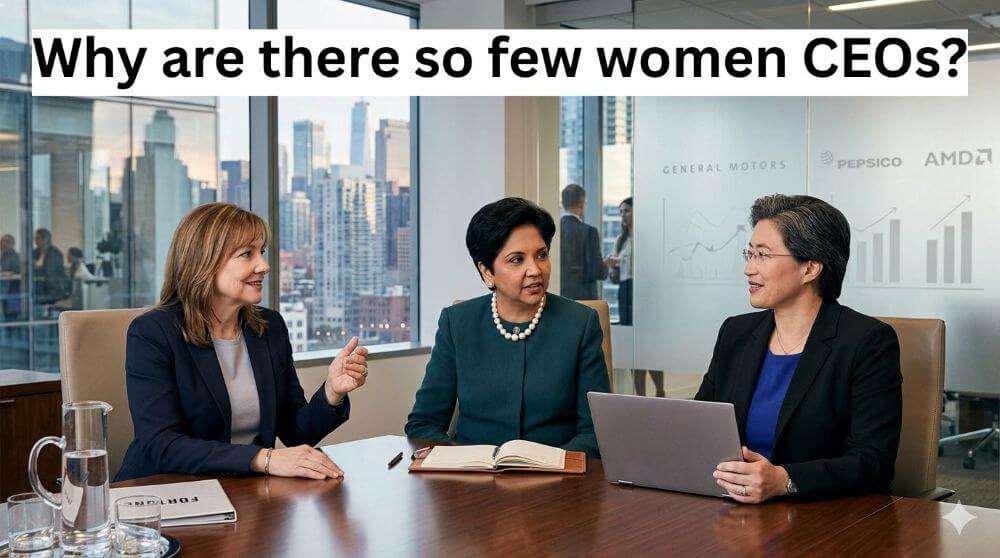
The landscape of corporate power is shifting, but the peak of the mountain remains heavily skewed. As of 2025, women lead roughly 11% of Fortune 500 companies, meaning about 55 CEOs in that elite group are female. While this is an improvement from previous decades, it raises a significant question: Why do men still dominate the CEO role?
The answer isn’t found in a single reason but in a complex web of structural, behavioral, and cultural factors. From negotiation styles to the types of roles that lead to the top, several barriers keep the “glass ceiling” intact for many talented women.
1. The “Line vs. Staff” Role Disparity
One of the most persistent structural issues is the executive pipeline. To become a CEO, a candidate usually needs experience in “Line Roles”—positions with Profit and Loss (P&L) responsibility.
Historically, men are more frequently placed in these profit-center roles, such as operations or sales. In contrast, women are often steered toward “Staff Roles,” such as Human Resources, Marketing, or Legal.
While these staff roles are vital, they rarely serve as the traditional springboard to the CEO chair. Without direct experience managing a company’s bottom line, women find it harder to convince boards they are ready for the top job.
2. Extreme Work Hours and the “Availability” Premium
Leadership at the highest level often demands a lifestyle that borders on the obsessive. Many top-tier CEOs are known for working 80 to 100 hours per week.
- Elon Musk is famous for sleeping on factory floors and maintaining a grueling schedule.
- Tim Cook and Satya Nadella are known for starting their days before dawn and maintaining constant availability.
Societal expectations often place a heavier burden of domestic labor and caregiving on women. This makes it structurally more difficult for many women to commit to the “extreme work” culture required to reach and maintain a CEO position in the current corporate climate.
3. Aggressive Negotiation and Power Maneuvers
There is a documented difference in how men and women navigate high-stakes conflict and negotiation. Men are often socialized to be more comfortable with aggressive, high-risk power plays.
Real-Life Examples of Power Maneuvering:
- Sam Altman (OpenAI): After being abruptly fired, Altman used his influence with employees and investors to maneuver his way back into the company within days, leading to a board overhaul.
- Steve Jobs (Apple): After his famous ousting, Jobs returned years later via the NeXT acquisition, eventually reclaiming the CEO spot and reshaping the board to fit his vision.
- Elon Musk (X/Twitter): Musk’s blunt “Go fuck yourself” to advertisers who threatened to leave showcased a high-risk, aggressive negotiation style that few female executives would be “allowed” to use without facing extreme backlash.
- Travis Kalanick (Uber): The co-founder of Uber famously employed a “growth at all costs” strategy. He was willing to enter markets and essentially break local transportation laws and municipal regulations in cities worldwide to establish Uber’s service. This aggressive, confrontational approach toward regulators allowed Uber to scale at a pace that a more risk-averse or “compliant” leader might have missed.
4. Cultural Bias and “The Glass Cliff”
Even when women reach the top, they often face a phenomenon called the “Glass Cliff.” This is when women are more likely to be appointed CEO during a time of crisis or downturn.
When the company inevitably struggles or fails to turn around quickly, the female CEO is often blamed and replaced. This creates higher turnover rates and reinforces the bias that “traditional” (male) leadership is safer for stability.
5. Weak Professional Networks
Success in the C-suite is often about who you know. “The Old Boys’ Club” isn’t just a cliché; it represents the informal networking—golf outings, private clubs, and late-night drinks—where mentorship and sponsorship happen.
Men frequently benefit from senior male leaders who “pull them up.” Women often lack these organic sponsorship opportunities, making the climb to the CEO position much lonelier and more difficult.
Some oustanding female CEOs raise to the top
In spite of the many hurdles women face to become CEOs, there have been several admirable leaders who have not only reached the top but have fundamentally reshaped their industries.
- Mary Barra has served as the CEO of General Motors (GM) since 2014, making history as the first woman to lead a major global automaker while guiding the company through a massive shift toward electric vehicles.
- In the healthcare sector, Gail Boudreaux has led Elevance Health since 2017, consistently ranking among the world’s most powerful women for her management of one of the largest health benefits providers in the U.S.
- The financial and logistics worlds have also seen historic shifts; Jane Fraser became the first woman to head a major Wall Street bank as CEO of Citigroup in 2021.
- Carol Tomé took the reins at UPS in 2020, bringing an emphasis on efficiency and sustainability to the delivery powerhouse.
- In the highly competitive semiconductor industry, Lisa Su has been instrumental in turning AMD into a dominant global force since 2014.
- We also cannot overlook the legacy of Indra Nooyi, who served as CEO of PepsiCo from 2006 to 2018; her “Performance with Purpose” strategy remains a blueprint for modern corporate leadership.
Summary
The disparity in CEO numbers is driven by a lack of P&L experience, the demands of extreme work hours, and differences in aggressive negotiation styles. While the numbers are improving, closing the gap requires changing how we develop executive pipelines and how we define leadership.
Frequently Asked Questions (FAQ)
What percentage of Fortune 500 CEOs are women? As of 2025, approximately 11% of Fortune 500 CEOs are women.
What is the “Glass Cliff” for female CEOs? It refers to the tendency of companies to hire women for leadership roles during periods of crisis, making their chance of failure higher.
Why are P&L roles important for becoming a CEO? Profit and Loss (P&L) roles prove a leader can directly manage the financial health and operations of a business, which is the primary requirement for a CEO.