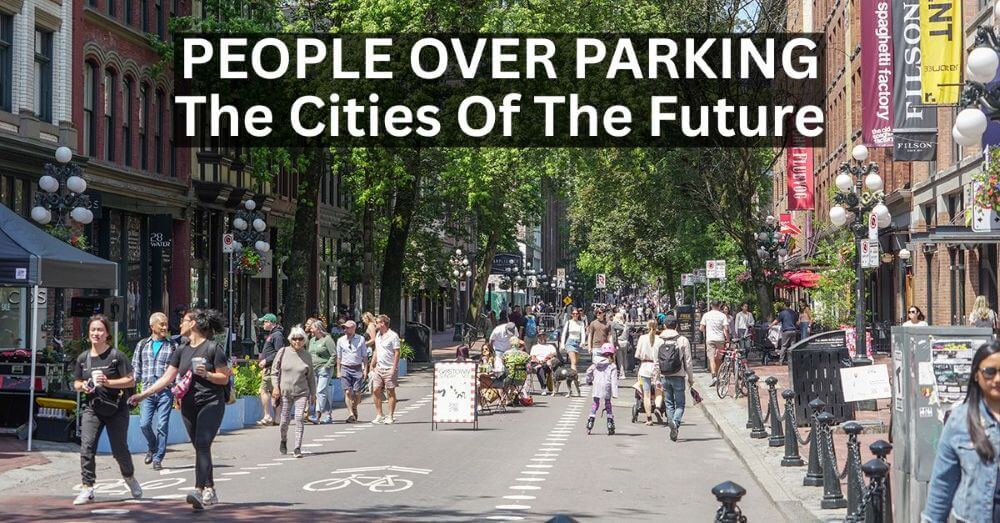
The idea of Parking Minimuns is an outdated idea that should dismantled and abolished in the cities in North America. Businesses and buildings should be allowed to build as many parkings as they deem necessary and not what an out of town regulator dictates.
In many cites Parking Minimuns state something like this:
- every apartment must come with 1 parking spot
- every restaurant must have, say, 10 or 20 spaces depending on its size
- every office must provide parking for employees and visitors
These rules are written into zoning laws, so developers are not allowed to build unless they meet those minimum parking requirements. These rules might have been a good idea when they were created, but now they are becoming obsolete and impeding maximum enjoyment of a city.
For decades now, cities have prioritized parking lots over human housing. But as we move further into the 21st century, it’s becoming clear that these ill-informed regulations are not the best citizens of most cities and the way we live, work, and move.
We must congratulate Governor J.B. Pritsker for his initiative in regards to parking regulations and zoning. Illinois’ new ‘People Over Parking Act’ is set to take effect June 1, 2026. The law, signed by J.B. Pritzker, will ban local governments from requiring minimum parking spaces for new residential and commercial developments located near transit hubs—within half a mile of stations or an eighth of a mile of frequent bus routes.
Other states such as California, Oregon, and Colorado have passed similar acts. These leaders have used state-level authority to override local parking mandates, signaling that the era of government-forced asphalt is coming to an end. While I don’t always find myself in agreement with Governor Pritzker’s policies, on the People Over Parking Act, I agree with him 100%. This is about economic freedom, common sense, and adapting to a world where car ownership is no longer a requirement for survival.
Why the People Over Parking Act is Necessary
The core of the People Over Parking Act is simple: it removes the “regulatory floor” that forces developers to build a specific number of parking spots for every unit. This shift addresses several critical issues that have plagued our communities for years.
Lowering the Cost of Housing
Structured parking is incredibly expensive. In North America, a single underground parking stall can cost between $50,000 and $80,000. These costs are inevitably passed down to the residents in the form of higher rent or purchase prices. By removing these mandates, we lower the barrier for affordable housing and let the market dictate how much parking is truly necessary.
Design Flexibility and Innovation
Developers can finally design buildings based on actual market demand rather than arbitrary municipal codes. This allows for more creative architecture and the use of land for living space instead of empty stalls. In a world with the People Over Parking Act, we prioritize bedrooms over bumpers. And if a develper thinks that it would be more profitable to build more parking spaces, he’s totaly free to do that. He can observe his environement, put his capital at risk and make the decision, as oppose as someone in capital hill telling him how to best use his resources.
6 Reasons This Change Benefits Our Communities
The transition away from mandatory parking is a win for everyone—from small business owners to retirees looking for walkable neighborhoods.
- Increased Housing Affordability: Removing the “hidden tax” of parking allows for more units to be built on the same plot of land at a lower cost per unit.
- Revitalization of Small and Historic Lots: In neighborhoods like Le Plateau (where I live), many historic lots sit empty because they can’t fit a building and the required parking. Now, these can become thriving cafes or homes.
- Improved Walkability: Fewer “dead zones” of asphalt mean shorter distances between destinations, creating a “virtuous cycle” for pedestrians and cyclists.
- Environmental Resilience: Replacing impervious asphalt with housing or parks helps manage stormwater and reduces the “heat island” effect that plagues urban centers.
- Higher Tax Revenue: A three-story shop or apartment building generates significantly more property tax revenue for the city than a flat parking lot, funding better public services without raising rates.
- Property Owner Freedom: This is a victory for property rights. It removes a layer of government bureaucracy, allowing owners to decide if their land is better used for a garden, an extra bedroom, or a small office.
The Personal Reality: Living Car-Free in Le Plateau
My support for the People Over Parking Act isn’t just theoretical; it’s based on how I live my life. I have chosen to have no car. Living in Le Plateau (the nicest neighborhood in Montreal), I have everything I need—food, parks, bars, and restaurants—within a short walk.
When I need to go further, I have options:
- Public Transportation: Reliable, cost-effective, and efficient.
- Car Sharing: Services like Communauto for specific trips.
- Ridesharing: Uber and the emerging fleet of robo-taxis.
This is the way of the future. Many new buildings will soon be designed with dedicated “drop-off zones” for autonomous vehicles rather than massive underground garages. Forcing people to own a car and forcing developers to build parking for them is a 20th-century solution to a 21st-century reality. The People Over Parking Act acknowledges that cities should be built for people, not just for storing machines.
Europen cities moving from minimum parking to maximum parking
the most prominent European cases of eliminating parking minimums, the shortlist would be:
- London (replaced with maximums)
- Berlin (fully eliminated)
- Hamburg (eliminated for residential)
And then a second tier of cities that achieved similar outcomes through different tools:
- Paris
- Zurich
- Amsterdam
Summary
The People Over Parking Act represents a shift toward market-based decision-making and individual liberty. By allowing property owners the freedom to build without government mandates, we create cities that are more affordable, more walkable, and ready for the technological shifts of the future.
Frequently Asked Questions (FAQ)
What is the People Over Parking Act? It is a legislative movement (most recently SB 2111 in Illinois) that prohibits local governments from imposing minimum parking requirements on developments near public transit hubs.
Does this mean I won’t be able to find parking? No. Developers will still build parking if they believe their tenants want it. It simply means the government isn’t forcing them to build more than the market demands.
How does this affect my property taxes? Generally, it is positive. Replacing low-value parking lots with high-value buildings increases the city’s tax base, providing more funds for schools and infrastructure.