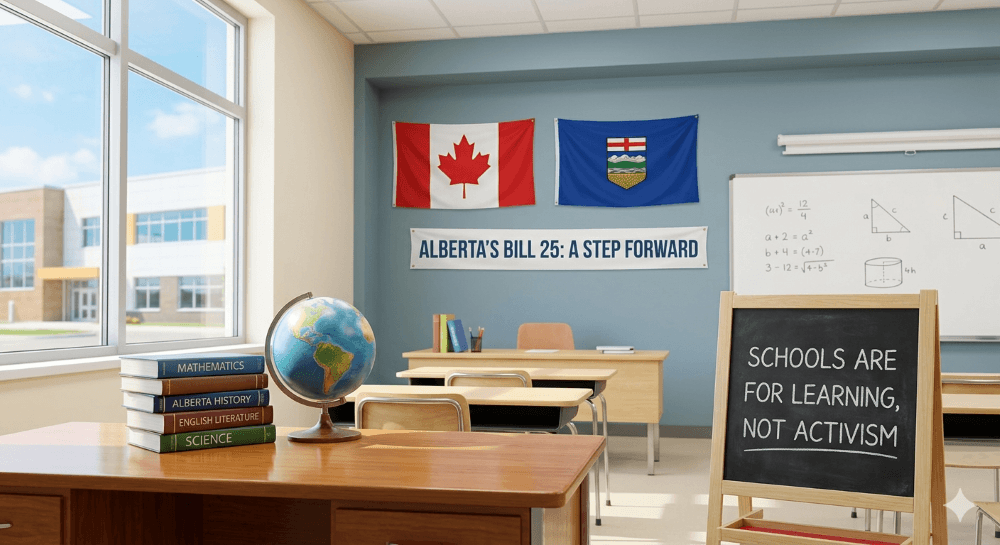
I think schools should be places where kids go to learn basic English and math, and maybe play some sports in the afternoon. Schools are not for activism. They are not for teaching an endless list of gender identities, flying political or advocacy flags—like Black Lives Matter, transgender rights, Free Palestine, or “Stop ICE”—or for assigning books about teen sexual content. These subjects do not belong in the classroom, especially when North America is falling behind other industrialized countries in basic science, math, and English.
The Case for Classroom Neutrality
When students enter a classroom, their environment should be a neutral ground designed for intellectual inquiry. The presence of political or cultural symbols, such as pride flags in a room dedicated to physics or calculus, creates a persistent distraction. It signals a teacher’s personal ideology rather than a commitment to objective curriculum standards.
Alberta’s Bill 25 acknowledges that schools should be spaces where students learn how to think, not what to think. By removing ideological bias, we allow young minds to develop their own perspectives based on facts and logic.
A Global Movement Toward Academic Excellence
Alberta is not alone in this journey. We are seeing a worldwide push for Education Reform that emphasizes traditional academic standards over cultural indoctrination. From North America to Latin America, the message is the same: prioritize the fundamentals that lead to success.
The Florida Model: Academics First
In the United States, Florida has been a leader in refocusing on academics. By setting strict guidelines on what can be taught regarding social ideologies, they have cleared the way for a more robust emphasis on reading and STEM subjects. This shift ensures that tax dollars are spent on measurable student achievement rather than social grievances.
El Salvador and President Nayib Bukele
President Nayib Bukele has made headlines for his decisive stance on schooling. His government has actively removed “gender ideology” from public education to prioritize scientific knowledge and traditional values. His policy includes:
- Biological Focus: Teaching emphasizes biological concepts recognizing only male and female sexes.
- Language Standards: Limiting inclusive language to maintain linguistic clarity and respect for traditional grammar.
- Parental Rights: Giving parents a stronger role in overseeing their children’s moral and educational development.
- Content Audits: Removing materials considered “ideological indoctrination” by the state.
Mexico: The Aguascalientes Reform
In March 2026, the Congress of Aguascalientes approved a reform to promote the use of “correct” Spanish. By adhering to the grammar rules recognized by the Royal Spanish Academy (RAE), they are discouraging the use of inclusive language like “todes” or “elles.” This ensures that students master the formal language required for professional and international success.
Why Guardrails in Education Reform Matter
Every community should encourage these guardrails. Without them, the educational mission becomes diluted. Education Reform ensures that the limited hours of the school day are spent on high-value learning. Many are tired of seeing math scores dip while political activism rises.
- Economic Readiness: Mastery of English and Math is the best predictor of future career success in a global market.
- Mental Clarity: Removing political noise allows students to focus on complex problem-solving without the fear of social repercussions.
- Institutional Trust: When schools stay neutral, they regain the trust of parents who feel sidelined by modern curriculum shifts.
The Role of the Teacher as a Facilitator
A teacher’s job is to facilitate the curriculum, not to act as a political guide. When a room is devoted to science, the only “truth” should be empirical data. Bill 25 provides the protection teachers need to stay objective and the assurance parents need that their children are being educated, not recruited. We want our teachers to be experts in their fields, not activists for a cause.
Summary: A Path Toward Better Results
The decision by the Alberta government to introduce Bill 25 is a brave step toward a better future. By aligning with global movements that value science, traditional language, and parental rights, Alberta is ensuring its students aren’t left behind. True Education Reform means acknowledging that some things belong in the home, and some things—like math and science—belong in the classroom.
Frequently Asked Questions (FAQ)
What is the primary goal of Alberta’s Bill 25? The bill aims to ensure classroom neutrality by removing political and ideological bias, focusing instead on core academic subjects like math and literacy.
How does this Education Reform impact parental rights? It strengthens the role of parents as the primary decision-makers regarding their child’s moral and social development, rather than the school system.
Why is inclusive language being limited in some regions? In places like Aguascalientes and El Salvador, the focus has shifted back to official grammar and biological definitions to ensure clarity in communication and scientific accuracy.
Does this mean social issues aren’t discussed at all? Social issues may be discussed, but they must be presented with balanced perspectives, ensuring no single ideology is taught as the only “correct” view.