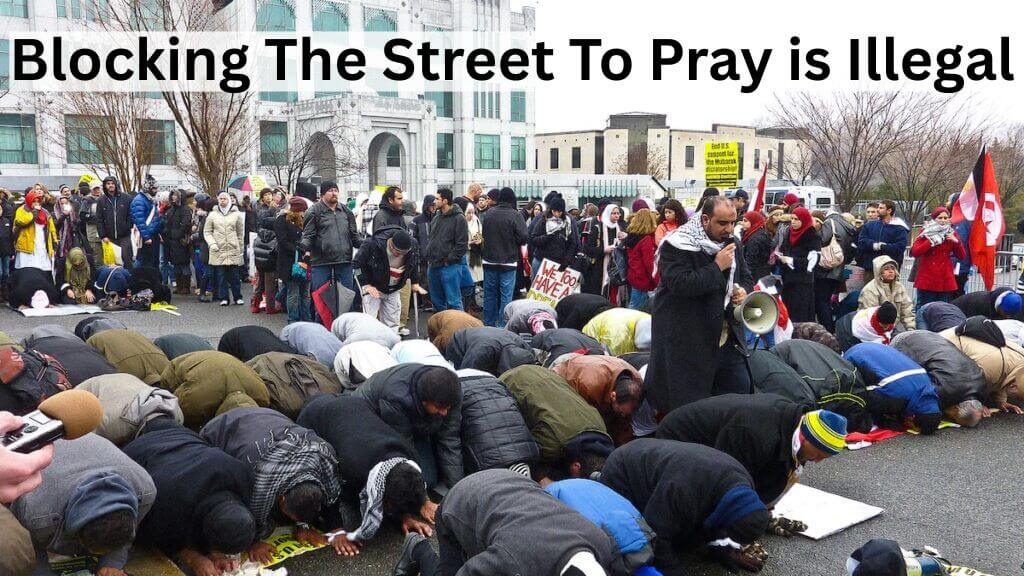
Whenever a group of Muslims blocks a street to pray, it is not simply an expression of religious freedom. To many, it feels like an act of intimidation. What ordinary citizen is going to step forward and say, “You’re blocking the street”? Very few. Confronting a group of 20 or 30 men is, by its nature, intimidating.
Mosques exist precisely to provide a space for prayer and religious observance. If those spaces are available, why move religious practices into the street? The question is unavoidable. When public space is taken over in this way, it can be perceived not as devotion, but as a display of power and unity, a message that rules can be bent without consequence.
In theory, maintaining balance in shared public spaces is the role of government. In practice, some governments hesitate. In countries such as England and France, the size and visibility of Muslim populations have made enforcement politically and socially sensitive. Reports of areas where authorities are reluctant to intervene have only reinforced the perception that the rule of law is unevenly applied.
Quebec has chosen a different path. With the passage of Bill 9 on April 2, 2026, the province is asserting that public order must apply equally to all. Under this framework, any group seeking to hold a large religious gathering in public space must obtain a municipal permit.
The principle is straightforward: sidewalks, intersections, parks, and streets belong to everyone. Preserving access to them is not an attack on religious freedom, but a reaffirmation of shared civic order.
A Necessary Crackdown on Religious Provocation
For too long, citizens in Montreal have had to endure the sight of hundreds of people blocking traffic and bridges to perform religous rituals. These acts are rarely about quiet devotion; they are calculated displays of strength. It specially felt intimidating when peple were holding pro-Palestine protests. It felt that anyone with a different opinion should fear for their safety.
Why Quebec Had to Act
- End of Intimidation: Mass prayers in the street create an atmosphere of “occupation” that intimidates secular citizens.
- Public Safety First: No group should have the power to block emergency services or commuters for a religious ritual.
- Strict Neutrality: Quebec’s model of laïcité demands that the public square remain neutral and free from religious dominance.
Muslims Praying in the Street: Why the Permit Matters
The new law doesn’t stop people from believing what they want, but it dictates where they can practice. By requiring a municipal permit, the government ensures that religious groups cannot simply “seize” a street. If a gathering is seen as a provocation or a safety risk, the permit can be denied, and the police now have the clear mandate to intervene.
Expanded Secularism Beyond the Sidewalk
Bill 9 doesn’t just stop at the street corner. It reinforces the secular shield across multiple sectors:
- Daycares and Schools: New staff in subsidized daycares and private schools are banned from wearing religious symbols, ensuring a neutral environment for children.
- Face Coverings: The ban on full-face veils in colleges and daycares is now solidified, prioritizing security and human interaction.
- The Notwithstanding Clause: Quebec is using its constitutional powers to ensure these common-sense rules aren’t struck down by activist courts.
Restoring Order to the Public Square
A street is a functional space for all citizens, not a place for political theater masked as prayer. In recent years, we’ve seen Muslims praying in the street in the middle of aggressive political protests. This fusion of religion and activism is a direct challenge to Quebec’s hard-won separation of church and state.
By enforcing Bill 9, the government is saying that religious expression does not grant you a “pass” to ignore traffic laws or civic norms. It is a win for every Quebecer who believes that religion belongs in the home or the house of worship—not blocking the way to work.
Summary: Quebec Stands Firm on Laïcité
In summary, Bill 9 Quebec is a bold and necessary move to stop the use of public spaces as tools of religious provocation. Whether it is Muslims praying in the street or any other religious group attempting to bypass municipal rules, the law is now clear: the public square remains secular. We congratulate the government for putting the rights of the secular majority first.
Frequently Asked Questions (FAQ)
Is all prayer banned in public?
No. Individual, discreet prayer is not the target. The law bans unauthorized group or collective prayers that obstruct public spaces without a municipal permit.
Why was Bill 9 Quebec passed?
It was passed to address the rising trend of mass street prayers blocking Montreal streets and to expand the secularism rules started by Bill 21.
Does this apply to all religions?
Yes. The law is neutral and applies to any religious group attempting to hold collective worship in a public thoroughfare without permission.
What are the penalties for unauthorized street prayer?
Under Bill 9, police have the authority to disperse the crowd and participants can face fines for violating municipal bylaws and provincial secularism standards.