| 📊 Alain’s Holdings — September 21, 2026 | ||||
|---|---|---|---|---|
| Symbol | Name | Price | Change | Change % |
| VOO | Vanguard S&P 500 ETF | 712.78 | +10.93 | +1.56% |
| QQQ | Invesco QQQ Trust | 741.47 | +20.02 | +2.77% |
| XIU.TO | iShares S&P/TSX 60 ETF | 53.41 | +0.37 | +0.70% |
Wall Street started the week with a bang.
Stocks surged Monday as three of the market’s biggest recent worries suddenly moved in a favorable direction:
Oil fell.
Treasury yields retreated.
And enthusiasm for artificial intelligence came roaring back.
The result was one of the strongest technology rallies in weeks, sending the Nasdaq Composite to a new all-time high.
Market Performance
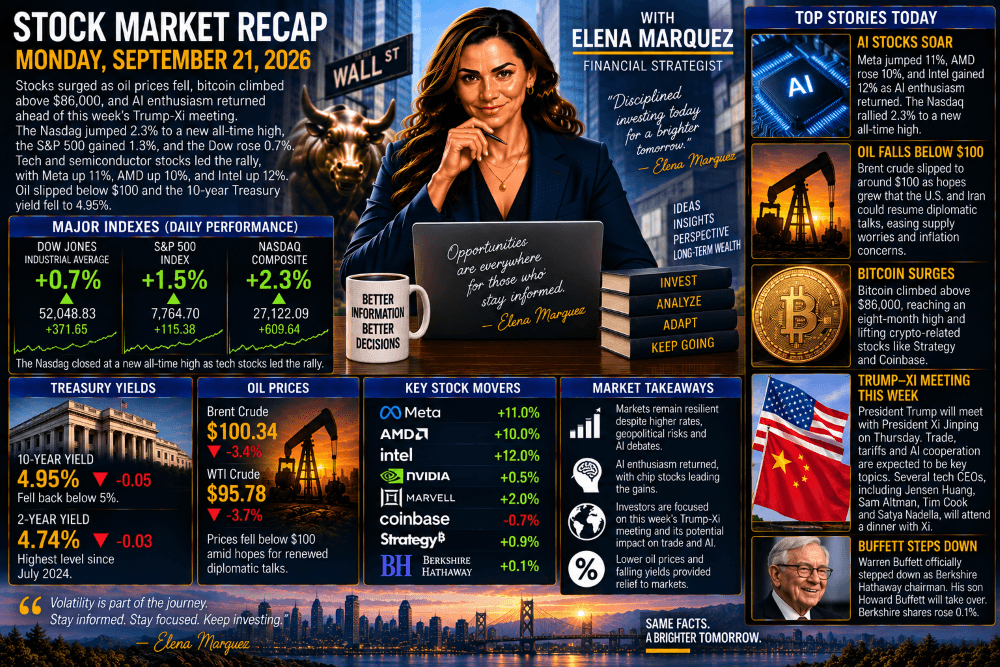
📈 Nasdaq Composite: +2.3% to 27,122.09
📈 S&P 500: +1.5% to 7,764.70
📈 Dow Jones: +0.7% to 52,048.83
The Nasdaq closed at a record, while the S&P 500 finished only about 0.4% below its own all-time high.
That’s an impressive turnaround after several weeks dominated by inflation fears, $100-plus oil, 5% Treasury yields and renewed Federal Reserve tightening.
AI Is Back
The biggest winners Monday were exactly the stocks investors had questioned only a week ago.
AI and semiconductor stocks exploded higher.
Meta: approximately +11%
AMD: approximately +10%
Intel: approximately +12%
The PHLX Semiconductor Index jumped about 4.3%.
AMD even crossed another remarkable milestone:
$1 trillion in market capitalization.
Just one week ago, investors were selling AI stocks after Anthropic CEO Dario Amodei called for slowing the development of frontier AI models over safety concerns.
Today?
Wall Street was buying AI again.
Aggressively.
Meta Reignites the AI Trade
Meta was one of Monday’s standout performers.
Shares surged roughly 11% amid enthusiasm surrounding the company’s AI initiatives, including its Muse AI agent.
The excitement spread rapidly through the semiconductor industry.
If increasingly sophisticated AI agents become widely used, the amount of computing required to run them could increase dramatically.
That means more demand for processors.
More servers.
More memory.
More networking.
And potentially more data centers.
Suddenly, investors who worried last week about slowing AI development were once again focused on something completely different:
AI demand.
AMD Joins the $1 Trillion Club
AMD’s surge pushed the semiconductor company beyond $1 trillion in market value for the first time.
That’s an extraordinary milestone.
AMD has spent years competing with Nvidia in high-performance computing and AI accelerators.
Now investors are increasingly betting that the AI infrastructure market could become large enough to support multiple enormous winners rather than a single dominant supplier.
The bigger takeaway may be this:
Wall Street still believes the AI revolution requires an extraordinary amount of computing power.
Monday’s rally suggests investors aren’t ready to abandon that thesis.
Intel Jumps 12%
Intel provided another surprise.
Shares jumped approximately 12%, extending the company’s extraordinary recent rally.
The market increasingly sees Intel as another potential beneficiary of enormous AI-related computing demand.
That’s particularly interesting because Intel spent years falling behind competitors in advanced semiconductors.
The AI boom may be giving the company another opportunity to regain relevance.
Investors appear willing to give Intel the benefit of the doubt—for now.
Oil Finally Falls Below $100
The technology rally wasn’t the only reason stocks jumped.
Oil provided another major catalyst.
Brent crude fell about 3.4% to $100.34 per barrel, while US crude dropped even more sharply to roughly $95.78.
That matters enormously.
For weeks, oil has been one of Wall Street’s biggest problems.
Higher oil means higher transportation costs.
Higher manufacturing costs.
Higher food costs.
Higher airline costs.
And ultimately, more inflation.
Lower oil reverses some of that pressure.
The market’s recent relationship has been relatively straightforward:
Oil ↑ → Inflation fears ↑ → Fed expectations ↑ → Treasury yields ↑ → Stocks ↓
Monday gave investors the opposite version:
Oil ↓ → Inflation fears ↓ → Treasury yields ↓ → Stocks ↑
The 10-Year Treasury Falls Back Below 5%
The bond market delivered another piece of good news.
The 10-year Treasury yield retreated to roughly 4.95%, falling back below the psychologically important 5% threshold.
That’s especially helpful for technology stocks.
High-growth companies are valued partly on profits expected many years into the future.
When interest rates rise, those distant profits become less valuable in today’s dollars.
When yields fall, the opposite happens.
That’s one reason Monday’s combination of falling oil and falling Treasury yields was such powerful fuel for technology stocks.
Bitcoin Breaks Above $86,000
Risk appetite wasn’t limited to stocks.
Bitcoin surged above $86,000, reaching its highest level in roughly eight months.
Crypto-related stocks rallied alongside it.
The move is particularly interesting considering the broader monetary environment.
The Federal Reserve just raised interest rates.
Treasury yields remain historically elevated.
And yet investors are still willing to move aggressively into speculative assets.
That’s another indication that liquidity and risk appetite remain surprisingly strong.
Wall Street Is Looking Toward China
The next major event comes Thursday, when President Donald Trump is scheduled to meet Chinese President Xi Jinping.
The talks are expected to include trade, tariffs and technology issues.
AI and semiconductor policy will be closely watched because restrictions on advanced chips have become an important part of US-China economic relations.
Several major technology executives are also expected to attend events surrounding Xi’s visit, including leaders associated with Nvidia, OpenAI, Microsoft, Qualcomm and Apple.
For investors, the important question is straightforward:
Can the world’s two largest economies reduce some of the uncertainty surrounding trade and technology?
Any concrete changes to tariffs, semiconductor rules or technology cooperation could have implications for global markets.
AI Has Become a Geopolitical Asset
There’s a bigger story developing here.
Artificial intelligence is no longer simply a technology investment theme.
It’s becoming a strategic geopolitical asset.
The United States wants leadership in advanced semiconductors and AI models.
China wants the same thing.
Companies such as Nvidia, AMD, Intel, Microsoft, Meta and OpenAI therefore sit at the intersection of:
Technology.
National security.
Trade policy.
Industrial policy.
And financial markets.
That makes Thursday’s US-China discussions particularly relevant to the AI trade.
From AI Fear to AI Euphoria in Seven Days
Perhaps the most fascinating thing about Monday’s rally is how quickly investor psychology changed.
One week ago:
AI leaders were discussing slowing development.
Chip stocks were plunging.
Investors were questioning AI capital spending.
Today:
Meta surged about 11%.
AMD jumped around 10%.
Intel gained roughly 12%.
The semiconductor index climbed more than 4%.
And the Nasdaq reached a record.
Nothing illustrates the speed of today’s market better than that reversal.
The long-term questions surrounding AI haven’t disappeared.
But Wall Street has decided—at least for today—that the growth opportunity matters more.
The Wall of Worry Isn’t Gone
Monday’s rally was powerful.
But investors shouldn’t confuse one strong session with the disappearance of risk.
The Federal Reserve just restarted its rate-hiking cycle.
Another increase remains possible.
Treasury yields are still near 5%.
Oil remains around $100.
The Middle East conflict continues.
Inflation remains above the Fed’s target.
And the debate over AI safety isn’t going away.
Yet the market continues climbing through those concerns.
That’s what makes the current environment so interesting.
September Isn’t Behaving Like September
September has historically been a difficult month for US stocks.
This year, investors entered the month facing an unusually long list of problems.
War.
Oil.
Inflation.
Higher rates.
5% Treasury yields.
AI safety concerns.
Trade uncertainty.
Yet the Nasdaq just reached another record.
That tells us something important about market psychology.
Investors remain remarkably willing to buy risk whenever one or two of those concerns ease.
Monday provided exactly that opportunity.
The Bottom Line
Monday was a classic risk-on session.
📈 Nasdaq: +2.3% — record high
📈 S&P 500: +1.5%
📈 Dow: +0.7%
🤖 Meta: ~+11%
💻 AMD: ~+10%
🖥️ Intel: ~+12%
₿ Bitcoin: above $86,000
📉 10-year Treasury: ~4.95%
🛢️ Brent crude: ~$100
The most important development wasn’t any single number.
It was the combination.
Oil fell.
Bond yields fell.
AI enthusiasm returned.
When those three things happened simultaneously, investors rushed back into technology.
Now attention turns toward Thursday’s Trump-Xi meeting and the policy questions surrounding trade, tariffs and artificial intelligence.
After weeks of climbing a wall of worry, the Nasdaq just reached a new record.
And once again, Wall Street is reminding us how quickly fear can turn into FOMO.
Other Stock Market blog posts
Leave a Reply