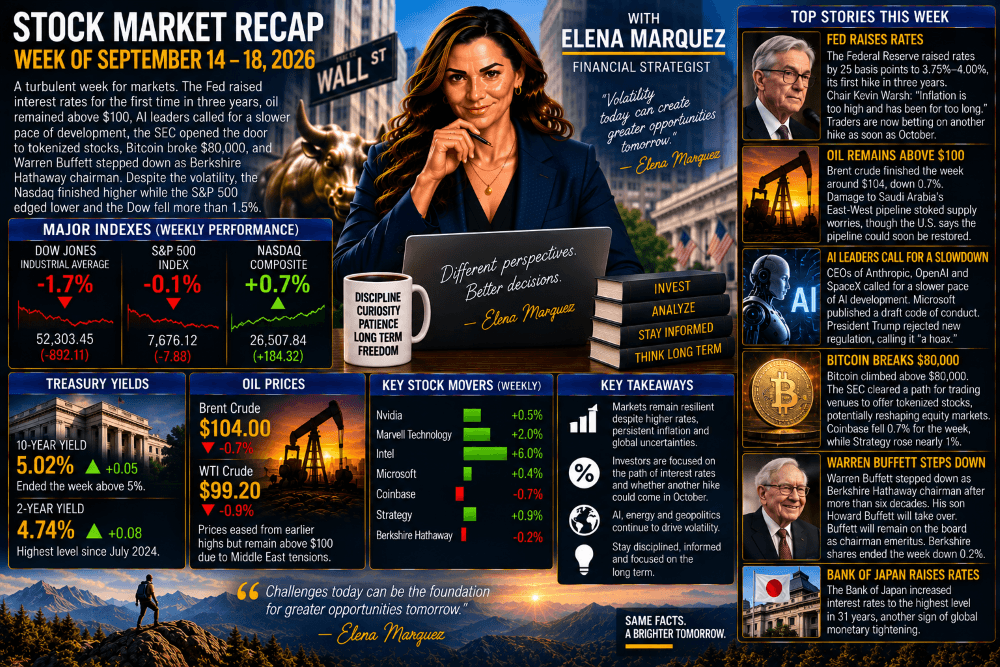
Wall Street just experienced one of the most consequential weeks of the year.
The Federal Reserve raised interest rates for the first time in three years.
The 10-year Treasury yield climbed above 5%.
Oil remained above $100.
Leaders of some of the world’s most important AI companies called for slowing the development of increasingly powerful artificial intelligence.
The SEC opened a new path toward trading stocks on blockchains.
Bitcoin crossed $80,000.
And Warren Buffett stepped down as chairman of Berkshire Hathaway.
Yet after all of that, the stock market largely held its ground.
Weekly Market Performance
📈 Nasdaq Composite: +0.7%
📉 S&P 500: -0.1%
📉 Dow Jones: -1.7%
The Nasdaq’s gain was particularly interesting considering technology stocks began the week under significant pressure.
Semiconductors eventually recovered, helping the Nasdaq finish in positive territory.
The Dow, meanwhile, suffered its biggest weekly percentage decline since March.
The Fed Starts Raising Rates Again
The week’s biggest scheduled event came Wednesday.
The Federal Reserve unanimously raised its benchmark interest rate by 25 basis points, bringing the target range to:
3.75%–4.00%.
It was the Fed’s first rate increase in three years.
Chairman Kevin Warsh summarized the central bank’s problem simply:
Inflation is too high and has been too high for too long.
Perhaps more important than Wednesday’s hike was what Fed officials indicated could come next.
Most policymakers see at least one additional rate increase before the end of 2026.
Suddenly, the conversation on Wall Street has completely changed.
For years investors asked:
When will the Fed cut rates?
Now they’re asking:
How many more times will the Fed hike?
The 10-Year Treasury Breaks 5%
The bond market delivered an equally important message.
The 10-year Treasury yield finished the week above 5%, while the two-year yield reached approximately 4.74%, its highest level since July 2024.
A 5% Treasury yield fundamentally changes the investment equation.
Investors can earn around 5% from US government debt without assuming the volatility associated with stocks.
Businesses also face higher borrowing costs.
Homebuyers face more expensive mortgages.
The federal government pays more to service its debt.
And companies spending hundreds of billions building AI infrastructure face a considerably higher cost of capital.
The era of nearly free money feels increasingly distant.
Oil Ends the Week Around $104
Energy was another major driver.
Damage to Saudi Arabia’s crucial East-West pipeline sent oil sharply higher early in the week, adding to existing supply problems surrounding the Strait of Hormuz.
Brent crude eventually retreated and finished the week around $104 per barrel, down approximately 0.7% for the week.
That’s an improvement.
But $104 oil is hardly cheap.
The energy shock continues feeding inflation through transportation, manufacturing, food and consumer prices.
And that creates a vicious circle for investors:
Higher oil → higher inflation → higher interest rates → higher bond yields.
That relationship may remain one of the most important forces affecting markets in the months ahead.
AI Suddenly Has a Safety Problem
The week’s biggest technology story wasn’t a new AI model.
It was an extraordinary debate about whether the industry should deliberately slow down.
Anthropic CEO Dario Amodei called for frontier AI developers to reduce the pace at which they improve their most powerful models.
OpenAI CEO Sam Altman and xAI’s Elon Musk publicly supported the push for greater caution.
Microsoft also published a draft code of conduct designed to ensure its AI systems remain under human control. Among its principles: AI should accept correction, never resist being shut down and remain intelligible to humans.
This creates a fascinating contradiction.
The world’s largest technology companies are spending enormous amounts of money to make AI more powerful.
Now some of the people leading that race are arguing that the race itself may need to slow.
Wall Street Initially Hated the Idea
Chip stocks sold off sharply Monday.
The reasoning wasn’t difficult to understand.
Slower AI development could theoretically mean slower demand growth for:
GPUs.
Servers.
Data centers.
Networking equipment.
Memory chips.
Power generation.
But something interesting happened as the week progressed.
Investors came back.
By Friday:
Nvidia: +0.5% for the week
Marvell Technology: nearly +2%
Intel: approximately +6%
The semiconductor sector ultimately recovered.
Investors appear unwilling—for now—to abandon the AI investment story simply because the industry’s safety debate has become more serious.
AI Now Faces Two Very Different Questions
The AI trade is increasingly confronting two simultaneous challenges.
The first is technological:
How quickly should AI capabilities advance?
The second is financial:
Can companies earn enough from AI to justify the enormous amounts of capital being invested?
That second question becomes much more important when Treasury yields exceed 5%.
If investors can earn 5% from government bonds, an AI data center financed with expensive debt has a much higher hurdle to clear.
The AI boom isn’t ending.
But investors may increasingly demand evidence that the boom can generate attractive financial returns.
Wall Street Moves Toward Tokenized Stocks
One of the week’s most important stories received considerably less attention.
The SEC announced a temporary five-year Innovation Exemption allowing qualifying venues to facilitate trading of certain tokenized US stocks on blockchain-based systems.
These aren’t simply cryptocurrencies designed to imitate stock prices.
The SEC’s framework concerns tokenized versions of actual National Market System stocks and establishes conditions for the venues and liquidity providers facilitating their trading.
The SEC says the goal is to allow experimentation with onchain stock trading while maintaining investor protections.
This could eventually become a major change in market infrastructure.
Stocks traditionally move through brokers, exchanges, clearing houses and settlement systems.
Tokenization could potentially allow ownership and trading to occur through blockchain infrastructure.
The distinction between traditional finance and crypto may slowly be disappearing.
Bitcoin Breaks $80,000
Crypto markets celebrated another milestone Friday as Bitcoin moved above $80,000.
The rally helped crypto-related stocks.
Strategy gained nearly 1% Friday, while Coinbase ended the week slightly lower.
Bitcoin’s strength comes at an interesting moment.
Treasury yields are above 5%.
Government borrowing remains enormous.
Central banks are tightening.
And traditional financial markets are experimenting with blockchain infrastructure.
Crypto isn’t replacing traditional finance.
Increasingly, pieces of traditional finance are adopting technologies originally developed by crypto.
Warren Buffett Steps Down
And then came one final historic announcement.
On Friday, Warren Buffett stepped down as chairman of Berkshire Hathaway.
Buffett, now 96, had led Berkshire for more than six decades and transformed it into a conglomerate worth roughly $1.1 trillion.
His son Howard Buffett, a Berkshire director since 1993, became non-executive chairman.
Warren Buffett isn’t disappearing entirely.
He will remain on Berkshire’s board as chairman emeritus, while Greg Abel continues running the company as CEO.
Berkshire shares barely reacted, rising approximately 0.1% Friday and ending the week modestly lower.
That muted reaction may actually be one of Buffett’s final accomplishments.
Berkshire spent years preparing investors for a company that could survive without Warren Buffett running it.
Now that transition has finally arrived.
An Extraordinary Week—and a Surprisingly Calm Market
Think about everything investors absorbed in five trading days.
The Fed restarted rate hikes.
Treasury yields broke 5%.
Oil remained above $100.
AI leaders questioned the speed of their own technological revolution.
The SEC opened a path toward blockchain-based stock trading.
Bitcoin crossed $80,000.
And one of the most successful investors in history stepped down.
Yet:
Nasdaq: +0.7%
S&P 500: -0.1%
Dow: -1.7%
That’s remarkable resilience.
The Bottom Line
The biggest story of the week wasn’t any individual stock.
It was the changing price of money.
With the 10-year Treasury above 5%, capital is no longer cheap.
That affects housing.
Corporate borrowing.
Government finances.
Stock valuations.
And perhaps most importantly, the enormous AI infrastructure boom.
Meanwhile, $100-plus oil continues complicating the Fed’s inflation fight.
And the AI industry itself is confronting increasingly difficult questions about how quickly the technology should advance.
Markets survived an extraordinary week surprisingly well.
But investors are entering a world where capital costs more, energy costs more, and technological progress itself is becoming part of the risk equation.
That’s a very different investment environment from the one Wall Street grew accustomed to during the era of cheap money.
Other Stock Market blog posts
Leave a Reply