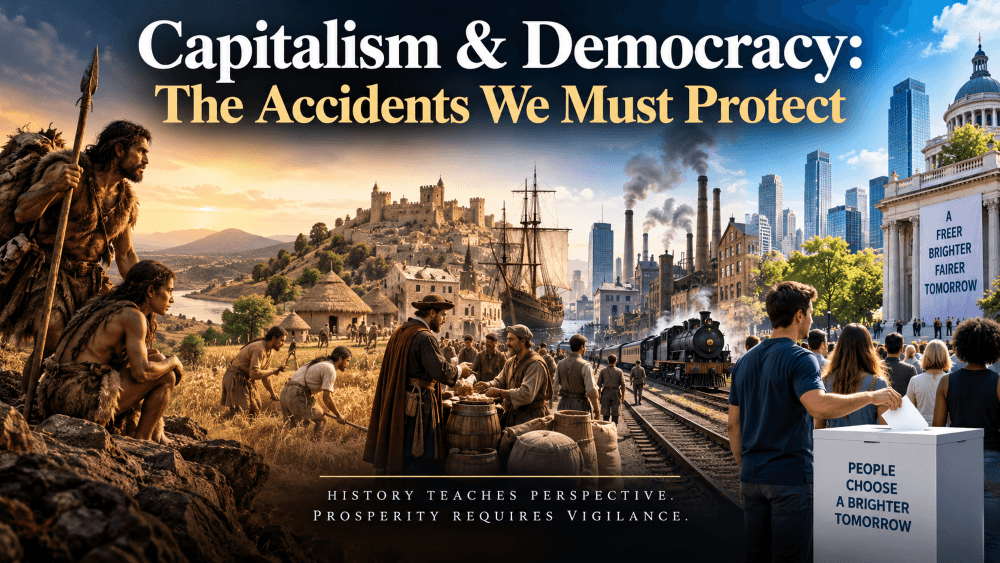
For most of human history, capitalism and democracy did not exist in anything resembling their modern forms.
Our ancestors lived as hunter-gatherers for the overwhelming majority of humanity’s existence. Later they lived as farmers, subjects of kings, members of empires, serfs, laborers and slaves.
The prosperous democratic society that many of us now regard as normal is anything but historically normal.
It is an extraordinary historical achievement.
And because we were born into it, we risk forgetting just how unusual it is.
Poverty Was the Normal Human Condition
Today, when we see poverty, we naturally ask: Why are these people poor?
History suggests another question:
Why are some societies rich?
For most of recorded history, ordinary people lived close to subsistence. A failed harvest, disease, injury or war could destroy a family’s livelihood.
Modern historical estimates necessarily involve uncertainty, but the broad picture is striking. Research summarized by Our World in Data estimates that roughly three-quarters of humanity lived in extreme poverty in 1820.
What changed was not human nature.
What changed were our institutions, technologies and ability to produce.
Over the last two centuries, productivity increased enormously. Markets expanded. Entrepreneurs experimented. Capital accumulated. Technology improved. International trade grew.
The result was something our ancestors rarely experienced: sustained economic growth.
This is one of the themes running throughout my History of Entrepreneurship series.
For centuries, merchants, inventors, financiers and entrepreneurs slowly discovered better ways to exchange goods, organize businesses, finance ventures and produce things.
Nobody designed modern capitalism in a conference room.
It evolved.
Capitalism Is Not Our Natural State
There was no stock market on the African savanna.
There were no corporations, mortgages, limited-liability companies, venture-capital funds or retirement accounts.
Capitalism is a relatively recent institutional arrangement built on older human practices such as trade, private ownership, contracts, specialization and entrepreneurship.
Even the word capitalism can be misleading because there has never been a single capitalist model. Canada, the United States, Sweden, Japan and Switzerland all organize their economies differently.
But modern market economies generally depend on several institutions:
- Private property
- Voluntary exchange
- Prices determined largely through markets
- Contracts
- Investment and capital accumulation
- Entrepreneurship
- Competition
- Institutions capable of enforcing rules
None of these eliminates greed, exploitation, corruption or inequality.
Capitalism does not transform humans into saints.
Instead, at its best, it creates institutions in which people can improve their own circumstances by producing something that other people voluntarily choose to buy.
That is an extraordinary social innovation.
Democracy Isn’t Automatic Either
Democracy is another historical exception.
Human societies have experimented with collective decision-making for millennia, and ancient Athens famously developed an influential form of democracy.
But universal representative democracy—with ordinary adults choosing governments through regular elections—is historically recent.
For much of recorded history, political power belonged to kings, emperors, aristocrats, military rulers and other elites.
Political authority was usually something imposed or inherited rather than periodically granted by voters.
Even modern democracies took centuries to expand political participation.
The assumption that governments should derive legitimacy from ordinary citizens is therefore not some permanent law of history.
It is an institution humans developed.
And institutions can disappear.
Human Rights Had to Be Turned Into Institutions
The same caution applies to human rights.
Human beings have possessed ideas about justice, fairness, dignity and moral obligation for thousands of years. Different civilizations and religious and philosophical traditions developed important concepts concerning how people should treat one another.
But the modern idea that every human being possesses rights simply because he or she is human took a long time to become embedded in national and international institutions.
The Universal Declaration of Human Rights was adopted only in 1948.
Think about how recent that is.
The document declared that human beings are entitled to fundamental rights regardless of race, religion, sex, nationality or other status.
Today these principles can sound obvious.
Historically, they were anything but obvious.
Slavery existed across civilizations. Conquered populations were frequently subjected to violence and exploitation. Political opponents could be imprisoned or killed. Women possessed few legal or political rights in many societies.
Human beings certainly possessed empathy and moral instincts.
But universal, legally recognized rights required institutions.
The Extraordinary Decline of Extreme Poverty
Perhaps the strongest reason for appreciating modern economic institutions is simply to look at what happened to poverty.
Two centuries ago, extreme poverty affected most of humanity.
Today it affects roughly one person in ten.
The progress has been especially dramatic during the last generation. In 1990, about 2.3 billion people lived below today’s international extreme-poverty threshold. By the middle of the 2020s, that number had fallen by roughly 1.5 billion people despite substantial growth in the world’s population.
This achievement cannot honestly be attributed to capitalism alone.
Improvements in science, medicine, sanitation, education, infrastructure, public health, political institutions and technology all contributed.
Governments played major roles.
So did markets.
So did entrepreneurs.
The important point is that widespread poverty was not invented by capitalism.
Widespread prosperity had to be created.
Capitalism and Democracy Are Imperfect
Defending capitalism and democracy should not require pretending that either is perfect.
Markets can produce monopolies and externalities. Wealth can translate into political influence. Businesses sometimes exploit workers or consumers. Financial systems periodically experience crises.
Democracies can become polarized. Voters can make terrible decisions. Politicians can become corrupt. Majorities can mistreat minorities.
These are legitimate problems.
Institutions should be criticized.
They should also be improved.
But there is an enormous difference between saying this institution has flaws that should be fixed and saying therefore the institution itself has no value.
We should judge institutions not against imaginary perfection but against realistic alternatives and historical experience.
Prosperity Makes It Easy to Forget Poverty
There is a paradox of successful societies.
The better they work, the easier it becomes to forget what came before them.
Someone born in a prosperous country today may reasonably expect:
- Food in supermarkets every day
- Clean drinking water
- Electricity
- Modern medicine
- Public education
- Transportation
- Internet access
- Legal protections
- The ability to criticize the government
- The ability to start a business
- The ability to vote politicians out of office
These things feel ordinary because we encounter them every day.
But historically they are extraordinary.
Our ancestors would have regarded many of them as unimaginable luxuries.
The Great Historical Accident
I like to think of modern civilization as a wonderful accident.
Not because everything happened randomly.
People fought wars, wrote constitutions, created businesses, challenged monarchs, invented technologies, demanded rights and built institutions.
But nobody thousands of years ago possessed a blueprint leading inevitably to today’s society.
Humanity stumbled forward.
We experimented.
We failed.
We copied ideas that worked.
We abandoned some ideas that didn’t.
Merchants discovered new forms of finance. Entrepreneurs discovered new methods of production. Philosophers developed ideas about liberty. Citizens demanded political representation. Reformers fought slavery and discrimination. Scientists expanded our understanding of nature.
Generation after generation added another brick.
Eventually we inherited something remarkable.
Capitalism and Democracy Require Maintenance
History gives us no reason to assume that progress is permanent.
Institutions survive because people maintain them.
Markets require competition and the rule of law. Property rights require functioning courts. Democracy requires peaceful transfers of power, political participation and institutions strong enough to constrain those who govern.
Human rights require people willing to defend the rights of others—even when those people are unpopular.
And capitalism requires rules that allow competition rather than protecting politically connected incumbents.
The goal should not be to freeze our institutions in their present form.
Quite the opposite.
We should constantly improve them.
But improvement begins with understanding what they accomplished.
Don’t Take Prosperity for Granted
When I study the history of entrepreneurship, one lesson repeatedly jumps from the page.
Prosperity is difficult to create.
Poverty requires no invention.
Economic stagnation requires no genius.
Political oppression requires no sophisticated philosophy.
The remarkable achievement is building societies capable of producing abundance while giving individuals meaningful freedom over their economic and political lives.
Capitalism, democracy and human rights did not descend from the sky.
Human beings built them.
Imperfectly.
Gradually.
Sometimes accidentally.
We should criticize them when criticism is deserved. We should reform them when they fail. We should continue searching for better institutions.
But we should also understand the inheritance we have received.
For most of human history, poverty, insecurity and political powerlessness were ordinary parts of life.
Today millions of us live with freedoms and material comforts that kings of the past could not have purchased.
That should not make us complacent.
It should make us careful.
Civilization is not something humanity finished building.
It is something every generation inherits—and then decides whether to maintain, improve or squander.
Frequently Asked Questions
Is capitalism natural?
Not in its modern institutional form. Humans have traded, owned possessions and specialized for thousands of years, but modern capitalism depends on sophisticated institutions such as enforceable contracts, corporations, financial markets, banking systems and extensive property rights.
Did capitalism eliminate global poverty?
No single institution can claim credit. Economic growth, technological innovation, markets, trade, governments, education, medicine, sanitation and public infrastructure all contributed. However, sustained economic growth has been crucial to the enormous reduction in extreme poverty over the last two centuries.
Is democracy historically unusual?
Modern representative democracy with widespread adult suffrage is historically recent. Although democratic institutions have important ancient precedents, most people throughout recorded history lived under monarchies, empires, aristocracies or other forms of government without universal electoral participation.
Why should capitalism and democracy be protected?
Because institutions capable of supporting economic freedom, political participation and individual rights took centuries to develop and are not guaranteed to survive automatically. Protecting them does not mean opposing reform; healthy institutions require criticism, adaptation and continuous improvement.
Leave a Reply