| 📊 Alain’s Holdings — September 18, 2026 | ||||
|---|---|---|---|---|
| Symbol | Name | Price | Change | Change % |
| VOO | Vanguard S&P 500 ETF | 701.85 | +0.82 | +0.12% |
| QQQ | Invesco QQQ Trust | 721.45 | +4.53 | +0.63% |
| XIU.TO | iShares S&P/TSX 60 ETF | 53.04 | -0.19 | -0.36% |
Wall Street ended a turbulent week on a mixed note Friday as investors continued adjusting to a market environment that suddenly looks very different from just a few months ago.
The Federal Reserve is raising interest rates again.
The 10-year Treasury yield is above 5%.
Oil remains extraordinarily expensive.
And the artificial intelligence boom is confronting an unexpected debate over whether the industry itself should slow down.
Yet through all of that, the stock market is proving surprisingly resilient.
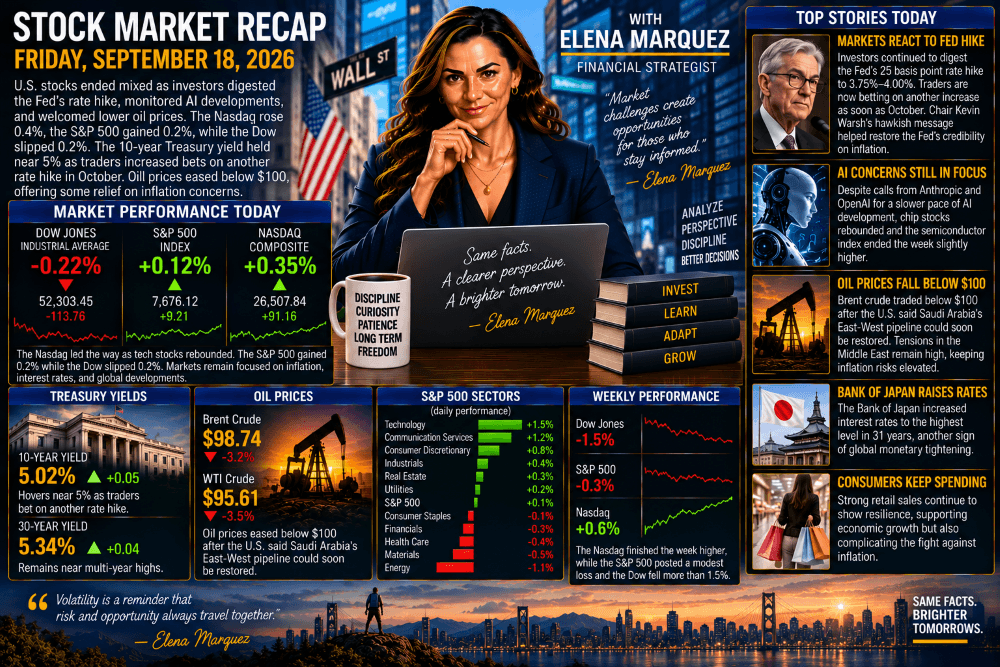
Market Performance
📈 Nasdaq Composite: +0.35%
📈 S&P 500: +0.12%
📉 Dow Jones: -0.22%
Technology stocks helped keep the broader market afloat, with semiconductor shares continuing their recovery from the sharp selloff earlier in the week.
For the week, the picture was mixed.
The Nasdaq managed to finish higher, while the S&P 500 posted a modest weekly decline and the Dow lost more than 1.5%.
That divergence tells us something important about this market:
Investors haven’t abandoned technology.
The Fed Hiked. Now What?
Wednesday’s Federal Reserve meeting was the biggest scheduled event of the week.
The Fed raised interest rates by 25 basis points, bringing its target range to 3.75%–4.00%.
It was the first Fed rate increase in three years.
But by Friday, investors had largely moved beyond the hike itself.
The market is already asking the next question:
When will the Fed hike again?
Traders increased bets Friday that another increase could arrive as soon as October.
That’s a remarkable shift.
For much of the past few years, Wall Street’s debate centered around rate cuts.
Now investors are debating the speed of a new tightening cycle.
The 10-Year Treasury Moves Above 5%
The bond market remains one of the biggest threats to stocks.
The 10-year Treasury yield climbed by roughly five basis points Friday, finishing just above 5%.
That level matters.
A 5% yield on US government debt creates genuine competition for stocks.
Why take significant equity risk if an investor can earn around 5% from Treasuries?
Higher yields also increase borrowing costs for businesses, consumers and the federal government.
And they create a particularly interesting problem for one of today’s biggest investment themes:
Artificial intelligence.
AI Has a $5% Problem
The AI boom requires enormous amounts of capital.
Companies are spending hundreds of billions of dollars on:
Data centers.
Semiconductors.
Power generation.
Networking equipment.
Cooling systems.
And new AI models.
Much of that expansion depends directly or indirectly on capital markets.
When money was cheap, financing ambitious projects was relatively easy.
With Treasury yields around 5%, the calculation changes.
Every AI investment now has a higher hurdle to clear.
Investors aren’t simply asking:
How powerful will AI become?
They’re increasingly asking:
Will these investments generate returns high enough to justify their enormous cost?
The AI Selloff Didn’t Last
Earlier this week, technology stocks were rattled after leaders at Anthropic and OpenAI called for slowing the development of frontier AI systems because of safety concerns.
Semiconductor stocks sold off sharply.
But by Friday, much of that damage had been repaired.
The PHLX Semiconductor Index finished the week slightly higher.
That’s significant.
Despite the dramatic headlines surrounding AI safety, investors don’t appear ready to abandon the AI investment story.
Instead, the market seems to be distinguishing between concerns about the long-term direction of AI and the very real near-term demand for chips, computing power and data-center infrastructure.
Oil Finally Offers Some Relief
One of the week’s biggest inflation threats also eased Friday.
Crude prices retreated after soaring earlier in the week amid continuing disruptions linked to the Middle East conflict.
The decline gave investors some relief because energy prices have become a major complication for central banks.
But the problem is far from solved.
Oil remains around historically elevated levels, and the Strait of Hormuz disruption continues to make forecasting global energy supplies extraordinarily difficult.
That matters far beyond gasoline prices.
Expensive oil raises transportation costs.
Transportation raises food costs.
It raises manufacturing costs.
It raises airline costs.
It raises delivery costs.
And eventually, many of those costs reach consumers.
That’s why oil has become so important to the Fed’s inflation fight.
Has the Fed Really Beaten Inflation?
JPMorgan Chase CEO Jamie Dimon summarized one of Wall Street’s biggest concerns this week:
“It’s not clear to me we’ve slayed inflation.”
That’s probably the central economic question heading into the final months of 2026.
Inflation has declined substantially from its earlier highs.
But energy prices remain elevated.
Consumer spending remains resilient.
The labor market remains relatively strong.
And the economy continues growing.
Those conditions give the Fed room to keep interest rates higher—and potentially raise them further.
The Bank of Japan Joins the Fight
The Federal Reserve isn’t acting alone.
The Bank of Japan raised interest rates Friday to their highest level in 31 years, another sign that monetary policy is tightening globally.
The Bank of England held rates this week, but warned about inflation risks.
Other central banks are confronting similar problems.
The common denominator is increasingly energy.
The Middle East conflict has created an inflation shock that central banks cannot directly control.
The Fed can’t produce oil.
The Bank of England can’t reopen shipping routes.
The Bank of Japan can’t repair Saudi pipelines.
They can only respond to the inflation that follows.
And their primary tool is interest rates.
Why Stocks Are Holding Up
Given everything happening, investors might reasonably wonder why stocks aren’t falling much more.
There are several possible explanations.
Corporate earnings remain strong.
The US economy continues expanding.
Consumer spending remains resilient.
AI investment remains enormous.
And despite higher rates, investors still see opportunities in equities.
The S&P 500 remains only about 2% below its 2026 record high.
That’s impressive considering the combination of 5% Treasury yields, $100-area oil and renewed Fed tightening.
A New Market Environment
The bigger story isn’t necessarily what happened Friday.
It’s how dramatically the investment landscape has changed.
For years, investors became accustomed to asking:
When will the Fed cut rates?
Now they’re asking:
How many times will the Fed hike?
They used to worry about whether AI companies could obtain enough chips.
Now they’re wondering whether AI development could deliberately slow.
And they once assumed oil prices would eventually normalize.
Now an extended geopolitical conflict has made energy prices one of the biggest variables affecting inflation and monetary policy.
The market has entered a very different environment.
The Bottom Line
Friday’s market looked calm on the surface:
📈 Nasdaq: +0.35%
📈 S&P 500: +0.12%
📉 Dow: -0.22%
But underneath those modest moves, investors are wrestling with some enormous questions.
Will the Fed hike again in October?
Can inflation fall while energy remains expensive?
Can stocks continue competing with 5% Treasury yields?
And can the AI boom justify the staggering amount of capital being invested in it?
The encouraging sign is that the market is absorbing all of these challenges without anything resembling panic.
Technology stocks have recovered.
Semiconductors bounced back.
Oil has eased from its recent highs.
And the S&P 500 remains relatively close to its record.
The market isn’t ignoring the risks.
It’s learning how to price them.
Other Stock Market blog posts
Leave a Reply