| 📊 Alain’s Holdings — September 15, 2026 | ||||
|---|---|---|---|---|
| Symbol | Name | Price | Change | Change % |
| VOO | Vanguard S&P 500 ETF | 696.20 | -3.10 | -0.44% |
| QQQ | Invesco QQQ Trust | 704.54 | -4.64 | -0.65% |
| XIU.TO | iShares S&P/TSX 60 ETF | 52.91 | -0.12 | -0.23% |
Wall Street fell for a second consecutive day Tuesday as investors confronted three increasingly connected risks:
Oil above $100.
Treasury yields around 5%.
And a Federal Reserve that appears ready to raise interest rates tomorrow.
The AI selloff that began Monday also continued to hang over technology stocks, although the bigger story Tuesday was increasingly the bond market.
Market Performance
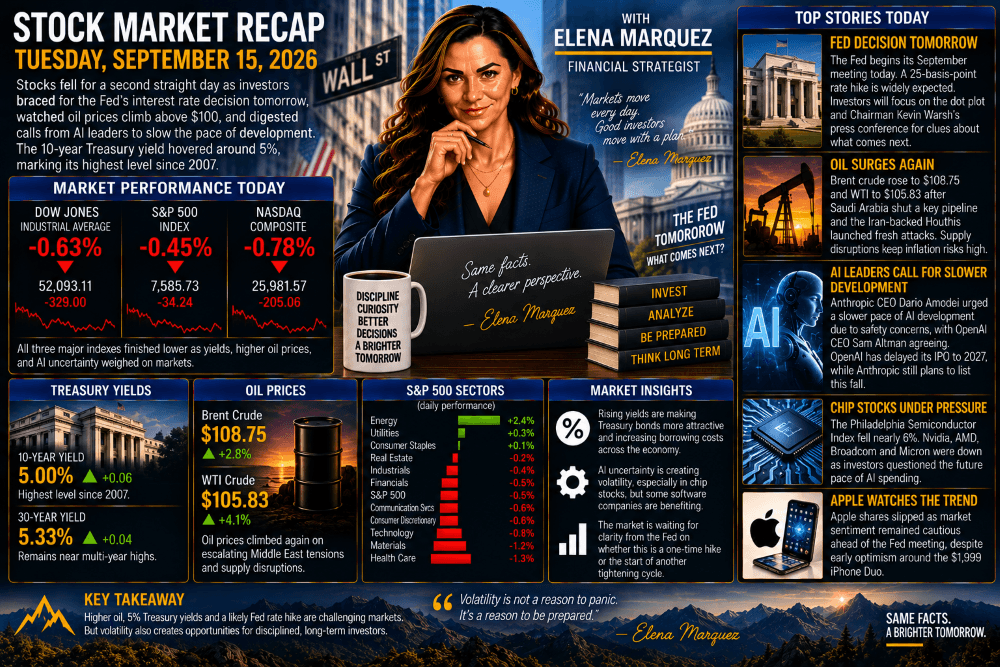
📉 Dow Jones: -0.63% to 52,093.11
📉 S&P 500: -0.45% to 7,585.73
📉 Nasdaq Composite: -0.78% to 25,981.57
The S&P 500 and Nasdaq closed at their lowest levels in more than a month.
This wasn’t panic.
But investors clearly weren’t interested in taking much additional risk one day before what could be the Federal Reserve’s first rate increase since 2023.
The 10-Year Treasury Hits a Milestone
The most important number Tuesday may have been:
5%.
The 10-year Treasury yield briefly climbed above that threshold overnight and reached its highest level since 2007.
It finished the U.S. session at roughly 5%.
That’s an extraordinary change in the investment environment.
A 5% Treasury yield gives investors an attractive alternative to stocks without requiring them to assume equity-market risk.
It also affects virtually every corner of the economy.
Mortgages become more expensive.
Corporate borrowing becomes more expensive.
Commercial real estate becomes more difficult to finance.
Government debt becomes more expensive to service.
And enormous AI data-center projects become more expensive to build.
That’s why the bond market increasingly matters just as much as tomorrow’s Fed decision.
The Fed May Hike—but the Bond Market Already Has
There’s an interesting way to think about what’s happening.
The Federal Reserve hasn’t raised rates yet.
But financial conditions have already tightened.
The 10-year Treasury yield has risen dramatically.
Mortgage rates have moved higher.
Corporate borrowing costs have increased.
And stock valuations are coming under pressure.
In effect, the bond market is already doing some of the Fed’s work.
Tomorrow’s question isn’t simply whether the Fed raises its policy rate by 25 basis points.
The more important question is:
How much more tightening does Kevin Warsh think the economy needs?
Oil Surges Again
Unfortunately for the Fed, the energy market isn’t making that decision any easier.
WTI crude surged more than 4% to $105.83 per barrel Tuesday.
Brent climbed roughly 3% to $108.75.
The latest catalyst was disruption to Saudi Arabia’s critical East-West Pipeline and export terminal at Yanbu following Houthi attacks.
Saudi Arabia has reportedly canceled some crude shipments to Europe.
That pipeline is particularly important because it allows Saudi oil to reach the Red Sea without passing through the Strait of Hormuz.
With Hormuz already severely disrupted by the conflict with Iran, problems with Saudi Arabia’s alternative export route create another potential bottleneck for global oil supplies.
Some Physical Oil Is Already Above $130
Here’s an even more striking number:
$130.
While Brent futures traded around $109, some physical crude cargoes in Europe were already changing hands above $130 per barrel.
That reflects the premium buyers are willing to pay for oil they can actually obtain immediately.
This distinction matters.
Futures markets tell us what traders expect oil to cost.
Physical markets tell us what refiners are paying to secure actual barrels.
When physical oil trades far above futures, it can signal genuine supply stress.
That’s exactly what central bankers don’t want to see while trying to control inflation.
Energy Was the Market’s Clear Winner
There was one obvious beneficiary Tuesday.
Energy stocks.
The sector gained roughly 2.4%, dramatically outperforming the broader market.
That’s the strange reality of an oil shock.
For consumers, expensive energy acts almost like a tax.
For airlines, manufacturers and transportation companies, it’s a major cost increase.
For oil producers, however, $100-plus crude can produce extraordinary cash flows.
So while technology stocks struggle with 5% Treasury yields and AI uncertainty, energy is suddenly becoming one of Wall Street’s strongest areas.
AI Anxiety Hasn’t Disappeared
Monday’s dramatic semiconductor selloff may have stabilized somewhat Tuesday, but the underlying debate hasn’t gone away.
Anthropic CEO Dario Amodei’s call for slowing frontier AI development—and Sam Altman’s support for an industrywide slowdown—has introduced a completely new risk into the AI investment thesis.
Until now, Wall Street worried about whether AI companies could obtain enough:
Chips.
Electricity.
Data centers.
Capital.
Now investors have to consider another potential constraint:
What if the industry deliberately slows itself down?
That’s a very different problem.
AI Meets 5% Money
And there’s another reason this debate matters.
AI infrastructure requires extraordinary amounts of capital.
Data centers can cost billions.
Power infrastructure costs billions more.
Then there are GPUs, networking equipment, cooling systems and land.
For years, technology companies benefited from extraordinarily cheap money.
That world is disappearing.
When Treasury yields are around 5%, the hurdle rate for every investment rises.
A project expected to generate mediocre returns might look attractive when capital costs 2%.
It looks much less attractive when investors can earn around 5% simply by owning Treasuries.
So the AI boom now faces two simultaneous questions:
How fast should AI advance?
And:
Can the financial returns justify the increasingly expensive infrastructure required to build it?
Tomorrow Is About More Than 25 Basis Points
Markets overwhelmingly expect the Federal Reserve to raise rates by 25 basis points Wednesday.
If that happens, the federal funds target range would move to 3.75%–4.00%.
The hike itself may therefore be the least interesting part of tomorrow.
Wall Street will focus heavily on the Fed’s new dot plot.
Each dot represents a policymaker’s expectation for the appropriate federal funds rate.
Together, those dots give investors an indication of where officials believe rates may be heading.
That’s especially important because Chairman Kevin Warsh has been reluctant to provide explicit forward guidance.
If Warsh won’t tell investors where rates are going, the dots may have to do some of the talking.
What Wall Street Wants to Know
There are essentially three possible messages tomorrow.
One-and-done: The Fed hikes once and waits.
That would probably be the most reassuring interpretation for stocks.
Higher for longer: The Fed hikes but signals rates will remain elevated for an extended period.
That could keep Treasury yields around current levels.
A new tightening cycle: Policymakers signal that persistent inflation and $100-plus oil could require several additional hikes.
That’s the scenario equity investors are most worried about.
The difference between those outcomes matters considerably more than tomorrow’s 25 basis points.
Why Stocks Haven’t Fallen More
There’s another interesting part of this story.
Despite everything happening, the stock market remains remarkably resilient.
Oil is around $109.
The 10-year Treasury is around 5%.
The Fed appears ready to raise rates.
AI companies are openly debating slowing technological development.
And yet the S&P 500 fell only 0.45% Tuesday.
Why?
Because the economy remains relatively strong.
Corporate earnings remain healthy.
Employment remains resilient.
AI investment hasn’t stopped.
And investors haven’t abandoned risk assets.
They’re becoming more selective.
That’s very different from panic.
The Bottom Line
Tuesday’s market gave investors another reminder that the investment environment has changed.
The Dow fell 0.63%.
The S&P 500 lost 0.45%.
The Nasdaq declined 0.78%.
But those aren’t today’s most important numbers.
These are:
10-year Treasury: ~5%
WTI crude: $105.83
Brent crude: $108.75
And tomorrow:
Fed decision: 2:00 p.m. ET
Wall Street has largely priced in a quarter-point hike.
So tomorrow’s market reaction may depend less on what the Federal Reserve does and more on what policymakers indicate comes next.
For months, investors wondered when rates would start coming down.
Now they’re asking a very different question:
How high could they go?
Other Stock Market blog posts
Leave a Reply