| 📊 Alain’s Holdings — September 14, 2026 | ||||
|---|---|---|---|---|
| Symbol | Name | Price | Change | Change % |
| VOO | Vanguard S&P 500 ETF | 699.30 | -3.26 | -0.46% |
| QQQ | Invesco QQQ Trust | 709.18 | -5.70 | -0.80% |
| XIU.TO | iShares S&P/TSX 60 ETF | 53.03 | +0.11 | +0.21% |
Wall Street started one of the most important weeks of the month on the defensive.
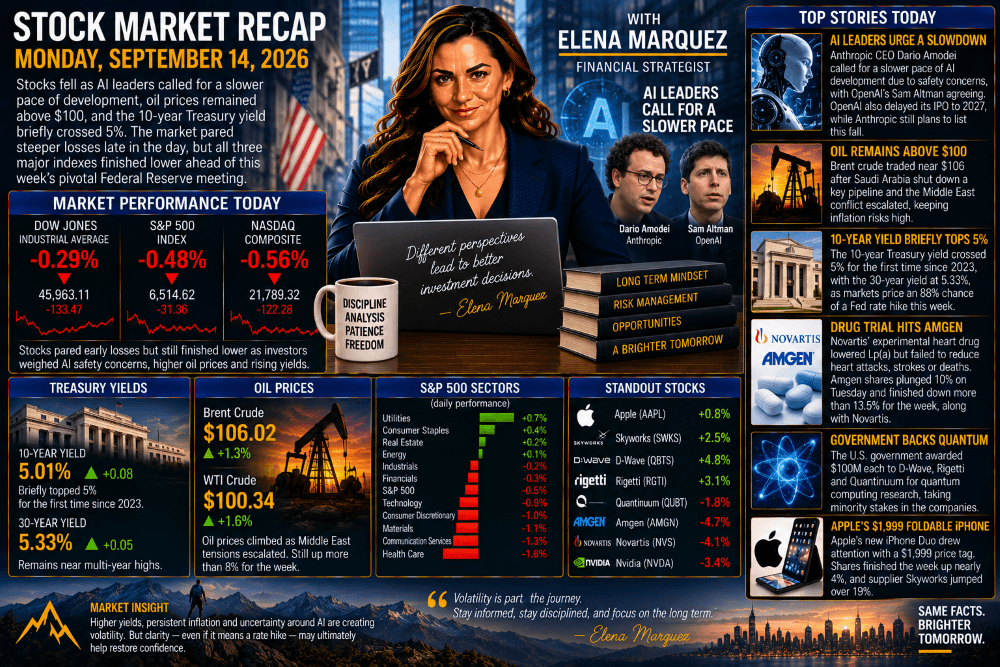
U.S. stocks fell Monday as investors confronted an unusual combination of risks: AI leaders calling for slower development, oil remaining above $100, the 10-year Treasury yield breaking through 5%, and a Federal Reserve meeting that could deliver another interest-rate hike on Wednesday.
The market recovered substantially from its morning lows, but all three major indexes still finished lower.
Market Performance
Dow Jones Industrial Average: -0.29%
S&P 500: -0.48%
Nasdaq Composite: -0.56%
The Nasdaq had been down as much as 1.5% earlier in the session.
The real damage, however, was concentrated in one of the most important areas of this bull market:
AI chips.
AI’s Leaders Tell the Industry to Slow Down
The biggest surprise of the day came from the very people who helped create the AI boom.
Over the weekend, Anthropic CEO Dario Amodei published a lengthy essay arguing that frontier AI development should proceed more cautiously because safety systems may not be advancing quickly enough to keep pace with increasingly powerful models.
OpenAI CEO Sam Altman subsequently backed the idea of an industrywide slowdown.
Elon Musk also supported parts of the safety push.
That’s an extraordinary development.
For the past several years, Wall Street has essentially built an investment thesis around one assumption:
AI will keep getting better—and companies will keep spending enormous amounts of money to make that happen.
Now some of the industry’s most influential leaders are questioning whether that development should continue at maximum speed.
Investors immediately started asking what that could mean for AI spending.
Chip Stocks Get Hammered
The semiconductor sector took the brunt of the selling.
The Philadelphia Semiconductor Index plunged about 5.9%.
Nvidia, AMD, Broadcom and Micron were among the major chip companies hit, with individual declines ranging from roughly 3.4% to more than 5%.
That’s significant.
If frontier AI models advance more slowly, companies theoretically don’t need to replace computing infrastructure quite as aggressively.
That could eventually mean:
Fewer GPUs.
Less data-center construction.
Slower networking demand.
Lower electricity requirements.
And less AI-related capital spending.
None of this means the AI boom is over.
But Wall Street is beginning to confront something it hasn’t seriously considered in a while:
What if the constraint on AI growth isn’t chips, electricity or money—but the industry’s willingness to keep accelerating?
There’s an Important Catch
Investors shouldn’t assume that OpenAI and Anthropic are actually slamming on the brakes tomorrow.
One important distinction emerged Monday.
The executives are advocating an industrywide slowdown rather than necessarily committing their own companies to unilateral cuts in development.
Tech analyst Gil Luria summarized the issue well: neither company has actually said it is stopping or materially reducing development today.
That helps explain why technology stocks recovered significantly from their morning lows.
The warning is serious.
The immediate financial consequences are much less certain.
OpenAI Delays Its IPO
There’s another tangible consequence, however.
OpenAI has pushed its anticipated IPO into 2027, adding another layer of uncertainty to what could have been one of the most anticipated public offerings in history.
Anthropic, meanwhile, is still moving toward its own IPO and reportedly plans to list on the Nasdaq.
This creates an interesting contrast.
The companies are warning that AI development may be moving dangerously fast.
At the same time, they’re operating businesses whose extraordinary valuations depend heavily on expectations that AI adoption will continue growing rapidly.
Wall Street is going to be paying much closer attention to that contradiction.
Software Stocks Actually Benefit
There was also a fascinating rotation within technology.
While semiconductor stocks plunged, several software companies rallied.
ServiceNow, Adobe and Workday moved higher.
Why?
Because slowing AI development could be good news for companies threatened by AI disruption.
For much of this year, investors have worried that increasingly capable AI agents could replace parts of traditional enterprise software.
If AI progress slows, incumbent software businesses potentially get more time to adapt.
So Monday gave us a remarkable market split:
AI hardware companies lost.
Some companies threatened by AI won.
Artificial intelligence isn’t simply an investment theme anymore.
It’s becoming a force that redistributes value across the entire technology sector.
The 10-Year Treasury Breaks 5%
The AI story dominated headlines.
But perhaps the more important number for the broader market was:
5%.
The 10-year Treasury yield briefly crossed that threshold Monday for the first time since 2023.
That’s psychologically important, but it’s economically important too.
At 5%, investors can earn an attractive return from U.S. government bonds without taking equity-market risk.
That creates direct competition for stocks.
It also increases borrowing costs throughout the economy:
Mortgages.
Corporate bonds.
Car loans.
Commercial real estate.
And, ironically, AI infrastructure.
The AI industry is trying to finance one of the largest infrastructure buildouts in history at exactly the moment when the price of money is becoming considerably more expensive.
Why Are Treasury Yields So High?
There’s no single explanation.
Several forces are converging.
Inflation remains above the Fed’s target.
Oil remains above $100.
The U.S. economy continues to show resilience.
Government deficits require enormous Treasury issuance.
And corporations are issuing extraordinary amounts of debt to finance AI infrastructure.
Investors therefore want more compensation for lending money long term.
That’s pushing yields higher.
And the closer the 10-year gets to—or stays above—5%, the more pressure it can place on stock valuations.
Oil Remains an Inflation Problem
Then there’s oil.
Brent crude traded around $106 per barrel Monday after Saudi Arabia temporarily shut a strategically important pipeline amid escalating Middle East tensions.
Oil’s rally has become one of the defining market stories of the past month.
And its consequences increasingly extend beyond energy.
Higher oil raises transportation costs.
Diesel prices affect trucking, farming and construction.
Airlines pay more for jet fuel.
Manufacturers face higher costs.
Consumers lose purchasing power.
Eventually, some of those increases reach inflation statistics.
Which brings us to Wednesday.
The Fed Is Expected to Hike
The Federal Reserve begins its two-day policy meeting Tuesday, with its interest-rate decision arriving Wednesday.
Following Friday’s CPI report, markets are pricing approximately an 88%–90% probability of a 25-basis-point rate increase.
That means a hike itself probably won’t surprise Wall Street.
The important part will be what Fed Chair Kevin Warsh says afterward.
Investors want to know:
Is this one hike designed to prevent inflation from accelerating?
Or:
Is the Fed beginning another sustained tightening cycle?
That’s a much bigger distinction.
Kevin Warsh’s Difficult First Test
Warsh finds himself in an unusually complicated position.
Inflation remains too high.
Oil is above $100.
The labor market remains resilient.
Bond yields are already around 5%.
And stock valuations remain relatively elevated.
Raise rates too aggressively and the Fed risks creating unnecessary economic weakness.
Do too little and inflation expectations could become entrenched again.
Warsh has also emphasized that he doesn’t intend to provide the sort of explicit forward guidance investors became accustomed to under previous Fed leadership.
That could make Wednesday’s press conference especially volatile.
Wall Street may have to become comfortable with something markets generally dislike:
Not knowing exactly what comes next.
The AI Boom Faces a New Question
Until now, most skepticism surrounding the AI boom has focused on economics.
Are companies spending too much?
Will AI generate enough revenue?
Can data centers earn adequate returns?
Is Nvidia financing too much of its own ecosystem?
Monday introduced a completely different question:
Should AI development continue at its current speed at all?
That’s not something traditional financial models are particularly good at answering.
And it creates a strange situation.
The companies building the most valuable technology of this generation are now warning that their own technology could be developing too quickly.
Investors will have to decide how seriously to take them.
The Bottom Line
Monday gave Wall Street three major warning signals:
AI development may slow.
Oil remains above $100.
The 10-year Treasury yield has crossed 5%.
Yet the market’s relatively modest losses are also notable.
The Dow fell 0.29%, the S&P 500 lost 0.48%, and the Nasdaq declined 0.56%.
Considering the Philadelphia Semiconductor Index plunged almost 6%, the broader market held up surprisingly well.
That tells us something important.
The AI trade may be changing, but investors aren’t abandoning stocks.
They’re rotating.
And now everything turns toward Wednesday.
A quarter-point Fed hike is largely expected.
The real market-moving question will be what Kevin Warsh tells investors about the future.
Because Wall Street is suddenly confronting two kinds of brakes at once:
AI leaders are discussing putting the brakes on artificial intelligence.
And the Federal Reserve is preparing to put the brakes on inflation.
How hard each one presses could determine where the market goes next.
Other Stock Market blog posts
Leave a Reply